An Oscar in a Tote Bag: Helle Faber’s Unassuming Triumph Against Odds and Propaganda
Just five days after a stunning upset at the Academy Awards, Danish producer Helle Faber returned to the cobbled courtyards of Copenhagen. The morning air, crisp with the promise of spring, carried the scent of fresh bread and the gentle murmur of a city awakening. As she stepped into the grand, historic grounds of Kunsthal Charlottenborg, a venerable institution of art and culture, Faber embodied an understated revolution. Unbeknownst to many who paused to offer congratulations during her brief stroll along the city’s picturesque canal, the coveted golden statuette, symbol of Hollywood’s highest honor, was tucked away discreetly within a familiar, moss-green tote bag – a humble vessel for such a monumental achievement.
Faber, a seasoned veteran of the documentary world, had just produced “Mr. Nobody Against Putin,” a film that defied expectations to claim the Best Documentary Oscar. Her victory was more than a personal triumph; it was a beacon for independent cinema, a testament to the power of a compelling story over colossal budgets and relentless marketing machines. Her homecoming coincided with the opening weekend of CPH:DOX, Copenhagen’s prestigious documentary film festival, amplifying an already palpable atmosphere of national pride. The city buzzed with the news, and the global documentary industry watched, offering fervent support for one of their own.

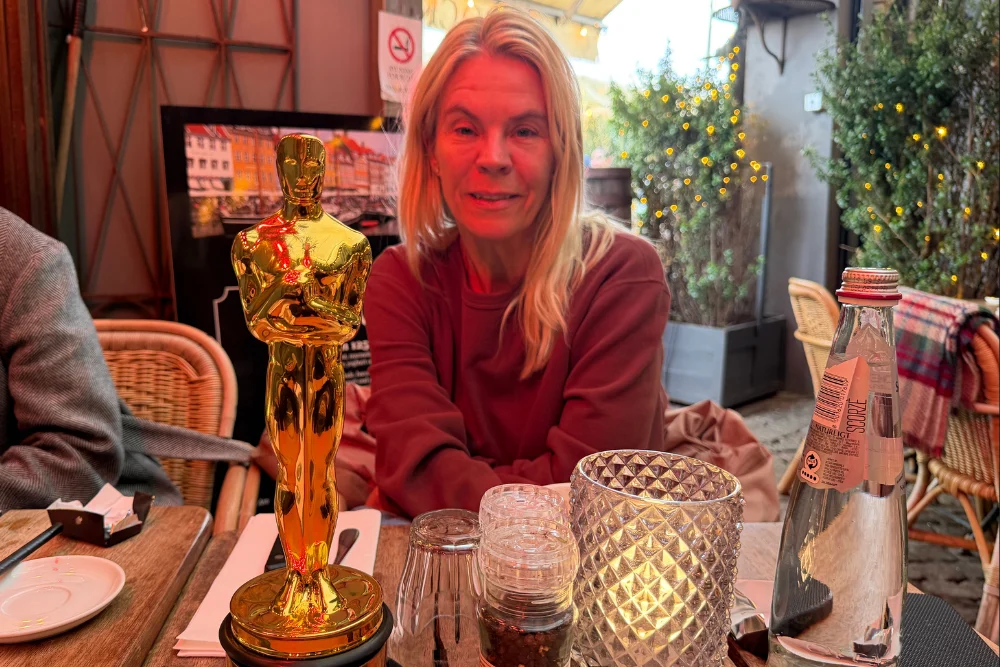
Settling into a quiet Copenhagen cafe, the aroma of freshly brewed coffee mingling with the city’s ambient hum, Faber admitted the whirlwind of the past weeks felt “a little insane.” Los Angeles, with its relentless glamour and high-stakes campaigning, now seemed a distant dream. The journey home had been punctuated by extraordinary gestures: invited to the cockpit, she had cradled the Oscar safely on her lap as the pilots flew her across the Atlantic. Upon landing, airport staff orchestrated a majestic water salute, jets of water arching 20 feet high to create a rainbow archway – a vivid, ethereal welcome home. From the security guards to her Uber driver, to the waitresses serving her coffee, everyone offered heartfelt congratulations, reflecting the deep resonance her victory had struck across the nation.

Mid-sentence, a distant drumroll heralded the Queen’s marching band, commencing their daily midday procession. Faber paused, a slight smile playing on her lips. “Everybody on the plane last night had their hands on this guy,” she joked, gesturing towards the Oscar resting on the table, a glint of disbelief still in her eyes. It was a moment of surreal normalcy, an intimate glimpse into the life of a new superstar grappling with the weight of her achievement.
“Mr. Nobody Against Putin” is a searing expose, co-directed by American filmmaker David Borenstein and Russian schoolteacher-turned-filmmaker Pavel Talankin. The film offers an unprecedented, harrowing look at how Russia systematically transformed its educational institutions into insidious propaganda machines amidst the ongoing war in Ukraine. Premiering at the Sundance Film Festival in 2025, the documentary embarked on a “slow-burning” festival run, gradually building critical acclaim and audience engagement. Its eventual nomination for Best Documentary at the Oscars was itself considered an unexpected feat, but its victory over the Netflix-backed favorite, “The Perfect Neighbor,” cemented its status as one of the night’s most significant upsets. This was not just a win for a film, but a powerful statement about the enduring value of independent, courageous journalism.
“We were up against Netflix and what felt like all the publicists in the world,” Faber quipped good-humoredly, reflecting on the David-and-Goliath battle for recognition. “We had to do everything by ourselves. It’s been very grassroots.” Their campaign, a testament to grit and ingenuity, eschewed the lavish previews and exclusive events typical of major studio contenders. “We couldn’t afford Soho House previews, food and drinks or anything like that. We had to make it happen with people who just wanted to support us.” The team poured their limited resources into a meticulous digital campaign, leveraging social media and online communities to build momentum. “When we got the nomination,” Faber recalled, a spark in her eye, “then, I thought we actually had a chance.” Yet, she quickly underscored the fundamental truth: “You don’t get anywhere without a strong film. And we had a strong film,” she concluded with a triumphant smile.

Meanwhile, across the globe in Los Angeles, co-director David Borenstein was packing his bags, preparing for his own journey back to Copenhagen. Speaking over the phone, his voice still tinged with the lingering disbelief, he confessed, “The shock hasn’t quite dissipated yet. The last few days have been really, really crazy.” His sentiments mirrored Faber’s, highlighting the profound impact of their unexpected victory. Borenstein echoed Faber’s observation about their late start in the Oscar race, noting that many competing films had been campaigning for months. “We were the last to start campaigning out of the Oscars shortlist,” he explained. “Many of these films have been campaigning since the beginning of the year, and we probably would have done the same thing if we had knowledge of what an Oscar campaign was. We didn’t know about the process. It was definitely not until the fall that we started dreaming of the fact that maybe we could go for it.”
The moment his name was called on stage on March 15th remains a blur of exhilaration and instinct. “It was a huge shock and then I immediately went into game mode, like, I’ve got to get up there and give a speech,” Borenstein recounted. The immediate aftermath was a whirlwind of “tremendous amount of pomp and circumstance.” Post-win, he was ushered into a backstage labyrinth of interviews, followed by jubilant celebrations with his team and a dizzying circuit of exclusive parties. It was a stark contrast to the film’s humble beginnings, a sudden immersion into the glitzy epicenter of the entertainment world.

In one particularly memorable instance, amidst the thumping music and celebrity chatter of a post-Oscar bash, Borenstein found himself desperately seeking a quiet corner for a scheduled interview with the BBC. His solution? A disabled bathroom. The image he shared – himself perched on the toilet, champagne glass in one hand, phone in the other, and the gleaming Oscar proudly displayed atop the sink – quickly became an iconic, humorously relatable snapshot of the night’s surreal chaos. “I mean, that’s the picture of the night,” he chuckled. “Definitely nothing sank in on that night. The day after, I suddenly realized how tired I was. I didn’t even get out of bed. It’s crazy. I suppose it’s sinking in right now.”
Beyond the personal exhilaration, Borenstein seized Hollywood’s most prominent stage to deliver one of the evening’s most openly political acceptance speeches. He declared his film to be about “how you lose your country,” elaborating, “And what we saw when working with this footage is that you lose it through countless small little acts of complicity. When we act complicit when a government murders people on the streets of our major cities, when we don’t say anything when oligarchs take over the media and control how we can produce it and consume it. We all face a moral choice, but luckily, even a nobody is more powerful than you think.” It was a bold statement, drawing direct parallels between the film’s narrative of Russian indoctrination and broader global concerns about democracy and dissent.

Asked about the critical importance of delivering such a potent message on Hollywood’s grandest stage, Borenstein explained that while the film was initially made to “show what was behind the full-scale invasion of Ukraine,” its meaning deepened significantly after premiering at the beginning of what would be Donald Trump’s second term. “It started to take on a double meaning,” he observed. “It became a broader story about how institutions and democracy die.” His speech, therefore, was a deliberate act of speaking truth to power, a call to vigilance not just for distant lands but for his own. “When I was sitting at the ceremony, I knew I wanted to deliver a speech that was talking about Russia but also about the United States,” he affirmed. “I thought it was important. What I learned about resistance is that, when we have the capacity to say something, it’s important to say something. If Pasha, as a small-town teacher in Kaibosh, found his voice, then why can’t the rest of us? He had so much at stake; we have much less. Let’s just say what needs to be said.”
Faber concurred, adding that Borenstein’s brave speech was integral to their overall strategy for “Mr. Nobody Against Putin.” “When you have a film that exposes a very brave man, you need to be brave as a director and as a producer,” she stated, her voice firm. “I’m so happy about the speech David gave. Many people felt the film resonated with what is going on in the U.S. today.” She further noted a curious shift in the broader Oscar ceremony’s tenor. “I also feel the Oscar show revealed that people don’t want to talk about what is going on anymore. There were so few statements like that on that night. If it had been three years ago, it would have been something completely different. Everyone would have made some kind of statement against what is going on in the U.S. Maybe Hollywood has been silenced. Or it silenced itself.” Her observation posed a chilling question about the entertainment industry’s evolving role in political discourse, particularly in times of significant global upheaval.
<img src="https://variety.com/wp-content/uploads/2026/03/Screenshot-2026-03-20-at-18.14.09.png?w=1024" data-lazy-src="https://variety.com/wp-content/uploads/2026/03/Screenshot-2026-03-20-at-18.14.09.png?w=1024" alt="" data-lazy-srcset="https://variety.com/wp-content/uploads/2026/03/Screenshot-2026-03-20-at-18.14.09.png 1434w, https://variety.com/wp-content/uploads/2026/03/Screenshot-2026-03-20-at-18.14.09.png?resize=150,117 150w, https://variety.com/wp-content/uploads/2026/03/Screenshot-2026-03-20-at-17.48.01.png?resize=300,224 300w" data-lazy-sizes="(min-width: 87.5rem) 1000px, (min-width: 78.75rem) 681px, (min-width: 48rem) 450px, (max-width: 48rem) 250px" height="797" width="1024" decoding="async" srcset="https://variety.com/wp-content/uploads/2026/03/Screenshot-2026-03-20-at-18.14.09.png 1434w, https://variety.com/wp-content/uploads/2026/03/Screenshot-2026-03-20-at-18.14.09.png?resize=150,117 150w, https://variety.com/wp-content/uploads