

Dancing with Skeletons: A Filmmaker’s Profound Journey to Unearth Identity and Kinship.
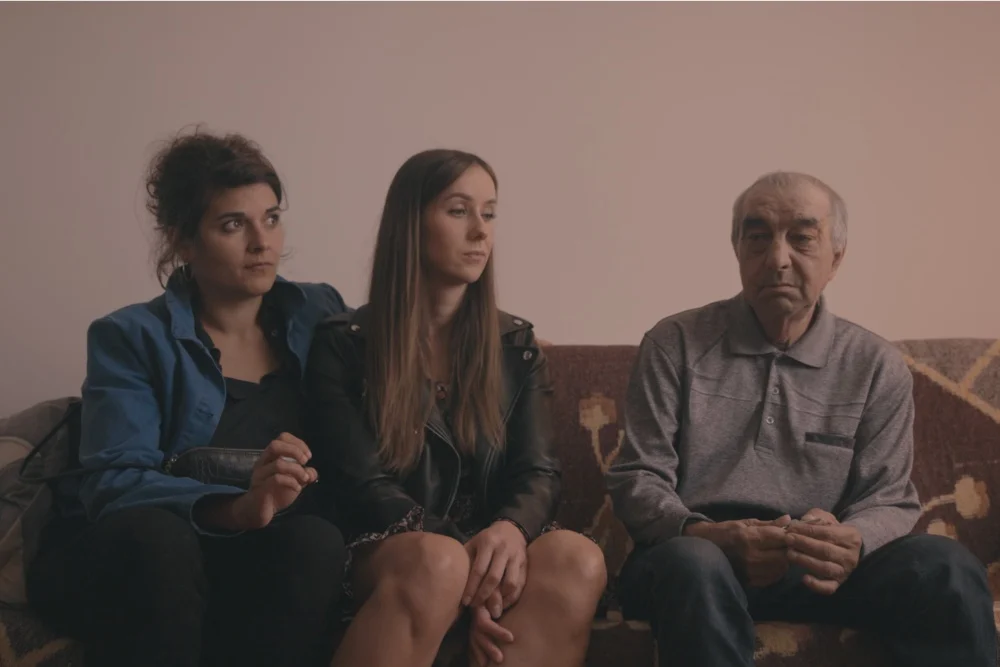
‘Something Familiar’ Director on Teaching the Skeleton in Her Closet to Dance: ‘Catharsis and Creativity Can Alchemize Trauma’
In the realm of deeply personal documentary filmmaking, British-Romanian director Rachel Taparjan has made an indelible mark with her debut feature, “Something Familiar.” Drawing inspiration from the profound wisdom of George Bernard Shaw, who famously quipped, “If you can’t get rid of the skeleton in your closet, you’d best take it out and teach it to dance,” Taparjan’s film courageously embraces this philosophy, inviting audiences into an intimate exploration of unresolved trauma, the enduring quest for identity, and the intricate threads of belonging.
The highly anticipated premiere of “Something Familiar” captivated audiences this week at CPH:DOX, Copenhagen’s esteemed international documentary festival, where it was featured prominently in the main competition. The film unfurls a compelling narrative, beginning with Taparjan’s compassionate decision to assist Mihaela, a woman adopted from the very same Romanian orphanage as the director herself, in her poignant search for her birth mother. This initial journey of shared discovery soon evolves into a deeply personal quest for Taparjan, as she embarks on her own parallel search for long-lost siblings, weaving a dual narrative that resonates with universal themes of human connection and self-discovery.
At its heart, “Something Familiar” is a testament to the resilience of the human spirit. “The film is about hope and overcoming adversity and trauma,” Taparjan shared with *Variety*, emphasizing that beyond the specific circumstances of adoption, the documentary delves into fundamental human experiences. “The focus is on the universal themes of identity and belonging,” she added, inviting viewers to reflect on their own understanding of self and their place in the world.
The geographical distances that initially separated these two women underscore the remarkable nature of their eventual connection. Mihaela, who had built a life on a sprawling farm in Manitoba, Canada, now resides in North Carolina, a continent away from her origins. Taparjan, a distinguished university lecturer and a highly qualified social worker, makes her home in the North-East of England. Their disparate lives, shaped by different cultures and experiences, converge through a shared past, creating a powerful dynamic that enriches the film’s narrative. This contrast highlights the extraordinary power of shared history to bridge vast physical and emotional divides.
“Mihaela and I started this journey not knowing what we would find,” Taparjan recounted, reflecting on the initial uncertainty that shrouded their undertaking. “But there was the drive to find out who we are, where we came from, and some of the circumstances around why we ended up in an orphanage in Romania.” This inherent human curiosity, the primal need to understand one’s roots, forms the bedrock of their quest, propelling them forward into the unknown with a blend of trepidation and unwavering determination.

The serendipitous genesis of the project began about six years ago with an unexpected email that landed in Taparjan’s inbox. “It said something along the lines of, ‘You don’t know me, but we were adopted from the same orphanage at the same time. I’d like to go back to Romania. Will you help?’” Taparjan vividly recalled the moment that would irrevocably alter the course of her life and career. Her initial reaction, however, was one of reluctance. “I’d just got back from Romania, and I wasn’t ready at all to engage in that process, so I ignored her for quite some time.” This candid admission reveals the deeply personal and often challenging nature of confronting one’s past, even for someone as professionally equipped to handle trauma as Taparjan. Yet, the persistent pull of shared destiny eventually prevailed. “Then, eventually, got back in touch with her and said, ‘You know, I’m ready. I’ll help.’”
Mihaela’s initial focus was simply to revisit the orphanage that had shaped her earliest memories. However, Taparjan, with her innate understanding of the profound implications of such a journey, gently guided their exploration deeper. “She wanted to go to the orphanage, but then I said, ‘What about finding your mum?’ And then that became another focus that we had together. So, yeah, she was ready. She wanted to embark on this journey long before I did.” This shift in focus transformed their joint venture from a simple homecoming to a complex, emotionally charged search for biological origins, a quest for answers that many adopted individuals grapple with throughout their lives.
Taparjan also expressed a strong desire to challenge prevailing stereotypes about Romania and its people, acknowledging that media portrayals have often been “quite stigmatizing.” Her film, she asserts, aims to deliver a profoundly different perspective on the country’s complex history and its human cost. Embodying the powerful principle of “Nothing about us, without us,” Taparjan highlighted the unique advantage of their insider perspective. “The fact that Mihaela and she are insiders telling this story is really interesting because [during the film] we are learning things as the audience is, and our pre-existing narratives are subverted, along with the audience’s.” This approach promises a nuanced, authentic portrayal, moving beyond simplistic narratives to reveal the true lived experiences of those directly affected by historical events.
One of the most profoundly moving and pivotal moments in the film occurs when Taparjan and Mihaela finally step inside the Romanian orphanage where their lives began. The experience transcended mere intellectual understanding. “People talk about embodied memory, and I was cognitively aware of it and interested in it, but I’d never really felt it,” Taparjan explained. “And, my gosh, when we got to that orphanage, something happened to both of us.” This visceral reaction speaks to the deep, often subconscious, connection individuals have to places of profound personal significance, particularly those tied to early childhood and trauma.
Elaborating on the enigmatic concept of “embodied memory,” Taparjan described it as an almost inexplicable sensation. “I suppose the nearest thing that we talk about is déjà vu. It’s like, ‘I’ve been here before,’ or ‘Something’s happened here before.’” Her own experience within the orphanage was particularly striking. “I felt very, very emotional in a certain room in that orphanage, and I didn’t expect to feel that. We later found out that that’s where the children were kept – in that room. Now, what was going on there? I don’t know. I can’t prove it. I have no scientific backup for this. I just know that I was overcome by something, and it was when I was in that room as an adult that I would have been in as a baby.” This powerful, non-cognitive recall of a traumatic environment underscores the profound impact of early experiences on the developing psyche, a memory stored not in the mind but in the very fabric of the body. “And there are other moments of that as well, sort of carrying the memory of something in the body, beneath conscious memory, beneath conscious thought.”
To fully contextualize the circumstances that led their biological mothers to place them in the orphanage, Taparjan diligently “lifts the lid on the pronatalist policies [in communist Romania] and how that actually impacted the women,” she stated. The film delves into the grim realities of Romania’s history concerning sexual and reproductive health rights. Under the repressive regime of Nicolae Ceaușescu, Decree 770, enacted in 1966, brutally stripped women of their bodily autonomy, imposing draconian bans on contraception and abortion in a desperate, often cruel, bid to boost the nation’s population. This policy, designed to enforce a “golden age” of demographic growth, led to overcrowded orphanages, clandestine abortions, and immense suffering for Romanian women.

Taparjan was determined to counteract the prevailing, often dehumanizing, stereotypes of Eastern European mothers. Their biological mothers, she insists, “weren’t cold, unfeeling, all those Eastern European tropes. That’s not the case. These women were subjugated. I mean, there was such a restriction on bodily autonomy. I just didn’t really realize the extent of it.” By shedding light on the systemic oppression faced by women during this period, the film offers a crucial reframing, transforming the narrative from one of personal abandonment to one of profound societal and political duress. This historical context is vital for understanding the heartbreaking decisions made by countless mothers, revealing them not as villains but as victims of a ruthless regime.
The striking coincidence that both Taparjan and Mihaela not only originated from the same orphanage but were there at the exact same time adds an extraordinary layer of complexity and fate to their story. “I didn’t realize the complexity of that until making this film, and the fact that my parents chose me instead of her,” Taparjan mused. “I didn’t realize that it was that sliding doors kind of thing.” This revelation transforms their shared past into a poignant “what if,” highlighting the delicate balance of chance and choice that shapes human lives, and the emotional weight of being the one chosen, while another was not.
A significant turning point in the film, according to Taparjan, arrives when “Mihaela learns something from the family members we managed to find that makes her completely reframe her identity and her existence, what she knew versus what she now knows. It completely flips it.” This moment represents the powerful, sometimes disorienting, impact of new truths on one’s deeply held sense of self, illustrating how discovery can shatter preconceived notions and rebuild an identity from the ground up.
For Taparjan, telling her own story presented a unique and heartbreaking dilemma. “I couldn’t meet my mum because I found out that she died. So how do you do that? How do you talk to the dead?” This profound question led her to innovative cinematic solutions. “Does cinema and filmmaking offer a way to do that? Well, it kind of does, or it kind of did for me.” Rather than resorting to fictionalized elements, Taparjan employed creative devices, “by working with actresses and different devices, I kind of did get to speak to a mother, or revive the idea of a mother.” This artistic approach allowed her to grapple with the archetype of motherhood, which, despite the physical absence of her own biological mother, remains “really present within this film.” This thoughtful exploration of grief and connection through art provides a compelling answer to the timeless human longing for familial bonds, even those severed by death. “So, I really thought about how to tell the story differently in that sense.”
Despite the loss of connection with her birth mother, Taparjan experiences a profound reunion in the film, connecting with her siblings. “What I find in terms of my siblings, I think that’s probably the biggest twist in the film, finding out what they went through.” The narrative then takes an even more astonishing turn. “And then I suppose the final twist is how similar some of my own life trajectory has been to theirs, particularly my sisters, which was a bit spooky because we didn’t know each other. We weren’t raised together.” This uncanny resonance in their life paths, marked by “really similar types of adversity and trauma,” resurrects the age-old “nature versus nurture” debate, making it vibrantly “alive throughout the film.” This discovery suggests an intrinsic, almost fated, connection that transcends environment, offering a powerful testament to genetic inheritance and shared predispositions.
The film’s evocative title, “Something Familiar,” perfectly encapsulates these intricate themes. Taparjan explains that it “reflects this theme in the film, playing around with that kind of spooky, eerie thing that none of us can quite explain.” Beyond the uncanny resemblances, the title also speaks to the deep-seated human need for recognition. “The title also refers to searching for the familiar in the faces of the family members that we managed to find, because it’s an obsession for every adopted person: Who do I look like? I mean, it sounds really superficial, but it’s so big.” This primal desire to see oneself reflected in another, to find a visual anchor to one’s identity, is a powerful driving force for adopted individuals. Ultimately, the title hints at a deeper, almost mystical connection: “And searching for the familiar in what we find, and then the familiar finding us in stuff we can’t explain,” Taparjan concluded, hinting at the profound, inexplicable bonds that defy logic and circumstance.

The journey of making “Something Familiar” proved to be transformative for Taparjan, forging positive changes within her. Revisiting Shaw’s enduring quote about teaching the skeleton to dance, she reflected on the inherent unpredictability of documentary filmmaking. “Within documentary, there’s always uncertainty. But you have to dance with the uncertain. We’re letting all these truths out, and then what’s going to happen? How is it going to affect us all?” For Taparjan, the process has yielded profound personal gains. “And for me, I now have contact with these siblings that I have never known before, and I’ve gone on this journey.” While hesitant to label it strictly “therapeutic” – a term she reserves for her professional therapy sessions – she readily embraces the concept of catharsis. “Some of it, I think, has been cathartic for me. I hesitate to say therapeutic, because I’ve got my therapist and that’s therapeutic, but certainly some catharsis and creativity can alchemize trauma in some way that therapy doesn’t necessarily do.” This suggests a unique healing power inherent in the creative act itself. “There’s something that the creative process has brought me that I couldn’t have got in individual therapy, I think.”
The film also delicately explores the complexities of Taparjan’s relationship with her adoptive parents. While they were initially supportive of the project, even participating in early interviews, their connection has since fractured. “They don’t want to have any contact with me and haven’t for about two and a half years. So, there’s been loss involved in the filmmaking as well,” she revealed with poignant honesty. In the early stages of the project, approximately four and a half to five years ago, her parents were “on board to do that, which was good, and they wanted to give their perspective and their memories of the place and what it meant to them.” Their narrative, Taparjan emphasizes, was “so essential to be included in this film, because their decision to adopt was prompted by the fact that their own daughter died suddenly when she was 14.” This tragic backstory casts a long shadow, framing the “sliding doors” choice between Taparjan and Mihaela, and illuminating how “grief and loss and how it guided the decisions that they made, and how it influenced the family breakdown between me and them, I think it can all be charted back to unresolved, traumatic loss.” This revelation adds a layer of profound human empathy to the film, acknowledging the ripple effects of grief across generations and relationships.
Taparjan’s extensive background in social work and her academic research into overcoming trauma profoundly influenced her directorial approach, particularly in how she engaged with the film’s subjects. “I would like to think it’s fed in by taking a trauma-informed approach to filmmaking. I would like to think that. I mean, you’d have to ask other people who are in the film if they feel that.” This commitment translated into a deep concern for “the ethics and the safety of people within the film.” She highlighted the meticulous care taken with her sister Ana, whose story forms a crucial part of the narrative. “Particularly with my sister Ana. She was really wanting to tell her story, but there’s a real fragility to Ana. She’s been through probably more than anybody else I know. I mean in terms of the level of adversity and trauma, and just really making sure there was caretaking around her whole involvement, and that the preparation was done properly, and that the aftercare was there if she wanted it, and also throughout the filming, you know, having a therapist on set and so on.” This comprehensive, ethical framework underscores Taparjan’s dedication to responsible storytelling, especially when dealing with vulnerable individuals. “So, I hope that that’s influenced my approach to filmmaking, because I’ve spent all day teaching about trauma and attachment and transaction and you name it. So, I hope that care, that ethics of care, crossed over.”
The realization of “Something Familiar” was a testament to international collaboration, bringing together a talented team committed to this powerful narrative. The film was produced by Monica Lăzurean-Gorgan and Elena Martin at Manifest Film in Romania, with co-production efforts from Aleksandra Bilic of My Accomplice and Dermot O’Dempsey of Shudder Films in the U.K. World sales are being expertly handled by Tijana Djukic at Stranger Film Sales, ensuring this poignant and vital story reaches audiences globally, sparking conversations about identity, history, and the enduring strength of the human spirit.