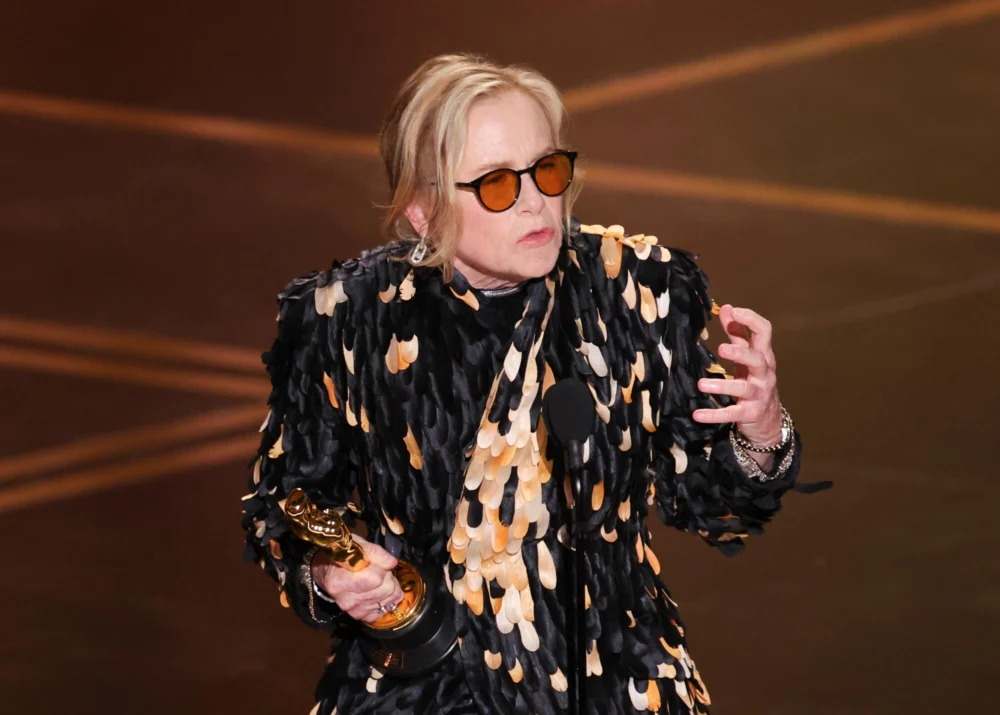
The air inside the Dolby Theatre shimmered with anticipation, a collective breath held as the envelope for Best Supporting Actress was torn open. When Amy Madigan’s name echoed through the hallowed hall, a ripple of genuine surprise, followed by thunderous applause, swept across the assembled luminaries. For Madigan herself, the shock was palpable, her expression a beautiful tableau of disbelief and burgeoning joy as she slowly made her way to the stage. It was a moment that transcended the usual polished decorum of awards season, a raw, authentic triumph that spoke volumes about an artist’s enduring craft and the unpredictable nature of recognition.
Her win was, by all accounts, an outlier in the grand tapestry of Academy Awards history. Madigan’s tour-de-force performance as Aunt Gladys in Zach Cregger’s chilling horror film, “Weapons,” was an undeniable masterclass in terror and psychological depth. Yet, the Academy has historically held a conservative stance towards genre cinema, particularly horror. While there have been recent, encouraging shifts towards acknowledging the artistry within horror – a growing openness to its narrative power and thematic resonance – a film like “Weapons,” which primarily aims to unnerve and terrify, rarely ascends to the ultimate Oscar stage. Its commentary on contemporary life, while present, resonated in a subtle, minor key, overshadowed by its potent commitment to visceral fear. Aunt Gladys, with her unsettling oscillation between saccharine grandiosity and whispered threats, emerged as the film’s beating, malevolent heart, the chief architect of its pervasive dread and, ultimately, a horror-movie villain destined for legend.
This context made Madigan’s victory all the more astonishing. When she accepted the award, her speech was a charming, unscripted cascade of emotion, a refreshing departure from the meticulously rehearsed addresses common on such nights. She humbly pushed back against the unspoken rule of not listing names, asserting with heartfelt conviction that those individuals were the very pillars that had supported her journey to that moment. Her humility wasn’t a performance; it was deeply earned, born from a career marked by both early promise and subsequent periods of quiet struggle. Throughout the rigorous promotional cycle for “Weapons,” spanning its theatrical release and subsequent awards campaign, Madigan had frequently spoken with candid vulnerability about feeling increasingly marginalized by Hollywood, a veteran actress accustomed to the disheartening silence of a phone that no longer rang with offers.
The industry’s tendency to sideline seasoned talent, especially women past a certain age, is a pervasive and often cruel reality. For Madigan, this period of being “counted out” must have carried its own unique ache, a quiet pain that only an artist deeply devoted to their craft can truly understand. Yet, within that pain lay an unexpected crucible, an opportunity to demonstrate an unparalleled resilience and to prove one’s mettle anew. Her previous Oscar nomination, for 1985’s “Twice in a Lifetime,” felt like a lifetime ago, occurring before any of her four fellow nominees in this category had even been born. That historical gap underscored not just her longevity, but also the arduous path she had navigated to return to such a prominent spotlight. When the role of Aunt Gladys presented itself, it was more than just another part; it was a chance to reclaim her artistic voice, to pour decades of lived experience and honed skill into a character whose very essence demanded an actor of profound capability.
Director Zach Cregger, a filmmaker known for pushing boundaries and subverting expectations, could only have dreamt that his character, Aunt Gladys, would be imbued with such a rich, terrifying life. On the page, Gladys’s origins and motivations were deliberately ambiguous, a skeletal framework designed to provoke rather than explain. It was Madigan who fleshed out this enigmatic figure, crafting a performance that was both horrifyingly specific and unnervingly universal. She masterfully navigated Gladys’s chilling duality: the public persona of a slightly dotty, endearingly eccentric older woman, seemingly aiming for lovability, juxtaposed with the private, malign force she truly embodied behind closed doors. The precise reasons for Aunt Gladys’s sinister acts – her insatiable need to siphon life from those she enchants – remain both chillingly obvious (a primal hunger for sustenance) and tantalizingly opaque, a dark magic beyond the comprehension of ordinary mortals. Madigan, with astonishing coherence, made sense of it all, drawing audiences into Gladys’s twisted logic and making her a villain not just of the genre, but of the human psyche.
This kind of performance, steeped in the visceral and often grotesque world of horror, has rarely been celebrated by the Academy. One might recall Ruth Gordon’s iconic, similarly garish and threatening witch in “Rosemary’s Baby,” a performance that did earn an Oscar nearly 60 years ago. However, “Rosemary’s Baby” arrived with a sheen of prestige, garnering additional nominations, including for its screenplay, that elevated it beyond a mere genre exercise. “Weapons,” by contrast, stood largely alone, with Madigan as its sole representative in the nominations. This stark contrast further amplified the power of her individual achievement. Her work was so utterly undeniable, so profoundly impactful, that it compelled the Academy to look beyond its traditional biases, to recognize raw talent over conventional prestige. She triumphed over four formidable performers whose films were widely celebrated across multiple categories, underscoring the singular, unignorable force of her portrayal.
At 75, Amy Madigan’s win positioned her as the second-oldest recipient in the Best Supporting Actress category’s history, a statistic that further underscored the significance of her journey. It was a victory not just for her, but for every artist who has felt the sting of professional neglect, for every woman in Hollywood who has been told her time has passed. Her work in “Weapons” spoke for itself, a compelling testament to an artist at the peak of her powers. But the sight of her striding onto that stage, battily and authentically herself, radiating a blend of shock, joy, and humility, served as a potent inspiration. It ignited a myriad of questions: Where had this immense talent been all this time? What further artistic gifts might still lie ahead for her? Her victory serves as a powerful reminder for performers that their best shot might indeed be just around the corner, waiting for the right role, the right moment. More broadly, it should ignite a fervent desire in imaginative directors like Cregger to seek out the ‘next’ Amy Madigan – to rediscover and champion the immense, often untapped, talent residing in actors whose names might only be a faint echo, but whose capabilities deserve a vibrant new stage.
Madigan’s triumph is a beacon, illuminating the enduring power of talent, resilience, and authenticity. It’s a testament to the idea that artistic brilliance, when undeniable, can shatter the most entrenched industry norms. Her journey from the margins back to the glittering center of Hollywood is not just a personal victory; it’s a narrative for our times, reminding us that true artistry knows no age limit, and that sometimes, the most profound impact comes from the most unexpected places. It’s a call to action for an industry often criticized for its narrow vision, a powerful plea to embrace the richness and depth that veteran artists bring to the screen, ensuring that extraordinary talent like Amy Madigan’s is never again “counted out.”