


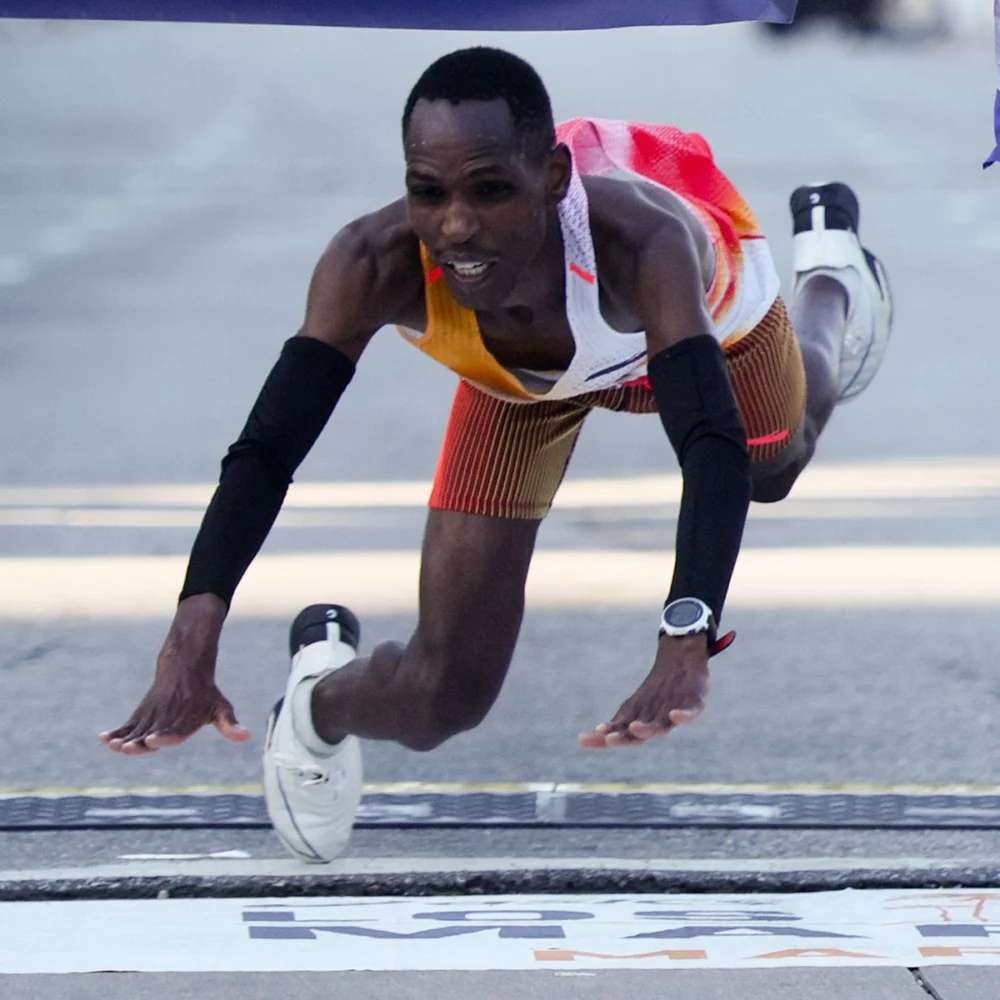
The 2026 Los Angeles Marathon was destined to be a historic event, drawing over 27,000 participants to the sun-drenched streets of Southern California. However, what began as a standard display of elite athletic endurance culminated in a whirlwind of social media controversy and a heart-stopping photo finish that has left the running community buzzing. At the center of the storm is Kenya’s Michael Kimani Kamau, an elite athlete who dominated the majority of the March 8 race, only to see a potential victory slip through his fingers in the final moments following a bewildering navigational error.
For more than 26 miles, Kamau appeared to be the undisputed frontrunner. His stride was rhythmic, his pace punishing, and his lead seemed insurmountable as he approached the final stretch of the grueling course. But as the finish line came into view, the narrative shifted from one of dominance to one of high-stakes confusion. In a moment captured by spectators and broadcast cameras alike, Kamau appeared to lose his bearings just as the race reached its climax. Instead of maintaining his trajectory toward the finish chute, he veered off-course, briefly running away from the finish line.
The misstep was brief—only a matter of seconds and a few stray steps—but in the world of professional marathon running, where victories are measured in heartbeats, it was an eternity. By the time the 34-year-old realized his error and corrected his path, the door had swung open for American runner Nathan Martin. Martin, who had been trailing Kamau but maintaining a steady, hopeful pace, seized the opportunity. In a final, desperate surge, Martin crossed the finish line with a time of 2:11:16.50. Kamau, trailing by the narrowest of margins, clocked in at 2:11:16.94. The difference—a mere 0.44 seconds—was the result of a race that had been led by one man for nearly two hours, only to be won by another in the final 800 meters.
As footage of the incident began to circulate online, fans and armchair analysts were quick to point fingers. Many social media users argued that the marathon’s lead motorcade was responsible for leading Kamau astray, suggesting that the vehicles made a turn that the runner instinctively followed. Others pointed to a spectator waving a Kenyan flag near the finish line, theorizing that the enthusiastic fan may have inadvertently distracted the athlete at a critical juncture. The outcry prompted a swift response from race officials, who sought to clarify the mechanics of the finish line procedures.
In a formal statement released on March 9, representatives for the Los Angeles Marathon dismissed the notion that the motorcade was at fault. They explained that the lead vehicles are required to make a pre-planned exit from the course before the runners enter the final fenced-in chute to ensure the safety of the athletes and the clarity of the finish line photos. According to the organization, the vehicles did not make a "wrong turn" but rather followed the established protocol. The statement emphasized that no official protests were filed by Kamau or his team, and as such, the results of the race remain finalized and unchanged.
While the marathon organizers stood by their logistical execution, they did acknowledge the role that spectator behavior can play in the final moments of such an intense competition. The sight of a fan just feet away from the finish line was labeled a "cause for concern," and officials promised to review crowd control measures for future events. The incident highlights the delicate balance between the electric atmosphere of a major city marathon and the need for a sterile, distraction-free environment for elite competitors who are pushed to the absolute limits of their physical and mental capacities.
Despite the controversy surrounding the men’s podium, the event was a celebration of global talent. In the men’s division, Enyew Nigat secured a respectable third place, rounding out a highly competitive top three. On the women’s side, Priscah Cherono took the top spot, delivering a commanding performance that was mercifully free of navigational drama. For the thousands of amateur runners who followed in their wake, the day was about personal bests, charitable fundraising, and the simple triumph of completing 26.2 miles.
Nathan Martin, for his part, expressed a sense of disbelief at his victory. In post-race interviews, he admitted that he hadn’t been certain he could catch Kamau until the very end. Seeing the pace car pull away and the lead runner falter gave him the psychological boost needed for that final, grueling sprint. "I have to at least try," he recalled thinking, a mindset that eventually earned him the title. Kamau has remained largely silent in the immediate aftermath, though his performance—even with the detour—remains a testament to his status as one of the sport’s premier athletes.
The drama in Los Angeles serves as a reminder that the marathon is as much a mental challenge as it is a physical one. It also highlights the public’s enduring fascination with the race, a feat of human will that attracts everyone from Olympic hopefuls to some of the biggest names in Hollywood. Over the years, the marathon has become a rite of passage for celebrities looking to test their mettle or raise awareness for causes close to their hearts.
The list of stars who have traded the red carpet for running shoes is long and varied. Harry Styles, for instance, has been spotted testing his endurance on the international stage, participating in both the Tokyo and Berlin Marathons in recent years. While Styles often keeps his training low-key, his presence on the course brings a level of pop-culture fervor to the world of distance running.
For others, the marathon is deeply personal. Tayshia Adams, a familiar face from "The Bachelor" franchise, recently returned to the New York City Marathon for the second time. For Adams, the race is about more than just the physical challenge; it’s about the energy of the crowd and the personal growth that comes from the training process. Similarly, Claire Holt of "The Originals" shared an emotional reflection after completing the Chicago Marathon. Running just 11 months after welcoming her third child, Holt used the platform to raise over $100,000 for Boston Children’s Hospital. Her journey was defined by 4:00 AM wake-up calls and the humility of pushing through self-doubt, a sentiment shared by many who take on the 26.2-mile distance.
The philanthropic power of the marathon is perhaps its most enduring legacy. Kevin Hart famously tackled the Chicago Marathon to raise funds for education, emphasizing that his goal was to bring awareness to the importance of sending kids to college. Ryan Reynolds used the 2008 New York City Marathon to honor his father’s battle with Parkinson’s disease, raising significant funds for the Michael J. Fox Foundation. Fox’s foundation has benefited from several celebrity runners, including "Sunday Today" host Willie Geist, who raised over $400,000 during his 2021 run.
The history of celebrity participation is also marked by impressive athletic feats. Cynthia Erivo, the star of "Wicked," stunned fans with a sub-four-hour finish in London, while model Karlie Kloss described the NYC Marathon as the hardest thing she had ever done, despite finishing with a strong time. Even royalty of the daytime screen and the political world have participated; Oprah Winfrey’s 1994 marathon run in Washington, D.C., remains an iconic moment in fitness history, as does George W. Bush’s 1993 Houston Marathon finish. Bush famously used his passion for running to argue that if the President of the United States can find time to train, anyone can.
Whether it is an elite athlete like Michael Kimani Kamau facing a split-second heartbreak or a Hollywood star like Alicia Keys chanting "one foot in front of the other" to reach the finish line, the marathon remains a uniquely democratic arena. It is a place where the smallest mistake can change the course of history, and where every participant, regardless of their fame, must face the same "silence and pain" described by Will Ferrell after his third marathon. As the Los Angeles Marathon looks toward 2027, the focus will undoubtedly return to the pavement, but the memory of Kamau’s wrong turn will linger as a cautionary tale of how quickly a race can change.