

Hollywood Showdown: Rosanna Arquette Confronts Tarantino on Divisive Language, Sparks Director’s Fiery Retort
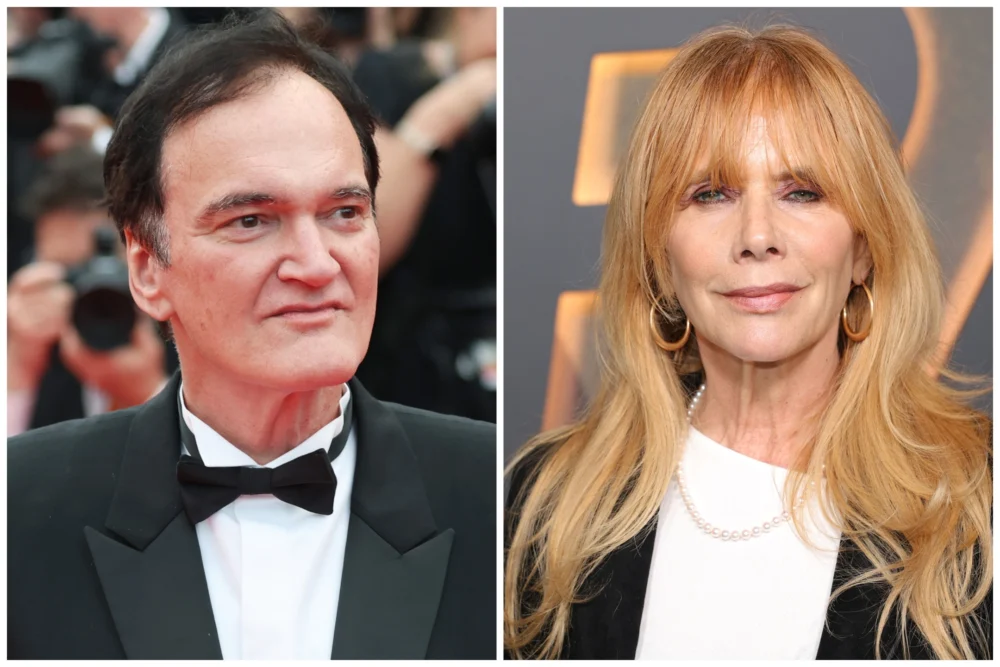
A simmering debate over artistic license and social responsibility has boiled over in Hollywood, as veteran actress Rosanna Arquette publicly challenged Quentin Tarantino on his controversial use of the N-word in his films. Her pointed criticism, voiced in a recent interview, has drawn an unusually swift and sharp rebuke from the acclaimed director, reigniting a long-standing discussion about the boundaries of creative expression and the impact of language in contemporary cinema. The exchange peels back the curtain on the delicate balance between professional camaraderie and personal conviction within the notoriously insular film industry.
Rosanna Arquette, a distinctive presence in film and television for decades, known for her roles in critically acclaimed works like “Desperately Seeking Susan” and “Pulp Fiction,” offered her candid thoughts during a wide-ranging conversation with The Sunday Times. While acknowledging the cinematic brilliance of Tarantino’s 1994 black comedy masterpiece, “Pulp Fiction,” in which she played a minor but memorable role as Jody, the wife of drug dealer Lance, Arquette did not shy away from expressing her profound discomfort with the director’s recurring linguistic choices. Her critique centered specifically on the frequent deployment of the N-word, a term laden with centuries of racial pain and oppression.
In her interview, published just days prior, Arquette articulated her personal exhaustion and moral opposition to the word’s presence in Tarantino’s oeuvre. “Personally, I am over the use of the N-word — I hate it,” she stated unequivocally, her words resonating with a growing public sentiment that calls for greater sensitivity and accountability from creators. She went further, expressing a deep frustration that Tarantino, despite the widespread and enduring criticism, seems to have been granted an unofficial “hall pass” by parts of the industry and fandom. For Arquette, this isn’t merely a matter of taste or artistic interpretation; it delves into the realm of ethics. “It’s not art, it’s just racist and creepy,” she concluded, delivering a stinging assessment that positioned her firmly on the side of those who believe certain words, regardless of their intended narrative context, carry an inherent power to offend and diminish.
Arquette’s outspokenness is not entirely new territory for the actress. In recent years, she has been a vocal advocate for various social causes, including women’s rights and mental health awareness, and was among the first women to publicly accuse Harvey Weinstein of sexual harassment, playing a significant role in the genesis of the #MeToo movement. Her willingness to speak truth to power, even when it involves challenging industry titans, has become a defining characteristic of her public persona. This latest critique, therefore, arrives not as an isolated comment, but as part of a broader pattern of Arquette using her platform to advocate for what she perceives as moral and social rectitude within Hollywood and beyond. Her critique of Tarantino, therefore, can be viewed through the lens of a conscientious artist grappling with the evolving standards of cultural sensitivity and the enduring impact of offensive language.
However, Arquette’s direct challenge did not go unanswered. Quentin Tarantino, a filmmaker notoriously protective of his creative vision and fiercely independent, responded just days later with a letter addressed directly to Arquette. His statement was less a nuanced defense of his artistic choices and more a sharp, personal rebuke, lambasting the actress for what he perceived as a betrayal of professional decorum and an ungrateful public slight. Tarantino accused Arquette of exhibiting “a decided lack of class, no less honor,” effectively turning the tables on her criticism by questioning her integrity and motives.
In his pointed letter, Tarantino made it clear that he viewed Arquette’s comments as a calculated move for personal gain. “I hope the publicity you’re getting from 132 different media outlets writing your name and printing your picture was worth disrespecting me and a film I remember quite clearly you were thrilled to be a part of?” he wrote, suggesting that her public critique was a cynical ploy for renewed relevance. He further elaborated on this perceived opportunism, stating, “Do you feel this way now? Very possibly. But after I gave you a job, and you took the money, to trash it for what I suspect is very cynical reasons, shows a decided lack of class, no less honor.” The director’s words painted Arquette as an unprincipled actor who benefited from his work only to later disparage it, implying a breach of an unspoken code of conduct among artistic colleagues.
This public spat highlights the enduring and often contentious debate surrounding Tarantino’s use of the N-word, a controversy that has shadowed his career for decades. While Arquette specifically referenced “Pulp Fiction,” where the racial slur is reportedly uttered approximately 20 times, it is Tarantino’s 2012 Western “Django Unchained” that often draws the most significant scrutiny. That film, set in the pre-Civil War American South, features the N-word an astonishing 110 times, a frequency that has fueled accusations of gratuitousness and insensitivity, even from some of his ardent admirers. Critics argue that while historical accuracy might necessitate the word’s presence in certain contexts, its sheer volume in “Django Unchained” pushes the boundaries of necessity, risking desensitization or even endorsement rather than critical engagement.
Tarantino, however, has consistently defended his use of the word as integral to character authenticity and historical realism. His position has been bolstered by the unwavering support of some of his most prominent Black collaborators, most notably Samuel L. Jackson and Jamie Foxx. Jackson, who has appeared in numerous Tarantino films, including “Pulp Fiction,” “Django Unchained,” and “Jackie Brown,” has frequently dismissed criticism of the director’s language, arguing that the words are spoken by characters in specific narrative contexts, not by Tarantino himself. He often points out that the dialogue reflects the harsh realities of the worlds Tarantino creates, particularly in films like “Django Unchained,” where the brutality of slavery is depicted without flinching from its linguistic accompaniment. Similarly, Jamie Foxx, the star of “Django Unchained,” has defended Tarantino, emphasizing the artistic integrity and historical necessity of the language to portray the oppressive environment of the era. Their defenses, coming from respected Black actors, have often served to complicate the narrative for critics, adding a layer of nuance to what might otherwise be a more straightforward condemnation.
The “hall pass” Arquette refers to is precisely this perceived immunity Tarantino enjoys, often attributed to his status as a singular auteur and the vocal support from his Black collaborators. For many, the debate isn’t about whether the N-word can ever appear in art, but about the context, frequency, and intent behind its use. Is it deployed to shock, to accurately reflect a historical period, to give voice to hateful characters, or simply to push boundaries? And at what point does its repetition risk normalizing a term that remains deeply offensive and hurtful to countless individuals? These are the complex questions that Arquette’s comments, and Tarantino’s response, bring back to the forefront of cultural discussion.
The director’s invocation of “esprit de corps” – a sense of camaraderie and mutual support among members of a group – is particularly telling. In Hollywood, where professional relationships are often intertwined with personal ones and reputation is paramount, public criticism from a former colleague, especially one who benefited from the director’s employment, can be seen as a serious transgression. Tarantino’s letter suggests a belief in an unspoken agreement: that while actors may privately hold reservations, airing grievances publicly, particularly after accepting payment for a role, crosses a line. This sentiment underscores the hierarchical nature of the film industry, where directors often hold significant power, and public dissent from actors can be viewed as an act of insubordination or disloyalty, regardless of the validity of the critique itself.
This incident also speaks to the broader cultural reckoning currently underway in the entertainment industry. In an era marked by heightened social consciousness, increased demands for authentic representation, and a greater understanding of the impact of language, artists are increasingly being held accountable for the messages and terms they choose to disseminate. What might have been brushed aside as mere “artistic freedom” in decades past is now subject to intense scrutiny, with audiences and critics alike demanding that creators consider the social implications of their work. Arquette’s decision to speak out reflects this shifting landscape, signaling a discomfort with the status quo and a willingness to challenge established norms, even if it means incurring the wrath of powerful figures like Quentin Tarantino.
Ultimately, the exchange between Arquette and Tarantino is more than just a personal dispute; it is a microcosm of a much larger, ongoing conversation about art, ethics, and responsibility. It forces a re-examination of what constitutes “art,” where the line between provocative and gratuitous lies, and the evolving role of creators in a world increasingly sensitive to the historical weight and contemporary impact of language. As Hollywood continues to grapple with its past and present, dialogues like this, however uncomfortable, are vital in shaping the future of storytelling and the stories we choose to tell.