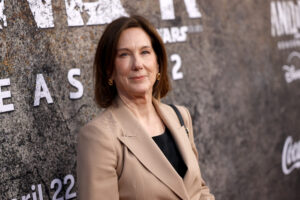


Hollywood icon Kathleen Kennedy, a name synonymous with some of the most indelible cinematic experiences of the last four decades, recently captivated an audience in Los Angeles, not with a blockbuster announcement, but with a profound homage to the often-unsung heroes of filmmaking: sound designers. At the Motion Picture Sound Editors’ (MPSE) annual Golden Reel Awards, the venerable producer and former president of Lucasfilm was bestowed with an honorary award, a testament to a career that has consistently championed the intricate artistry of sound in storytelling. This recognition underscores her unparalleled understanding of cinema’s multifaceted craft, an insight that has shaped an extraordinary filmography including titans like Jurassic Park, Back to the Future, and Schindler’s List.
The ceremony, held at the historic Wilshire Ebell Theater, saw Kennedy accept her accolade from legendary sound designer Ben Burtt, whose groundbreaking work defined the sonic landscape of the Star Wars universe and beyond. In her acceptance speech, Kennedy articulated with characteristic clarity the indispensable role of sound. "Sound helps root the story," she explained, her words resonating with decades of experience bringing fantastical worlds to life. "It helps represent where characters are, not only geographically, but emotionally. It helps foreshadow the intent of a character or define what they’re going through. In short, it takes the audience on the journey of the film." This philosophy, she revealed, was cultivated early in her career through collaborations with true masters of the craft, individuals who instilled in her the understanding that sound is far more than a post-production embellishment; it is "the heartbeat of the story that should be conceived and designed and refined from the earliest stages of the process."
One particularly poignant lesson, Kennedy recalled, came during the production of Steven Spielberg’s seminal 1982 classic, E.T. the Extra-Terrestrial. Working alongside Burtt, she witnessed firsthand the alchemical power of sound in transforming an elaborate puppet into a living, breathing character. "Steven and I spent so much time worrying about how E.T. was going to look," she admitted, reflecting on the arduous task of bringing the lovable alien to the screen. "But it wasn’t until we heard those heavy, shuffling footsteps and the raspy, melodic breathing that E.T. became real. He wasn’t a puppet anymore, he was a friend." The origin of E.T.’s distinctive voice, a marvel of creative ingenuity, is a story Kennedy delightedly shared: it came from recording a woman named Pat Welsh, whose unique vocal quality, a result of smoking two packs of Kools cigarettes daily, caught Ben Burtt’s ear outside a photography store in San Anselmo. Burtt, recognizing the extraordinary potential, patiently waited for her to emerge, then simply asked, "Would you like to be an alien in a movie?" This anecdote perfectly encapsulates Kennedy’s point about the profound impact of meticulously crafted sound, elevating visual storytelling to an emotional, visceral experience.
Kennedy’s career, spanning over 70 feature films as a producer or executive producer prior to her Lucasfilm tenure, has consistently demonstrated this profound appreciation for every facet of filmmaking. Her earlier work, which collectively garnered an astonishing 120 Academy Award nominations and 25 wins, includes a pantheon of cinematic achievements: the high-octane adventures of the Back to the Future trilogy, the whimsical charm of Who Framed Roger Rabbit, the suspenseful brilliance of The Sixth Sense, and the enduring magic of Gremlins and The Goonies. Each project, regardless of genre, benefited from her keen eye for talent and her holistic approach to production, ensuring that all elements, including sound, contributed to the film’s overall impact.
The conversation backstage after her acceptance speech offered a glimpse into Kennedy’s ongoing projects and her forward-looking perspective on the industry. Addressing the highly anticipated May release of The Mandalorian & Grogu, a film she not only greenlit but also serves as producer, Kennedy highlighted another perfect example of non-verbal storytelling through sound and visual design. Asked about her first experience hearing Grogu – affectionately known as Baby Yoda – she reiterated the character’s unique appeal. "He’s another perfect example of a character that has to emote and you have to feel connected to, and he never speaks a word." Kennedy confirmed that, despite the iconic broken English of his namesake, audiences will continue to fall deeper in love with Grogu "on the big screen, and he never says a word." This creative choice, to maintain Grogu’s silent expressiveness, further underscores her deep understanding of how effective storytelling transcends dialogue, relying heavily on visual cues, emotional performances, and the subtle power of sound (or its absence) to convey character and narrative.
Her reflections also touched upon the recent, meticulously planned leadership transition at Lucasfilm, where she formally handed over the reins to longtime deputies Dave Filoni, now president and chief creative officer, and Lynwen Brennan, co-president. Kennedy characterized this shift not as an abrupt departure, but as the culmination of a decade-long strategic mentorship. "It didn’t just happen six months ago," she clarified, emphasizing the deliberate nature of the succession. "I spent 10 years talking Dave into gradually stepping into live action. He had so much experience in animation. He’s so knowledgeable about Star Wars and loves it so much, it’s really been a 10-year mentoring process for both of them." She praised Brennan, who rose through the ranks of Industrial Light & Magic and served as Kennedy’s General Manager, for her operational acumen. "I would argue that the transition has been really pretty seamless," Kennedy affirmed, a testament to her visionary leadership in cultivating future leaders and ensuring the continued vitality of the Lucasfilm legacy.
The evening’s host, comedian Patton Oswalt, playfully acknowledged the often-intense world Kennedy navigated during her tenure at Lucasfilm. Following her speech, Oswalt joked that Kennedy had gone backstage for a ritual "freeing her from the nerd mafia she’s been trapped with for years." He quipped that she had been "freed from the comments section," a lighthearted jab at the fervent, and occasionally volatile, nature of Star Wars fandom on social media. Kennedy, with her characteristic grace, addressed these complexities backstage, acknowledging the unique landscape she inherited. "I really segued into [that job] when the fan expectations collided with social media. That really has created a kind of explosion," she observed. While recognizing the challenges, she underscored the enduring importance of the fanbase: "It’s always been important to Lucasfilm, that the fans are a huge part of what the franchise is. So that was something that was new to me and something that grew over time, but it’s remained incredibly important to the company." Her ability to navigate this passionate ecosystem, balancing creative vision with fan engagement, speaks volumes about her resilience and strategic leadership.
Concluding her on-stage remarks, Kennedy delivered a final, memorable tribute to the boundless curiosity and inventive spirit of sound designers, harking back to her work on Raiders of the Lost Ark, the inaugural film in the iconic Indiana Jones franchise. "What I love most about sound designers and editors is your curiosity," she proclaimed, painting a vivid picture of their unique creative process. "You’re the only people I know who can hear the scrape of a toilet lid and think that’s it. That’s it! That’s the sound of the Ark of the Covenant opening." This anecdote perfectly encapsulates the ingenious and often unconventional methods employed by sound artists to conjure cinematic magic, a process Kennedy has consistently admired and supported throughout her career.
In a recent interview, Kennedy had hinted at her interest in exploring the possibilities of artificial intelligence in filmmaking. Backstage, she took the opportunity to clarify her nuanced stance on this burgeoning technology, preferring the term "augmented reality" over "artificial intelligence." She emphasized her unwavering commitment to human creativity: "Many of us in the industry absolutely are committed to human beings and a human point of view." Her interest lies not in replacing human artistry, but in leveraging these tools to enhance it. "We’ll see if these tools can end up augmenting that process, speed things up and find a place in the flow of creativity. That’s what I find quite intriguing about some of these tools. But, to actually replace human beings in the process? No." This thoughtful perspective positions Kennedy as a forward-thinking leader who champions innovation while steadfastly protecting the irreplaceable value of human imagination and skill in the filmmaking process.
Kathleen Kennedy’s tenure at Lucasfilm saw the release of cinematic behemoths such as Star Wars: The Force Awakens, which became the highest-grossing domestic film of all time, alongside critical and commercial successes like Rogue One and The Last Jedi, as well as Solo. Beyond The Mandalorian & Grogu, her remaining producer projects at Lucasfilm include the highly anticipated Ryan Gosling-led Star Wars vehicle, Star Fighter. Her extraordinary career has been punctuated by numerous accolades, including eight Academy Award nominations, a BAFTA fellowship, and a CBE Award. Beyond her immense creative and executive contributions, Kennedy has also been a tireless advocate for industry reform and equity. She served as board chair for the American Film Institute (AFI) and was a founding Council Member of the Hollywood Commission to Eliminate Sexual Harassment and Advance Equality, demonstrating her commitment to fostering a more inclusive and equitable environment within the industry. Currently, she continues to lend her expertise and influence as a board member for the LA Promise Fund, the Library of America, and USC’s School of Cinematic Arts.
From her early days assisting Steven Spielberg to her groundbreaking role as a female producer shattering glass ceilings, and ultimately to her stewardship of one of the world’s most beloved franchises, Kathleen Kennedy’s journey is a testament to vision, resilience, and an unwavering dedication to the art of storytelling. Her recent honor from the MPSE is not just a recognition of her profound appreciation for sound, but a celebration of a career that has consistently pushed the boundaries of cinematic excellence, enriching the lives of audiences worldwide.