

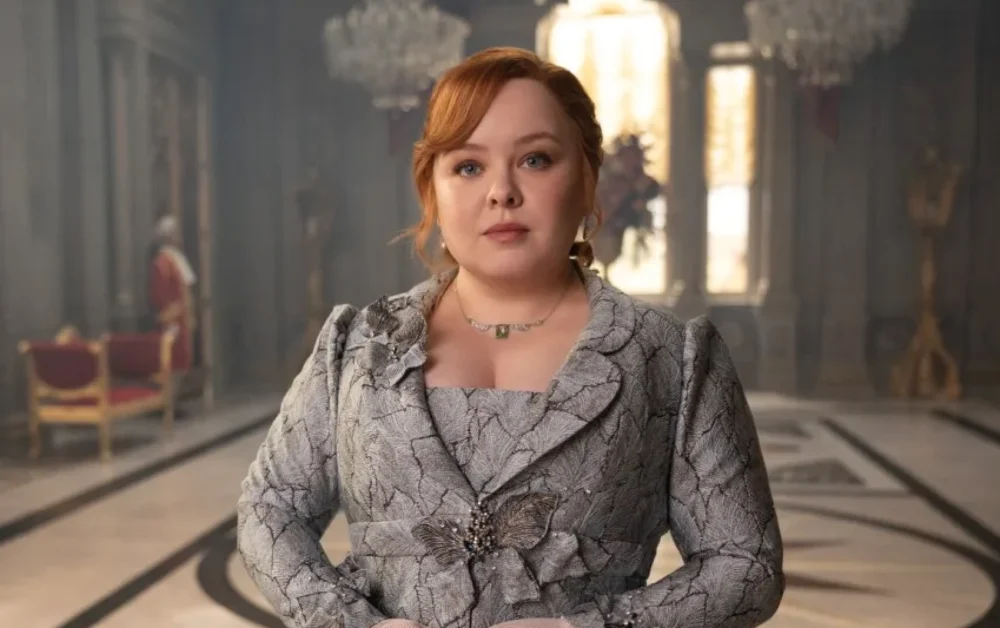
In the glittering, Regency-era world of Netflix’s global phenomenon, “Bridgerton,” actress Nicola Coughlan has captivated millions as the sharp-witted and endearing Penelope Featherington. Yet, beyond the gilded ballrooms and whispered secrets of Mayfair, Coughlan has found herself at the forefront of a very modern battle: the fight against unsolicited commentary on women’s bodies. Her recent revelations to Elle UK magazine underscore the deeply personal and often invasive challenges faced by public figures, particularly women, in an age where the lines between admiration and intrusion are increasingly blurred.
The incident Coughlan recounted, a jarring encounter in a public bathroom with an inebriated fan, serves as a stark reminder of this pervasive issue. While filming the highly anticipated third season of “Bridgerton,” which places Penelope’s burgeoning romance with Colin Bridgerton (Luke Newton) at its heart, Coughlan was confronted by a woman who, fueled by alcohol and a misplaced sense of familiarity, began to openly dissect the actress’s physique. Such an encounter, occurring in a space traditionally afforded a modicum of privacy, left Coughlan feeling profoundly violated and distressed. The experience highlights a disturbing trend where fans, emboldened by parasocial relationships fostered through media, feel entitled to comment on the most intimate aspects of a celebrity’s being, often without regard for their humanity.
This particular confrontation struck a raw nerve for Coughlan, given the ongoing, often misguided, public discourse surrounding her body. She revealed to Elle UK that during the filming of Season 3, she had been diligently exercising, leading to significant weight loss. “You know what was really bizarre was, when I was shooting that series, I was exercising a lot because I knew I had to, so I had lost a bunch of weight — I was probably a size 10 and one of the corsets was a size 8,” Coughlan explained. Despite this personal transformation, she continued to be labeled “plus size” by segments of the media and public. Her exasperation was palpable: “And then people talked about how I was plus size and I was like, ‘How fucked are we that I am the biggest woman you want to see on screen?'” This statement encapsulates a broader frustration felt by many women who find their bodies constantly scrutinized and pigeonholed by arbitrary and often unhealthy societal standards, particularly within an industry that has historically championed a very narrow definition of beauty.
The impact of such relentless focus on her physical appearance, rather than her craft, became painfully clear during the bathroom encounter. “I remember this really drunk girl once talking to me in a bathroom being like, ‘I loved [‘Bridgerton’] because of your body,’” Coughlan recalled, the memory still fresh with discomfort. “And she started talking about my body, and I was like, ‘I want to die. I hate this so much…’ It’s really hard when you work on something for months and months of your life, you don’t see your family, you really dedicate yourself and then it comes down to what you look like — it’s so fucking boring.” Her raw honesty lays bare the emotional toll of constant body shaming, transforming what should be a celebration of artistic achievement into a battleground over physical attributes. It underscores the dehumanizing effect of reducing an actor’s complex performance and dedication to their size or shape, a particularly galling experience for someone who pours their heart and soul into their work.
Coughlan’s experience is not an isolated incident but rather a microcosm of the intense scrutiny female actors, especially those who defy traditional Hollywood archetypes, routinely face. The entertainment industry, despite its recent strides towards diversity, still grapples with deeply ingrained biases regarding body image. Actresses like Coughlan, whose talent shines brightly irrespective of their size, often become unwitting symbols in the broader conversation about body positivity and representation. However, being a symbol comes with its own burden, as it often invites public ownership and commentary that can feel intrusive and suffocating.
This latest revelation from Coughlan is consistent with her long-standing and vocal advocacy against body shaming. She has, with admirable consistency, used her platform to push back against the relentless public dissection of her physique. In a powerful 2022 Instagram post, she directly addressed her critics, drawing a clear boundary: “If you have an opinion about my body please, please don’t share it with me…It’s really hard to take the weight of thousands of opinions on how you look being sent directly to you every day.” This plea for respect and privacy resonated with countless individuals who also grapple with unwanted comments about their appearance. It highlighted the emotional labor involved in navigating public life when one’s physical self becomes a subject of open debate, often by strangers who feel entitled to express their views.
Her stance has remained unwavering. In an interview with The Irish Times, Coughlan articulated her core philosophy, prioritizing her professional integrity above all else. “All I care about is the work. Bodies change, if I lose weight or gain weight or I do anything it’s no one’s business, all I care about is doing good acting and being judged on that,” she asserted. This declaration serves as a powerful reminder that an actor’s primary role is to embody a character and deliver a compelling performance, not to conform to an audience’s preconceived notions of physical perfection. It’s a call for professional respect, urging the public to shift their focus from superficial attributes to the depth and quality of her artistic contributions.
The culmination of Coughlan’s personal journey and public advocacy found a powerful, defiant expression in “Bridgerton” Season 3. Amidst the swirling rumors and incessant scrutiny surrounding her body, Coughlan made a deliberate and empowering choice regarding a pivotal sex scene between Penelope and Colin. She collaborated closely with intimacy coordinator Lizzy Talbot, ensuring the scene was not only artistically authentic but also a deeply personal statement. “I specifically asked for certain lines and moments to be included,” Coughlan revealed to Stylist in 2024. “There’s one scene where I’m very naked on camera, and that was my idea, my choice.”
This decision to embrace full nudity on screen, in a role that had historically been portrayed as the “wallflower,” was far more than just a creative choice; it was an act of profound self-reclamation. It transformed a potentially vulnerable moment into a powerful declaration of autonomy and self-acceptance. “It just felt like the biggest ‘fuck you’ to all the conversation surrounding my body; it was amazingly empowering,” she stated with candid force. In a society that often dictates how women should look and behave, particularly in intimate settings, Coughlan’s choice was a radical act of defiance. It was a reclaiming of her own body, asserting that it belongs to her alone and that its depiction on screen would be on her terms, free from the shadow of external judgment.
Her motivation was not merely defiance but also an affirmation of her own beauty and confidence. “I felt beautiful in the moment, and I thought: ‘When I’m 80, I want to look back on this and remember how fucking hot I looked!’” This sentiment encapsulates the essence of true body positivity – not just acceptance, but celebration. It’s a testament to the idea that confidence and attractiveness are internally generated, independent of societal approval. By embracing her body in its entirety on screen, Coughlan not only delivered a powerful performance true to Penelope’s awakening but also sent an undeniable message to every critic and troll: her worth, her talent, and her beauty are immutable, and she is the sole arbiter of her own image.
Nicola Coughlan’s journey, from the discomfort of a bathroom confrontation to the triumphant assertion of self in a pivotal on-screen moment, offers a compelling narrative on celebrity, body image, and the ongoing struggle for respect and autonomy. Her willingness to share these experiences provides invaluable insight into the pressures faced by women in the public eye and serves as an inspiring example of how to navigate and ultimately transcend relentless scrutiny. In a world still grappling with unrealistic beauty standards, Coughlan stands as a beacon of authenticity, reminding us that true empowerment comes from within, fiercely defended and unapologetically celebrated.