


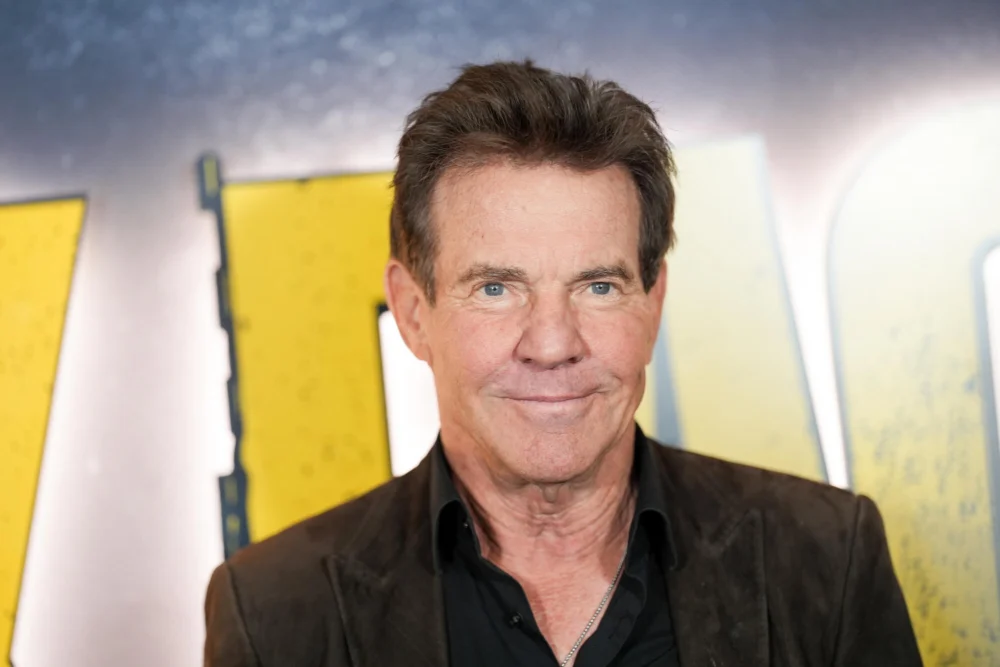
Dennis Quaid Charts a Course Through America’s Shifting Political Landscape, Advocating for Common Sense Amidst Deepening Divides
Veteran actor Dennis Quaid, known for his versatile career spanning decades and most recently for his portrayal of President Ronald Reagan in the 2024 biopic “Reagan,” has offered a candid assessment of the current state of American politics. In a recent interview, Quaid expressed his belief that the political pendulum has swung excessively to the left in recent years, contributing to a deeply polarized national discourse.
Quaid’s insights emerged during his appearance on Pastor Greg Laurie’s popular program, “The Greg Laurie Show,” a platform often frequented by figures discussing faith, culture, and societal trends from a generally conservative perspective. The conversation quickly turned to the escalating political tensions in the United States, a topic that resonates deeply with a broad segment of the American public grappling with stark ideological divides.
Pastor Laurie initiated the discussion by observing, “Things have gone so extremely, so far left right now.” To illustrate the dramatic shift, Laurie recounted an anecdote from a podcast featuring comedians Bill Maher and Dana Carvey. Carvey, a satirist celebrated for his political impersonations, reportedly quipped to his Hollywood peers, “I’ve told my friends in Hollywood I’m a Clinton Democrat, and some of them are calling me a Nazi now.” This stark example underscored the radical transformation of political identity and the increasingly hostile nature of partisan labels.
Quaid responded to the anecdote with a concise yet poignant remark: “You can’t do that.” His comment spoke volumes about the erosion of civil discourse and the troubling trend of demonizing those with differing viewpoints, even those considered historically mainstream. The actor further elaborated on this sentiment, agreeing with Laurie’s underlying premise that the political center has drastically shifted. Quaid observed that what was once considered a moderate “Clinton Democrat” position is now often equated with being a “neo-con” or aligning with the far-right. “What used to be, you can’t be anymore,” Quaid lamented, highlighting the profound redefinition of political categories and the shrinking space for traditional centrism.
This re-evaluation of political labels and the perceived leftward drift in American society is a theme frequently discussed across various media, from academic analyses to popular talk shows. The concept of the “Overton Window,” which describes the range of policies politically acceptable to the mainstream population at a given time, appears to be a dynamic force in Quaid’s observations. As the window shifts, ideas once considered fringe can become mainstream, and vice-versa, leading to a sense of disorientation and frustration for those who feel their long-held moderate views are suddenly branded as extreme.
Despite his critique of the current political trajectory, Quaid was keen to clarify his own political identity. He firmly stated that he does not align himself with the Republican Party. Instead, he prefers to be seen as “a common-sense independent.” While acknowledging that he “leans more conservative in my head,” Quaid reiterated his core philosophy: “I’m just for common sense, is really what I am.” This self-description resonates with a growing number of Americans who express disillusionment with both major parties and seek pragmatic solutions over ideological purity. In an era where partisan loyalty often overshadows practical governance, the appeal of a “common-sense” approach has gained considerable traction among voters weary of gridlock and divisive rhetoric.
Quaid’s independent stance, particularly within the often-liberal landscape of Hollywood, makes his voice stand out. While many celebrities are vocal about their political affiliations, Quaid’s deliberate choice to distance himself from a party label while still expressing conservative leanings offers a nuanced perspective that can bridge divides or, at the very least, provoke thought outside conventional entertainment industry norms. His career, marked by diverse roles and a reputation for authenticity, lends weight to his personal political reflections.
The conversation with Pastor Laurie also ventured into a discussion about former President Donald Trump. Laurie introduced the subject by describing Trump in surprisingly personal terms, characterizing him as “very personable, incredibly funny, a good listener and surprisingly approachable person.” This portrayal often contrasts with the highly charged public image of the former president, suggesting a different dimension to his character.
Quaid readily agreed with Laurie’s assessment, affirming his own experiences with Trump. “Surprisingly approachable and very funny. And really genuine,” Quaid stated, echoing Laurie’s observations. He went on to articulate a key reason for Trump’s enduring appeal to his base, suggesting that his genuineness is integral to his political success. “He wouldn’t be president if he wasn’t genuine. The people who voted for him, they know that he has their best interests at heart, that he is a genuine person,” Quaid asserted. This perspective highlights the importance of perceived authenticity in modern politics, where voters often connect with candidates they believe are true to themselves, regardless of policy specifics or conventional political decorum.
Quaid also commented on Trump’s remarkable energy, drawing a parallel to his own reputation for vitality. “I’ve never seen anybody with that kind of energy,” Quaid remarked, adding with a touch of self-awareness, “People say that about me, but he’s really got a lot of energy.” This observation offers a glimpse into the personal charisma that contributes to a politician’s public persona, often overlooked in analyses focused solely on policy or political strategy.
The discussion briefly shifted to Quaid’s past experiences in the White House, providing a lighter, more anecdotal moment. When Laurie inquired if Quaid had ever stayed in the historic Lincoln Bedroom, the actor corrected him, stating he had stayed in the “Queen’s bedroom across the way.” Quaid then shared a rather relatable detail: “They serve instant coffee in the morning” at the White House, which he found “really puts things in perspective.” He candidly observed, “Pretty bad coffee.” This amusing detail served as a humanizing element, reminding listeners that even the most hallowed halls of power have mundane realities. He clarified that this particular visit, including spending a whole weekend with the president, occurred during the Clinton presidency, underscoring his exposure to various administrations over the years.
Reflecting on his recent role as Ronald Reagan, Quaid shared his approach to embodying the iconic figure. He emphasized the importance of looking “past the event, and get to the human of it.” For Quaid, portraying Reagan involved delving beyond the political speeches and historical moments to capture the essence of the man himself, including subtle physical nuances like the former president’s facial nerve damage and distinctive walk. This commitment to humanizing historical figures through meticulous character study is a hallmark of Quaid’s acting career and perhaps informs his broader view of humanity, even in the political sphere.
Towards the conclusion of the interview, Quaid offered a more expansive, almost philosophical outlook on the current societal moment. “We’re going through a spiritual revolution,” he declared to Laurie. This statement transcends the immediate political squabbles, suggesting a deeper, more fundamental shift occurring beneath the surface of daily news cycles. Clarifying that he wasn’t speaking in terms of conventional “Republican and Democrat” divides, Quaid expressed a hopeful vision for this spiritual transformation: “But I am talking about those two coming together.”
This concept of a “spiritual revolution” and the coming together of disparate elements speaks to a longing for unity and a re-evaluation of core values in a fragmented society. It suggests that beyond the political rhetoric and partisan battles, there is a deeper human yearning for connection, purpose, and perhaps a shared moral compass. For many, including those who follow Laurie’s ministry, this spiritual dimension offers a path forward from the current state of discord, envisioning a future where common humanity and shared spiritual principles might transcend political differences.
Dennis Quaid’s reflections offer a compelling snapshot of an actor navigating the complexities of modern American identity and politics. From his critique of a perceived leftward shift and his embrace of a “common-sense independent” label to his candid observations on presidential personalities and his hopeful vision of a “spiritual revolution,” Quaid provides a voice that seeks to understand and articulate the anxieties and aspirations of a nation in flux. His willingness to share these views, particularly from within the often-polarized entertainment industry, underscores a desire for dialogue and a search for common ground in an increasingly divided world.