

As the final envelope was ceremoniously unfurled at the 98th Academy Awards, it not only sealed the fate of the evening’s most coveted prize but also perfectly encapsulated an Oscar season that had relentlessly demonstrated a fundamental truth: even the most seemingly unassailable narratives can dramatically transform when the ultimate votes are cast. What began as a season defined by one film’s unprecedented dominance culminated in a night of nuanced victories, historic firsts, and a long-anticipated coronation that reshaped the industry’s landscape.
For months, the cinematic world had buzzed with anticipation, much of it centered around "Sinners," a film that had captivated critics and audiences alike, garnering an astounding, record-breaking 16 Oscar nominations. Its sheer volume of recognition suggested an inevitable sweep, a juggernaut destined to claim the night’s top honors. Yet, as the curtain fell on the 98th ceremony, "Sinners" found itself celebrated for profound individual achievements rather than a clean sweep, yielding the Best Picture crown to another cinematic titan.
Instead, the evening belonged to Paul Thomas Anderson, whose expansive and emotionally resonant epic, "One Battle After Another," ascended to the Academy’s highest honor. This victory was more than just an award; it was the culmination of a quiet, yet persistent, groundswell of support that had been building since the film’s early screenings in September. Industry insiders and critics began to whisper of a moment long overdue, a collective desire to see one of contemporary cinema’s most revered auteurs finally step into the Oscar spotlight he had so richly deserved. Anderson, the visionary behind modern classics like "Boogie Nights," "Magnolia," and "There Will Be Blood," had consistently pushed the boundaries of storytelling, creating films that were as intellectually stimulating as they were emotionally raw. His win for "One Battle After Another" marked a triumphant zenith in a career already replete with critical acclaim.
"One Battle After Another," nominated for 13 Oscars, ultimately clinched six, including the prestigious awards for Best Picture, Best Director for Anderson himself, and Best Adapted Screenplay. The film’s intricate narrative and masterful pacing were further recognized with a win for Best Editing, a testament to its compelling construction. The night also saw Sean Penn secure his third acting Oscar for his transformative performance in the film, a remarkable achievement that solidifies his place among Hollywood’s most decorated actors, joining an elite club of performers with three or more acting statuettes. Perhaps one of the most significant, albeit less heralded, milestones of the evening was the Academy’s inaugural Casting Oscar, presented to Cassandra Kulukundis. This new category, long championed by casting directors who are instrumental in shaping a film’s authenticity and impact, recognized Kulukundis’s exceptional work in assembling the perfect ensemble for Anderson’s intricate narrative, acknowledging a crucial, often overlooked, creative contribution to filmmaking.
Despite the decisive outcome for "One Battle After Another," the path to Best Picture was anything but predetermined. The pre-show buzz and even the early hours of the ceremony suggested a neck-and-neck race, particularly given that Warner Bros. had produced both leading contenders. "One Battle After Another" and "Sinners" represented two distinct, yet equally compelling, cinematic achievements, making the final decision feel genuinely unpredictable. Ultimately, it was "One Battle After Another’s" steady accumulation of precursor awards and growing industry enthusiasm throughout the extended awards season that provided the decisive momentum, demonstrating the power of a carefully nurtured campaign.
However, like most Oscar seasons, the story of the 98th Academy Awards was never confined to a single winner or a dominant film. It was a mosaic of moments, each contributing to a larger narrative of progress, recognition, and the ever-evolving face of Hollywood. One of the ceremony’s most profoundly moving instances arrived with Michael B. Jordan’s win for Best Actor in "Sinners." His portrayal, a nuanced and powerful performance that resonated deeply with audiences, earned him a place in history as only the sixth Black man to win the award, joining the esteemed ranks of Sidney Poitier, Denzel Washington, Jamie Foxx, Forest Whitaker, and Will Smith. In a heartfelt and eloquent speech, Jordan paid homage to these trailblazers, acknowledging the shoulders upon which he stood and the legacy he was now privileged to carry forward. His victory was not just a personal triumph but a potent symbol of expanding representation and the recognition of diverse talent at the highest echelons of cinematic achievement.
For much of the evening, an undercurrent of cautious anticipation permeated the Dolby Theatre. As category after category passed without a win for "Sinners," a palpable tension grew. Phones across the industry lit up with text messages, as voters and observers alike wondered if the season’s most nominated film might, against all expectations, walk away with fewer major awards than anticipated. This arc, the journey of a perceived frontrunner navigating an unpredictable awards landscape, may ultimately define the 98th season as much as any individual victory.
While "Sinners" narrowly missed out on the Best Picture accolade, and the Academy entered its 99th year without a Black winner in the Best Director category—a statistic that continues to highlight a critical area for progress—the film’s indelible mark on Oscar history is undeniably secure. The powerful closing images of the night, featuring Michael B. Jordan, director Ryan Coogler, and cinematographer Autumn Durald Arkapaw standing together with their well-deserved statuettes, transcended the confines of a single category win. They represented something far greater: a tangible shift in who is recognized and celebrated within the industry.
Arkapaw’s victory for Best Cinematography in "Sinners" was, in particular, a monumental achievement. She became the first woman, the first Black person, and the first Filipina to win in this highly technical and historically male-dominated category. Her win also marked her as the 22nd Black woman to win an Oscar overall, shattering multiple glass ceilings in one fell swoop. This watershed moment meant that a woman has now won an Oscar in every single non-gendered category, signaling a significant dismantling of traditional barriers.
Placed within a broader context, Arkapaw’s triumph reflected a discernible shift unfolding across the entire industry. In recent years, Black women have steadily broken barriers in crucial craft roles: Hannah Beachler’s groundbreaking work in production design and Ruth E. Carter’s unparalleled success in costume design are powerful precedents. Now, cinematography proudly joins that list. It is particularly noteworthy that each of these milestones—Beachler, Carter, and Arkapaw’s wins—came through films directed by Ryan Coogler. This remarkable pattern underscores Coogler’s profound influence, demonstrating how his vision extends far beyond captivating storytelling into actively fostering and reshaping opportunities for diverse talent behind the camera, thereby creating a more inclusive and representative cinematic landscape.
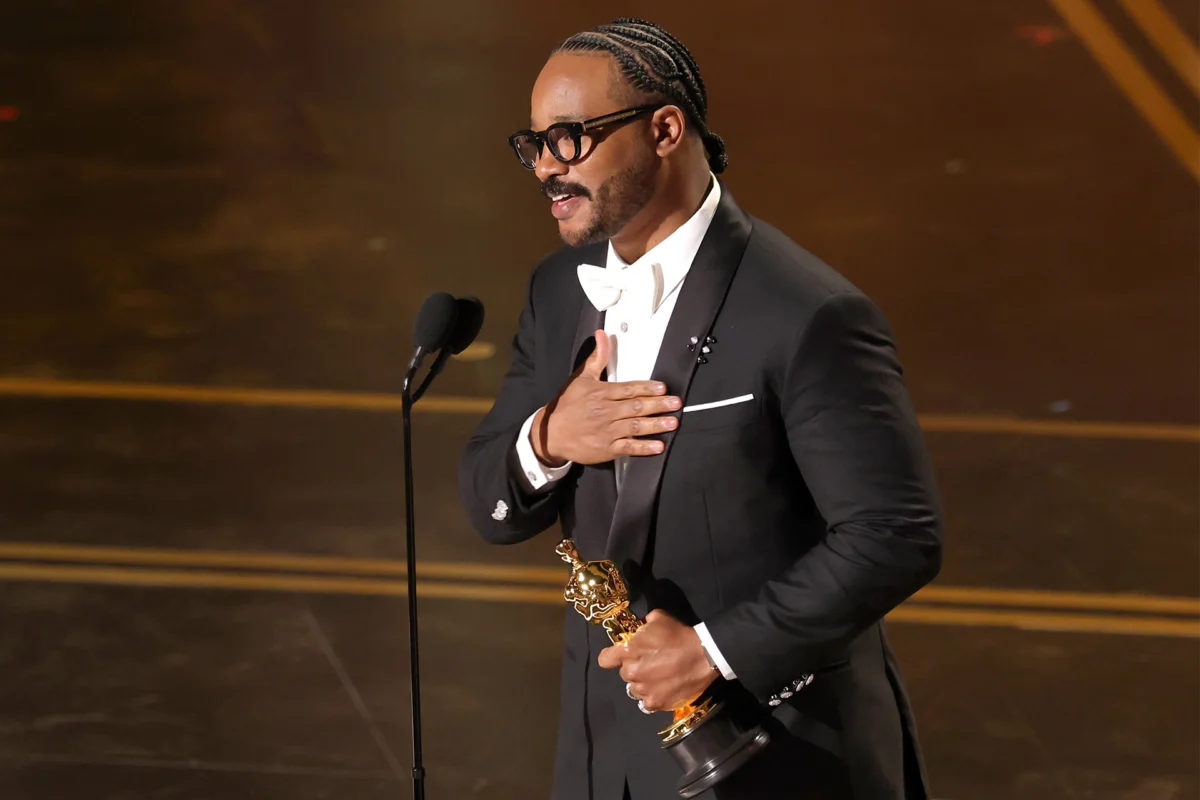
There was a particularly poignant moment when Coogler himself won for Original Screenplay for "Sinners." In a gesture of profound respect and admiration, he asked his cast to stand, allowing him to publicly acknowledge and pay tribute to his collaborators. It was as if Coogler, with a prescient understanding of how the evening might ultimately unfold, seized that singular opportunity to share his admiration and love with the team that had collectively shattered records and pushed boundaries across the Oscar stage. Coogler’s win also made him only the second Black screenwriter to win Original Screenplay, following Jordan Peele’s historic victory for "Get Out" in 2017, further solidifying the growing recognition of Black voices in screenwriting.
The acting races delivered additional firsts and memorable moments, highlighting the Academy’s increasingly global perspective. Jessie Buckley captivated audiences with her nuanced performance in Chloé Zhao’s "Hamnet," earning her the Best Actress Oscar and making her the first Irish winner in that category. Her victory closed out a season where literary adaptations once again proved to be fertile ground for Oscar recognition, demonstrating the enduring power of classic narratives interpreted through a contemporary lens. Notably, this marked the seventh Best Actress-winning performance directed by a woman, and Zhao herself achieved a unique distinction as the first female director to helm two Best Actress winners, having previously guided Frances McDormand to her Oscar for "Nomadland" in 2020. This consistent recognition for performances under female direction underscores a growing appreciation for diverse directorial perspectives.
Like every awards year, the 98th Oscars also produced its share of heartbreaks, reminding us of the fierce competition and subjective nature of artistic evaluation. Earlier in the season, many observers had confidently predicted Timothée Chalamet’s clear path to victory for his electrifying performance in "Marty Supreme." By the time the final ballots were counted, however, the 30-year-old star left the ceremony without a win. His film, "Marty Supreme," also went home empty-handed, including for its four-time nominated creative force, Josh Safdie, who was cited for producing, directing, writing, and editing. This outcome served as a stark reminder that even the strongest early buzz can dissipate in the final stretch of an Oscar campaign.
Awards campaigns, it is often said, are part art and part personality. Oscar watchers, with a hint of humor, frequently joke that the race can sometimes feel like 51% performance and 49% popularity contest, akin to a high school prom king or queen election. This delicate balance, however, doesn’t always apply evenly. Sean Penn, already a two-time Oscar winner for "Mystic River" and "Milk," did not attend the ceremony to accept his third acting Oscar. While his work in "One Battle After Another" drew widespread admiration throughout the industry for its depth and intensity, his win also reignited important discussions about long-overdue recognition for veteran actors such as Delroy Lindo and Stellan Skarsgård, both first-time nominees in their 70s who are still awaiting their inaugural Oscar. Their continued absence from the winner’s circle highlights the Academy’s unpredictable nature and the many esteemed careers that, despite undeniable talent, may never culminate in an Oscar win.
If there was one win that truly captured the unpredictable and delightful spirit of the Academy, it belonged to Amy Madigan. Her supporting actress victory for the horror film "Weapons" instantly entered the pantheon of beloved Oscar surprises, perhaps the most unexpected since Marisa Tomei’s legendary win for "My Cousin Vinny" in 1992. Madigan was the film’s sole nominee, missed a key BAFTA nomination (despite eligibility), and logged the least screen time among the formidable contenders. That she ultimately prevailed speaks volumes about the Academy’s occasional, yet powerful, willingness to embrace pure instinct and a truly impactful performance over established momentum or campaign narratives.
The documentary race offered another late-season twist, reinforcing the night’s theme of unexpected outcomes. "Mr. Nobody Against Putin," a compelling and timely examination of Vladimir Putin’s crackdown on free expression during the Russo-Ukrainian war, won Best Documentary Feature. This was an upset over the widely favored "The Perfect Neighbor," which had been acquired by Netflix out of Sundance and was expected to dominate the major precursor circuit. "Mr. Nobody Against Putin’s" victory underscored the Academy’s occasional lean towards films with profound social and political relevance, even against a perceived frontrunner.
Elsewhere, "KPop Demon Hunters" made its own unique mark on history by securing victories in both Best Animated Feature and Best Original Song. This double triumph helped Netflix tie its personal record of seven Oscars in a single year, matching its impressive 2021 haul that included wins for "Mank" and "Ma Rainey’s Black Bottom." The success of "KPop Demon Hunters" highlighted the increasing global appeal of animation and the platform’s continued commitment to diverse storytelling.
Craft categories also saw a clear winner, with "Frankenstein" picking up three Oscars for Production Design, Costume Design, and Makeup and Hairstyling. The meticulous artistry and immersive world-building of the film were deservedly celebrated. A particularly heartwarming moment, though not broadcast on television, occurred when director Guillermo del Toro, a long-time champion of animation and the creative crafts, stood up to enthusiastically encourage the crowd to applaud the "KPop Demon Hunters" team. This small but telling gesture from the Oscar-winning filmmaker behind "Pinocchio" delivered a powerful reminder of the camaraderie and mutual respect that still defines the industry, transcending competitive categories.
Even the ceremony’s statistics reflected the season’s unpredictable nature. For only the seventh time in Academy history, a category ended in a tie when "The Singers" and "Two People Exchanging Saliva" both won Best Live-Action Short Film. A studio executive, perhaps half-jokingly, quipped to Variety in the lobby, "If you needed any other proof that only 200 people vote in the shorts, there you go." The last Oscar tie occurred in 2013, when "Zero Dark Thirty" and "Skyfall" shared the award for Sound Editing. The most famous tie remains the 1968 Best Actress race, when Katharine Hepburn for "The Lion in Winter" and Barbra Streisand for "Funny Girl" both received the coveted trophy, a moment that continues to be a legendary anecdote in Oscar lore.
Looking back, the 2025–26 awards season, culminating in the 98th Academy Awards, played out much like the Oscars themselves: a little unpredictable, a bit more emotional than expected, and occasionally delightfully contradictory. It was a season that defied easy categorization and rewarded a diverse array of cinematic achievements.
The 2026 Oscars marked a record-breaking night for horror films, with the genre collecting an unprecedented eight Academy Awards. "Sinners" led the way with four wins, celebrating its artistic merit and cultural impact, while "Frankenstein" claimed three craft prizes, showcasing the genre’s capacity for visual and technical excellence. Amy Madigan’s surprising win for "Weapons" solidified horror’s strong showing. This total dramatically surpassed the previous record of five wins, all earned by the iconic "The Silence of the Lambs" in 1991, signaling a significant shift in the Academy’s recognition of horror as a serious and artistically rich genre.
Variety‘s final predictions, a highly anticipated barometer of the race, correctly called 18 of the 24 categories—a respectable 75% success rate. However, the larger, more profound lesson of the season may be simpler and more enduring. For all the meticulously compiled statistics, the exhaustive analysis of precursor awards, and the carefully constructed narratives that shape the race, the Academy still retains a unique way of reminding everyone that the true story isn’t definitively written until that final, golden envelope is opened. The 98th Academy Awards, with its blend of expected triumphs and exhilarating surprises, stands as a testament to the dynamic, ever-evolving nature of cinematic excellence and the enduring power of storytelling.
With the curtain now closed on this memorable season, the industry can finally catch its breath, reflecting on the profound impact of these films and performances, and eagerly anticipating the newer, greater cinematic endeavors that lie ahead on the horizon.