


The cinematic landscape delivered a weekend of stark contrasts, showcasing the volatile nature of audience reception and Hollywood’s evolving strategies. While Pixar celebrated a much-needed triumph with its original animated feature, “Hoppers,” Warner Bros. faced a sobering reality check as Maggie Gyllenhaal’s highly anticipated “The Bride” crumbled under the weight of high expectations and a hefty budget. This weekend wasn’t just about numbers; it was a testament to the unpredictable dance between artistic ambition, audience taste, and the unforgiving economics of the big screen.
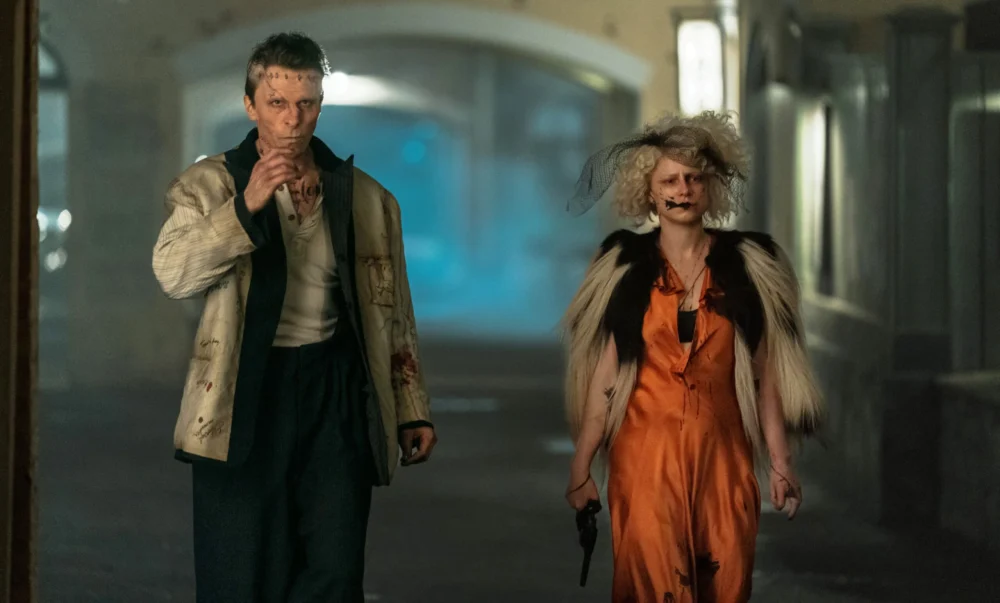
Gyllenhaal’s “The Bride,” a bold feminist reinterpretation of the iconic “Bride of Frankenstein” narrative, arrived in theaters with considerable buzz, fueled by its intriguing premise and the director’s acclaimed previous work. However, its box office debut proved to be a cinematic tragedy, collecting a meager $7.3 million across 3,304 North American venues. This figure drastically missed even the most conservative projections, which had estimated an opening between $10 million and $15 million, with the studio itself optimistically forecasting $16 million to $18 million. The film’s financial woes are particularly alarming given its substantial $90 million production cost—a staggering sum for a horror-adjacent genre film, typically known for delivering high returns on more modest investments. Industry analysts are already bracing for “The Bride” to become one of the year’s most significant financial disappointments, projected to incur losses in the tens of millions.
The original “Bride of Frankenstein,” released in 1935, is a beloved classic, a gothic masterpiece that has transcended its horror roots to become a cultural touchstone. Its enduring themes of creation, rejection, and the search for companionship have inspired countless interpretations. Gyllenhaal’s decision to revisit this narrative through a modern, feminist lens was met with both excitement and trepidation. On one hand, it promised a fresh perspective on a story ripe for contemporary commentary, perhaps exploring themes of female autonomy, societal expectations, and monstrous beauty with greater depth. On the other, it carried the immense pressure of living up to a legendary predecessor while also carving out its own identity. Gyllenhaal, known for her nuanced performances and her critically lauded directorial debut with “The Lost Daughter,” seemed poised to deliver a sophisticated genre piece. Unfortunately, critical reception for “The Bride” landed squarely in the middle, earning a “not great” 59% on Rotten Tomatoes. While not a complete critical drubbing, it lacked the glowing endorsements that might have propelled it forward. More critically, audience sentiment, as measured by CinemaScore exit polls, delivered a damning “C+.” This grade is often considered a death knell for a film’s theatrical longevity, indicating poor word-of-mouth that quickly stifles ticket sales. For a film relying on sustained interest, particularly in a competitive market, a “C+” signals an immediate struggle for survival.
The global picture for “The Bride” offers little comfort, with an international haul of just $6.3 million, bringing its worldwide total to a tragic $13.6 million. This marks a sharp reversal of fortune for Warner Bros., which had been enjoying a remarkable winning streak with recent hits like “Sinners,” “Weapons,” and Emerald Fennell’s “Wuthering Heights.” In a candid note to the press, the studio acknowledged the setback, stating, “In an increasingly ‘risk-averse’ business like ours, we believe the business is better served with studios taking bold swings on originals like this one.” They attempted to contextualize the loss by referencing the legendary 1927 Yankees’ 44 losses, a nod to the inevitability of occasional failures even amidst overall success. While admirable to champion original storytelling, the financial reality of “The Bride” underscores the immense challenge of launching high-budget, adult-oriented genre films without broad critical acclaim or immediate audience adoration. In an era dominated by established franchises and IP, original concepts, even those with a strong creative vision, face an uphill battle to capture and maintain public interest, especially when production costs soar.
In stark contrast to “The Bride’s” struggles, Pixar’s latest original offering, “Hoppers,” leaped into the top spot with a robust $46 million from approximately 4,000 theaters in North America. This charming, kid-friendly “creature feature” added another $42 million from international markets, culminating in a triumphant global debut of $88 million. For Pixar, this success is more than just another box office win; it’s a vital resurgence. The animation powerhouse, renowned for its innovative storytelling and emotional depth, has faced a challenging period marked by several original films struggling to find theatrical traction and others being relegated directly to streaming platforms. Its last unequivocal original hit was 2017’s musical fantasy “Coco,” which opened to $50 million and went on to gross $210 million domestically and an impressive $823 million worldwide. Since “Coco,” while Pixar has continued to produce critically acclaimed work, its original theatrical releases have sometimes struggled to connect with the broad family audience in the same way its sequels or other studios’ adaptations have.
“Hoppers,” directed by Daniel Chong, tells the heartwarming and imaginative story of Mabel, an ardent animal lover whose mind is ingeniously transferred into a lifelike robotic beaver. This extraordinary ability allows her to communicate directly with fellow creatures, embarking on a mission to safeguard their natural habitat from destruction. The film’s narrative, blending themes of empathy, environmentalism, and technological wonder, perfectly aligns with Pixar’s legacy of crafting emotionally resonant stories that appeal to both children and adults. The film’s exceptional performance is underpinned by stellar reviews, boasting a glowing 94% on Rotten Tomatoes, and an enthusiastic audience reception, reflected in a coveted “A” grade on CinemaScore. These strong indicators suggest that “Hoppers” has not only captivated critics but has also resonated deeply with families, paving the way for strong word-of-mouth and sustained box office success. As Alan Bergman, Co-Chairman of Disney Entertainment, remarked, “This is a fantastic original film from the incredible team at Pixar, and it’s wonderful to see audiences coming out with their friends and families to enjoy it together. Congratulations to our director Daniel Chong, our producer Nicole Paradis Grindle, and our talented cast, along with Pete Docter, Jim Morris, and everyone at Pixar, on a tremendous launch.”
The success of “Hoppers” also highlights a broader trend in the family film market. While animated sequels like Pixar’s own “Inside Out 2” (which grossed a staggering $1.69 billion in 2024) and “Zootopia 2” (racking up $1.86 billion since Thanksgiving) continue to dominate, along with adaptations of beloved properties such as Universal’s “The Super Mario Bros. Movie” ($1.3 billion in 2023), “Hoppers” proves that original animated fare can still thrive with the right blend of quality and marketing. This is a crucial distinction, as Pixar’s most recent original attempt, 2025’s “Elio,” fizzled with $154 million globally against a $150 million budget, illustrating the fine line between success and struggle for new concepts. However, the industry remains encouraged by the remarkable staying power of well-received PG films. “Zootopia 2,” for instance, remained among the top 10 on box office charts for an impressive 14 weekends, while Sony’s animal-centric “GOAT” has shown minimal drops since its February opening. David A. Gross, who leads the movie consulting firm Franchise Entertainment Research, emphasized this point: “When Disney and Pixar have a picture that delivers, they set it up for the long run. It gives positive word-of-mouth time to circulate, families and groups have a chance to plan a visit, and kids return for repeat viewing. With spring holidays rolling out over the next few weeks, this should be a good run.” With a production budget of $150 million, “Hoppers” is now well-positioned to not only recoup its costs but also to become a significant financial and critical success story for Pixar, reaffirming the studio’s ability to innovate and capture the hearts of audiences worldwide.
Beyond the dramatic contrast of “The Bride” and “Hoppers,” the box office saw other notable performances. Paramount’s “Scream 7” continued to prove the enduring appeal of the horror genre, even amidst a steep 74% decline in its sophomore outing. Despite this drop, the slasher sequel still managed to secure second place, outperforming “The Bride” with $17.3 million for the weekend. Its domestic tally now stands at $93.3 million, with a global total of $149.4 million. The film is on track to surpass both the original 1996 “Scream” ($173 million) and its 1997 sequel “Scream 2” ($172 million), positioning itself as the highest-grossing installment in the venerable franchise. A significant factor in its success has been the triumphant return of Neve Campbell as the iconic Sidney Prescott, whose absence from the previous entry due to a salary dispute had left many fans disappointed. Her heroic comeback, coupled with the consistent popularity of the horror genre, demonstrates the power of legacy characters and fan loyalty in driving box office numbers.
Meanwhile, other films continued to demonstrate strong “legs” in their theatrical runs. “GOAT” secured the No. 4 spot with $6.6 million in its fourth weekend, pushing its domestic total to $83.8 million and a global haul of $146 million against an $80 million budget. This animal-centric film, much like “Hoppers,” highlights the consistent demand for well-made family entertainment that resonates across different demographics. Rounding out the top five was Emerald Fennell’s literary adaptation, “Wuthering Heights,” which garnered $3.8 million in its fourth frame. The film, from the acclaimed director of “Promising Young Woman” and “Saltburn,” has amassed $78 million in North America and an impressive $134.9 million overseas, resulting in a global tally of $213 million against an $80 million budget. Fennell’s unique stylistic approach to classic literature appears to have struck a chord, demonstrating that prestige adaptations, when executed with a distinct vision, can still draw significant audiences and achieve substantial financial success. These steady performances underscore the diverse tastes of moviegoers and the various paths to success in the complex world of cinematic releases, where original animation, enduring horror franchises, and fresh takes on literary classics can all find their audience amidst the occasional stumble of a high-profile “bold swing.”