

Hollywood has witnessed a seismic shift, marking a profound moment in its storied history with the Academy Award nomination of Autumn Durald Arkapaw for her breathtaking cinematography in “Sinners.” This nomination is not merely an acknowledgment of exceptional artistic talent but a groundbreaking milestone, as Arkapaw becomes the first woman of color ever to be recognized in the highly competitive Best Cinematography category. Her achievement resonates far beyond the accolades, symbolizing a long-overdue crack in the glass ceiling that has historically marginalized diverse voices and visions in the film industry’s most technically demanding and visually influential roles.
The significance of Arkapaw’s nomination cannot be overstated when viewed through the lens of Oscar history. The Best Cinematography category, celebrating the artistry of visual storytelling, has remained stubbornly male-dominated since its inception. For nearly a century, the hallowed halls of the Academy Awards have rarely echoed with the names of female cinematographers. Before Arkapaw, only three women had ever managed to break into this exclusive club: Rachel Morrison, who made history in 2018 for her gritty, evocative work on “Mudbound,” followed by Ari Wegner in 2021 for the atmospheric Western “The Power of the Dog,” and Mandy Walker in 2022 for her vibrant portrayal in “Elvis.” Each of these nominations was a landmark in itself, yet none ultimately culminated in a win, underscoring the deep-seated challenges women face in gaining ultimate recognition in this field. Arkapaw’s inclusion not only adds to this pioneering group but also shatters another barrier, diversifying the representation within this elite quartet.
Autumn Durald Arkapaw brings a unique and rich perspective to her craft, stemming from her Filipino and Creole heritage. This background, often underrepresented in mainstream media and especially behind the camera, informs a visual sensibility that is both distinct and deeply personal. Her nomination is a powerful affirmation that talent knows no gender or race, and that diverse life experiences can enrich the cinematic landscape in invaluable ways. It highlights the growing recognition that the stories told on screen, and the way they are visually captured, benefit immensely from a plurality of perspectives.
The list of her fellow nominees this year stands as a testament to the high caliber of competition in the cinematography field. Arkapaw is nominated alongside a roster of acclaimed talents, including Adolpho Veloso for his work on “Train Dreams,” Michael Bauman for “One Battle After Another,” Dan Laustsen for his haunting visuals in “Frankenstein,” and Darius Khondji for the visually arresting “Marty Supreme.” Each of these cinematographers has pushed the boundaries of visual storytelling, making Arkapaw’s place among them all the more impressive and a clear indication of her immense skill and innovative approach.
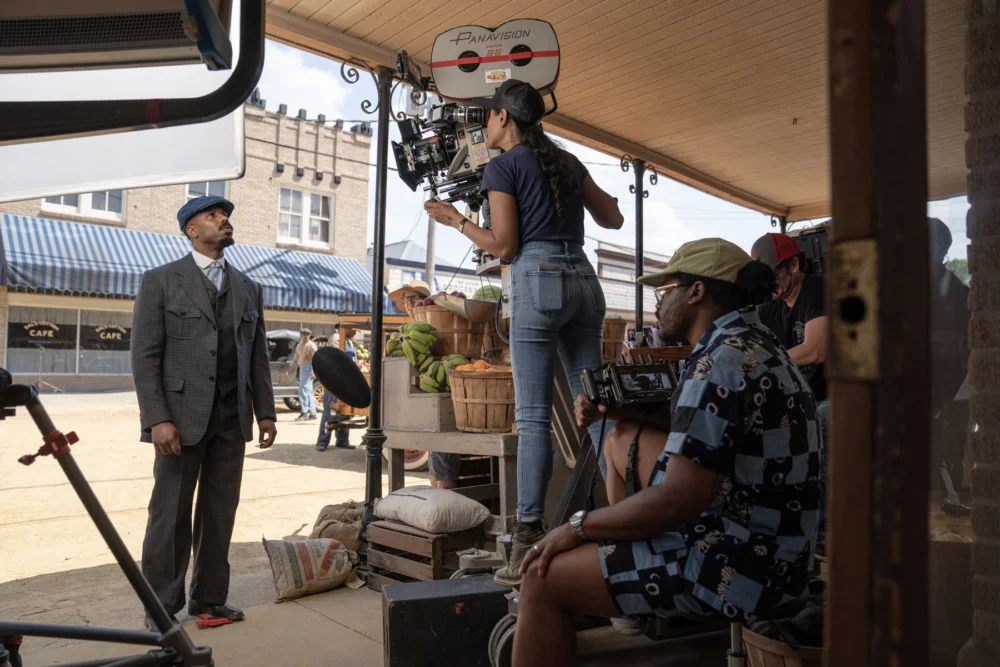
Beyond the cultural and historical significance, Arkapaw’s nomination also recognizes her technical prowess and pioneering spirit. For her work on “Sinners,” she achieved another industry first: becoming the first female cinematographer to shoot extensively with both Imax 65mm and Ultra Panavision formats. These aren’t just technical specifications; they are tools that allow for an expansive, immersive visual experience, demanding a deep understanding of light, scale, and composition. Imax 65mm, known for its unparalleled resolution and immersive quality, creates images that fill massive screens with breathtaking detail, drawing audiences into the very fabric of the film. Ultra Panavision, a vintage anamorphic format, offers a super-wide aspect ratio and distinctive visual characteristics, imbuing films with a classic, epic feel. Arkapaw’s mastery of these demanding formats speaks volumes about her technical expertise and her audacious vision in pushing cinematic boundaries.
Her work on “Sinners” is the culmination of a fruitful and evolving creative partnership with director Ryan Coogler. This marks their second collaboration, following their highly successful endeavor on “Black Panther: Wakanda Forever,” a film celebrated for its vibrant visual language and emotional depth. The synergy between a director and cinematographer is paramount to a film’s visual success, and Arkapaw’s enduring partnership with Coogler exemplifies this symbiotic relationship. As Arkapaw shared in a previous conversation with *Variety*, their collaboration is built on mutual respect and understanding: “We support each other,” she affirmed. “I’ve learned how to read the story through [Ryan’s] eyes, to understand what he needs to tell it and what is important to him.” This quote offers a profound insight into the intimate dance between director and DP, where the cinematographer translates the director’s vision into tangible, evocative imagery, becoming a co-author of the film’s visual narrative.
One of the most widely discussed and visually arresting sequences in “Sinners” is the pivotal “Piercing the Veil” scene, a testament to Arkapaw’s innovative approach and meticulous planning. This sequence is a masterclass in cinematic transformation, illustrating her ability to seamlessly blend grounded reality with surreal, ethereal moments. Arkapaw meticulously explained the intricate layers of this scene’s construction: “At first this sequence is grounded in reality and then turns into a surreal moment in which the camera goes up to the roof and burns away, then comes back down into a wonderful fire exterior shot which transitions into the introduction of three strong characters, and then you’re back into the film.” This description alone hints at the complexity and ambition embedded within her visual strategy.
Delving deeper into the technical execution, Arkapaw revealed the specific tools and techniques employed to achieve this breathtaking effect. The three shots within the juke joint, where much of the initial action unfolds, were “all on Steadicam and shot on 15perf Imax [65mm running horizontally].” The use of Steadicam provided fluid, immersive movement, allowing the audience to feel intimately connected to the characters and the unfolding drama, while the 15-perf Imax 65mm film ensured an unparalleled level of detail and presence. The transition from the interior to the surreal exterior was ingeniously crafted: “And there’s a blend of a VFX takeover that tips up into the roof that’s based off of a burning roof plate that we shot on the last day of principal photography.” This fusion of practical effects, meticulously captured on film, with sophisticated visual effects, allowed for a believable yet fantastical journey upwards, symbolizing a literal “piercing of the veil” between worlds. This upward motion, depicting a burning roof, is not just a visual spectacle but a narrative device, signaling a momentous shift in the film’s reality.
The sequence culminates in a dramatic return to an exterior shot, equally ambitious in its scope. “Then, it transitions into a night exterior shot that’s on a 50-foot techno crane that pulls back in a night exterior where you see them dancing with the effect of a burned mill around them.” The techno crane, a versatile tool for expansive, controlled camera movements, allows for a majestic pull-back, revealing the broader context of the scene and the haunting beauty of a burned-out mill. This environmental detail not only adds to the visual texture but also reinforces the film’s themes of destruction and renewal. As the camera retreats, it subtly reveals three enigmatic figures observing the revelry from a distance: Remmick (Jack O’Connell), Joan (Lola Kirke), and Bert (Peter Dreimanis) – the vampires. This reveal, orchestrated with precision, transforms the scene from a moment of surreal beauty into one charged with suspense and the introduction of powerful new forces, all masterfully guided by Arkapaw’s lens. The “Piercing the Veil” sequence is a testament to her profound understanding of how to weave together technical artistry, narrative progression, and emotional resonance into a cohesive and unforgettable cinematic experience.
The increasing attention garnered by Arkapaw’s exceptional work extends beyond critical acclaim and awards season buzz; it carries a profound social resonance. She openly expresses her gratitude for the opportunity to continue opening doors for greater representation in cinematography and to serve as a beacon of inspiration for aspiring female cinematographers, particularly those from underrepresented backgrounds. This isn’t just about personal achievement; it’s about shifting the paradigm for an entire industry. “It means the world when young girls, or film students of similar heritage, come up to me and express their gratitude, not just for the work, but for the fact that they can see someone like themselves behind the camera,” she shared. This sentiment underscores the transformative power of visibility and representation. For too long, the image of a cinematographer has been predominantly male, often white, perpetuating a narrow perception of who can excel in these highly technical and creative roles. Arkapaw’s presence, her success, and her nomination shatter this antiquated stereotype, offering a tangible example of what is possible when talent is recognized, irrespective of gender or ethnicity.
Her journey highlights the ongoing push for diversity and inclusion across all facets of the film industry. While progress has been made, particularly in front of the camera, the technical and creative roles behind the scenes have often lagged. Cinematography, with its demanding physical and technical requirements, has historically been one of the toughest nuts to crack for women. Perceptions about strength, leadership, and technical aptitude have long served as subtle, and sometimes not-so-subtle, barriers. Arkapaw’s nomination challenges these ingrained biases, proving that vision, skill, and collaborative spirit are the true determinants of success. It sends a powerful message to studios, production companies, and film schools that there is a wealth of untapped talent waiting to contribute to the cinematic landscape, and that actively seeking out and nurturing diverse voices is not just an ethical imperative but a creative advantage.
The ripple effect of Arkapaw’s achievement will undoubtedly be felt for years to come. Her presence on the Oscar nominee list is not just a moment of celebration but a catalyst for change, inspiring a new generation of filmmakers to pursue their dreams, armed with the knowledge that the industry is slowly, but surely, becoming more equitable. It encourages young women and individuals from marginalized communities to see themselves not just as consumers of cinema but as creators, visionaries, and leaders behind the lens. As the film industry continues its evolution, groundbreaking figures like Autumn Durald Arkapaw are instrumental in shaping a future where talent and vision are the only criteria that matter, leading the way towards a truly inclusive and representative cinematic world.