

Melody and Grit: João Nicolau’s ‘Providence and the Guitar’ Strikes a Bold Opening Chord at Rotterdam
Tonight marks a pivotal moment in the cinematic landscape as Portuguese filmmaker João Nicolau’s latest masterpiece, “Providence and the Guitar,” takes center stage as the opening film of the prestigious International Film Festival Rotterdam (IFFR). In an unprecedented move, the film will simultaneously premiere across five different screening rooms in the Dutch city, a testament to the festival’s belief in its singular vision and compelling narrative. For Nicolau, this prominent position is met with a profound sense of “great responsibility,” acknowledging the weight and honor of such an esteemed slot.
The International Film Festival Rotterdam has long cultivated a reputation as a vibrant, forward-thinking platform, celebrated globally for its unwavering commitment to showcasing audacious, independent, and often challenging cinema. Unlike many festivals that might opt for a more commercially safe or widely accessible choice for their grand opening, IFFR consistently champions artistic integrity and experimental storytelling. This ethos perfectly aligns with Nicolau’s “Providence and the Guitar,” a film that defies easy categorization and invites its audience into a rich, layered experience. Ahead of its world premiere, Nicolau shared his genuine excitement with *Variety*, expressing that it is an “immense joy” to be granted such a prestigious platform. He spoke of IFFR’s unique character, a festival known for its willingness to embrace “riskier cinema” and elevate “smaller productions,” making it an ideal home for his latest work.
Nicolau openly acknowledged the unconventional nature of his film as an opening night selection, describing the programming team’s decision as “a very bold, courageous choice.” He elaborated, “it is not necessarily your typical opener. I say this not because of the themes that the film explores, but because of its language. There is a certain demand to it, and we open several doors to the audience and invite them in. I’m very curious about the reaction on the ground.” This candid reflection underscores the film’s distinctive artistic language and its potential to provoke thought and discussion, qualities that IFFR audiences have historically embraced with enthusiasm. The festival’s selection speaks volumes about its confidence in Nicolau’s vision and its commitment to presenting a diverse spectrum of cinematic expression, even if it means challenging conventional expectations.
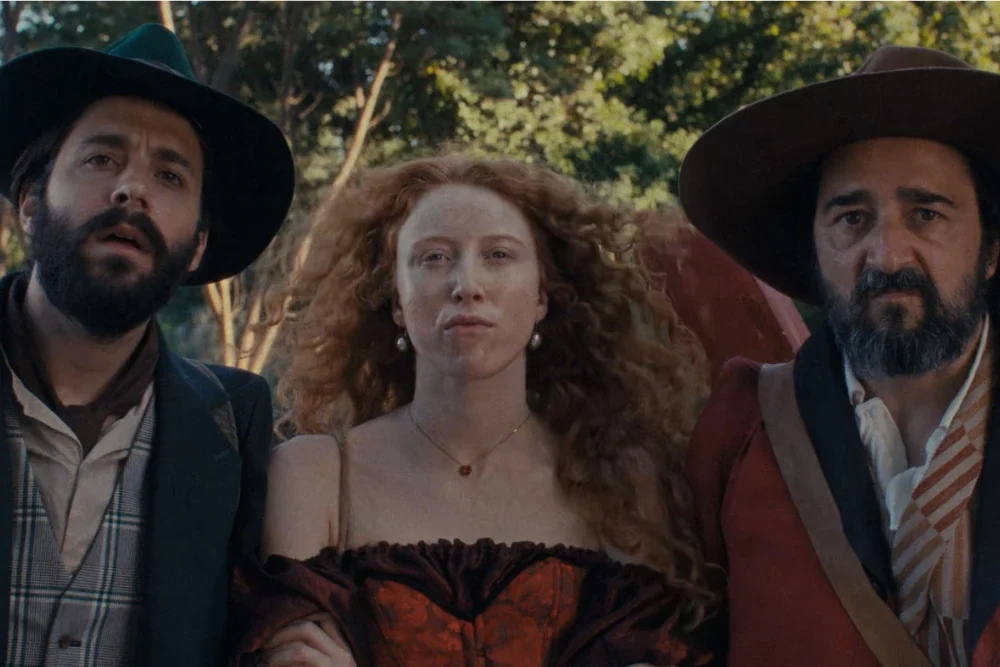
“Providence and the Guitar” is an imaginative adaptation of Robert Louis Stevenson’s eponymous short story, a tale that Nicolau has expanded and reinterpreted with remarkable creative freedom. The film masterfully weaves together two distinct temporal narratives, following the journey of traveling artists Leão, portrayed by the talented Pedro Inês, and Elvira, brought to life by Clara Riedenstein. In the film’s period sequences, set in an evocatively rendered, somewhat indeterminate past, the duo navigates the precarious life of itinerant musicians, constantly dodging the watchful eyes of moody police officers and outmaneuvering artistic rivals as they move from town to town. These segments are imbued with a sense of historical charm and the timeless struggle of artists striving to survive through their craft.
However, Nicolau introduces a compelling contemporary counterpoint to this historical narrative. The film is “peppered with sequences in the present,” where Leão and Elvira reappear as members of a punk rock band. This striking temporal juxtaposition highlights the enduring nature of their artistic and personal struggles, demonstrating that the challenges faced by artists, particularly those committed to an unconventional path, transcend eras. In this modern context, their fight to make a living through their art continues, albeit with a different sound and aesthetic. This clever narrative device not only enriches the characters’ arcs but also provides a powerful commentary on the universal and persistent difficulties inherent in pursuing a creative life, regardless of the historical backdrop.
Nicolau shared that Stevenson’s brief original short story served as “a starting point” rather than a rigid blueprint for his two-hour feature. He explained, “I fell in love with the tone of the narrative and the characters, and I thought it deserved a feature film to translate its richness and the nuances of the language.” This deep appreciation for the source material, coupled with a desire to explore its latent potential, fueled his ambition to expand it into a full-length cinematic experience. Notably, Nicolau’s previous films often featured “drier, more laconic characters,” making “Providence and the Guitar” a deliberate pivot towards a richer, more expressive narrative style. He embraced “the pleasure of exploring language,” allowing the dialogue and character interactions to breathe with a newfound vibrancy and depth, a departure that promises a more emotionally resonant viewing experience.
The director further elaborated on the evolution of the film’s unique time-hopping structure. Initially, he conceived a “camera version” that closely adhered to the short story’s linear framework. However, his creative process led him to develop a “symphonic version,” which daringly incorporated sequences set in the future. These “flashbacks” to the future, as it were, serve to deepen the audience’s understanding of the main couple’s complex relationship, offering glimpses into their ongoing journey and the resilience of their bond. Nicolau found that the core “themes explored in the short story were really current,” making the temporal jumps feel “natural” and necessary to fully articulate the film’s message about the timeless nature of artistic struggle, love, and perseverance.

Music is not merely a backdrop in “Providence and the Guitar”; it is an essential character, a pulsating heart that drives the narrative and defines its protagonists. All of the songs featured in the film are original compositions, born from the creative synergy between Nicolau and his long-time collaborator, João Lobo. The sole exception is a poignant tune that incorporates a poem by the revered Brazilian poet Carlos Drummond de Andrade, adding a layer of literary depth to the musical tapestry. Nicolau, an amateur musician himself, emphasized that music has consistently occupied “a central stage” in all of his cinematic endeavors. For him, music is intrinsically linked to the human experience, an expressive force as fundamental as any other aspect of life. “Music is a key part of human existence,” he stated. “If we film characters eating, working, making love, we can also film characters singing, playing and composing together.” This philosophy imbues the film’s musical elements with authenticity and emotional weight.
The simplicity of the musical arrangements in the film is not a limitation but a deliberate artistic choice, dictated by the narrative’s period setting. As Nicolau explained, the main characters, being itinerant musicians constantly on the road, had access only to an acoustic guitar. This practical constraint meant “there was no space or scope for big musical arrangements,” forcing a creative focus on raw, intimate melodies and harmonies. This minimalist approach enhances the authenticity of the historical sequences, allowing the music to feel organic to the characters’ circumstances and the simplicity of their lives. It foregrounds the purity of their artistic expression, stripping away any elaborate production to reveal the core emotion of the songs.
Further enriching the film’s musical dimension was the opportunity to collaborate with Salvador Sobral, the beloved Portuguese singer and 2017 Eurovision winner. Nicolau expressed his delight in working with his long-time friend, highlighting his interest in “having professional musicians try their hand at cinema in my films.” The casting process with Sobral was a success, leading to an intriguing outcome: “interestingly, he barely sings in the film. But his nature as a musician is present in all of his scenes.” This speaks to Nicolau’s discerning eye for talent, recognizing that an artist’s essence can transcend their primary medium. Sobral’s presence, even in a non-singing role, lends an undeniable authenticity to the portrayal of artists and their intrinsic connection to music, subtly infusing the film with the spirit of a true performer.
Despite the grand stage of IFFR, the journey to bring “Providence and the Guitar” to fruition was not without its significant hurdles. The most formidable challenge, as Nicolau candidly revealed, was the production’s severely limited budget. Efforts to secure co-production deals with prospective partners in Belgium and France ultimately fell through, leaving “Providence and the Guitar” as an entirely Portuguese production. This meant relying solely on the support of the country’s national film body, the ICA, a testament to the resilience and resourcefulness of independent filmmaking. This financial constraint, while daunting, paradoxically became a catalyst for creative innovation.
“This lack of money ended up orienting a lot of my creative choices,” Nicolau remarked, demonstrating how adversity can spark ingenious solutions. Unable to afford lavish production design or the construction of elaborate new sets, the director made a pivotal decision: “I decided to create an indefinite past. Not that this is key to the film itself, as long as we did not have contemporary elements on the screen. The past in the film could be 70 or 200 years ago.” This creative adaptation to financial realities resulted in a timeless aesthetic that serves the narrative well, blurring specific historical markers to focus instead on the universal human experience of its characters. It highlights how constraints, when embraced creatively, can lead to unique artistic expressions, turning what might seem like a disadvantage into a distinctive stylistic signature.
While Nicolau acknowledged that the film “could have been shot in any small European village that was convenient for the co-production,” he expressed profound satisfaction in having made the film in his native Portuguese language. Despite Stevenson’s original text being in English, Nicolau’s deep connection to a Portuguese translation proved foundational. “I always wanted the film to be in Portuguese because, despite the original text being in English, I fell in love with the Portuguese translation. That was my starting point for all the dialogue. There was a pleasure in the language and the sound that was fundamental to me creatively.” This commitment to linguistic authenticity underscores the film’s profound sense of cultural identity and allows the dialogue to resonate with a specific rhythm and musicality that Nicolau found creatively indispensable, adding another layer of artistry to the adaptation.
“Providence and the Guitar” stands as a testament to the power of artistic vision and the resilience required to bring challenging projects to life. Produced by Luís Urbano and Sandro Aguilar for O Som e a Fúria, with Shellac holding international sales rights, the film is poised to captivate audiences at IFFR and beyond. It promises a journey into the heart of artistic struggle, love, and the enduring human spirit, wrapped in a uniquely crafted narrative that defies conventional boundaries and invites profound reflection.