


**Gregg Araki Unleashes a Provocative, Pop-Art Exploration of Desire and Dominance in “I Want Your Sex”**
Forget the staid power suits and conventional boardrooms. When an aggressively contemporary artist strides into her studio, the dress code is less about corporate conformity and more about audacious self-expression. Think transparent fabrics, vertiginous stiletto heels, and an undeniable aura of unapologetic dominance. Such is the electrifying world of Gregg Araki’s latest cinematic offering, “I Want Your Sex,” a film that plunges audiences into a vibrant, BDSM-tinged workplace comedy where the boundaries of desire and control are gleefully shattered.
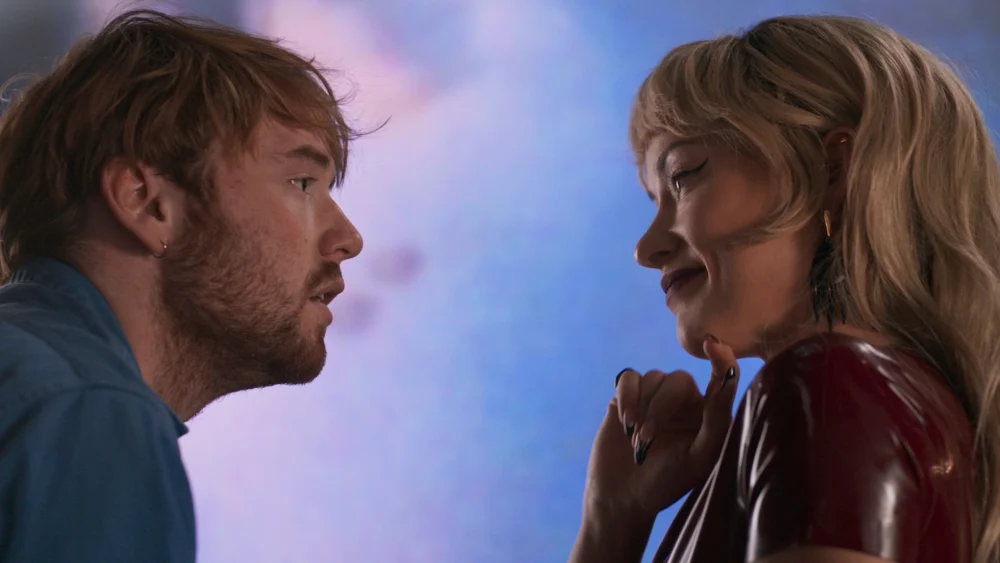
Premiering to buzz at Sundance, the film introduces us to Erika Tracy, portrayed with magnetic intensity by Olivia Wilde. Tracy is a force of nature, a movie boss whose commanding presence and unyielding demands haven’t been seen with such overt sexual undertones since James Spader’s memorable turn in “Secretary,” the last truly BDSM-themed workplace comedy to captivate the festival circuit. Wilde’s Erika is a formidable figure, a modern-day siren who wields power not just with her intellect, but with an aesthetic of pure, unadulterated female authority. Opposite her, Cooper Hoffman plays Elliot, her all-too-eager subordinate, a young man seemingly thrilled to relinquish control to such an enthralling superior. Araki, ever the provocateur, crafts a narrative that is utterly liberated in its depiction of sex and nudity, yet, paradoxically, maintains a somewhat classic framework for the interpersonal dynamics unfolding between its lusty protagonists.
While the overt sexuality and transgressive themes might initially suggest a radical departure, “I Want Your Sex” harbors surprising common ground with the screwball comedies of Hollywood’s golden age. Echoes of classic romantic skirmishes, reminiscent of the witty banter and power plays in films like “The Shop Around the Corner” or the rapid-fire dialogue of “His Girl Friday,” can be discerned beneath the film’s glossy, neon-hued surface. Of course, Araki is fully aware that his target demographic, steeped in contemporary culture, might not immediately draw these connections. For the pioneering queer indie filmmaker, whose recent work, “Now Apocalypse,” also sought to recontextualize familiar tropes for a new generation, this unconventional rom-com represents a logical, albeit audacious, evolution of his long-standing sex-positive sensibility. Even as he steers his narrative into novel, often startling, territory, Araki’s signature blend of irreverence and genuine curiosity about human sexuality shines through.
Araki’s filmography has always been characterized by its fearless embrace of the avant-garde, often imbued with a raw, punk rock energy. “I Want Your Sex,” while arguably less overtly “punk” than some of his earlier, more confrontational works, still retains an edge sharper than nearly anything else currently in circulation. It represents a sincere, almost anthropological, attempt by Araki to bridge the generational divide and connect with younger audiences, whose relationship to sex and intimacy presents a fascinating contrast to his own. As a self-proclaimed “child of the Swinging ’60s,” Araki came of age in an era of burgeoning sexual liberation. The contemporary audience for “I Want Your Sex,” however, has grown up in a landscape saturated with digital pornography, often leading to a paradoxical combination of overexposure and profound insecurity about genuine intimacy. This generation, while perhaps more circumspect and considerate when it comes to explicit discussions of consent, frequently struggles with the nuances of real-world connection. It is precisely this contemporary context that makes Hoffman’s Elliot so compelling; he beams with a palpable relief at finding himself entirely at Erika’s service, declaring, “When she’s in charge, I don’t have to make any decisions.” This eager relinquishing of control speaks volumes about a generation often overwhelmed by choice and the anxieties of self-determination. Yet, as Araki subtly suggests, even the most intoxicating freedom can, at times, become overwhelming.
The film wastes no time in establishing its darkly comedic tone. The opening sequence plunges us directly into a moment of surreal chaos: Elliot stumbles out of Erika’s opulent mansion, disoriented and clad in a blood-splattered pink bra and panties, only to make a horrifying discovery – his boss, Erika, floating lifelessly face down in the swimming pool. The scene immediately cuts to the sterile confines of a police interrogation room, where the unflappable Margaret Cho and the deadpan Johnny Knoxville, playing detectives, grill a bewildered Elliot about the preceding events. A fluorescent pink caption, boldly emblazoned with “9 1/2 weeks earlier,” winks knowingly at Adrian Lyne’s iconic ’80s cine-kink classic, setting the stage for a flashback that promises both eroticism and intrigue. Araki’s judicious use of ultra-saturated color schemes, a visual signature he shares with cinematic masters like Pedro Almodóvar, immediately immerses the audience in a heightened, almost hyperreal world where every shade pulsates with meaning.
Erotic cinema, by its very nature, often flirts with an element of danger, a tension that electrifies the narrative. “I Want Your Sex” embraces this premise from its provocative opening, placing Elliot under immediate suspicion for Erika’s demise. However, Araki, ever the master of tonal shifts, cannot resist leaning into the inherent comedy of the situation – and why should he? For Araki, sex, even when it involves the complexities of degradation and pain play (think pig masks, ball gags, handcuffs, and the sharp sting of stiletto heels), should ultimately be a source of joy and liberation. He steadfastly believes it’s far more engaging and human to invite the audience to laugh alongside the participants, to revel in the absurdity and pleasure, rather than descending into the grim, dark rabbit holes explored by directors like David Cronenberg or the Wachowskis with their more austere, often menacing, portrayals of leather and latex. Araki’s approach is distinctly celebratory, viewing the exploration of sexual boundaries as a playful, rather than purely perilous, endeavor.
Araki’s films are renowned for their vibrant, candy-colored palettes, and “I Want Your Sex” is a dazzling exemplar, particularly within Erika’s art studio, where Elliot is employed as one of her assistants. This space is a riot of hyper-stylized excess, a playground for the creation of what Erika proudly, and ironically, terms “meaningful art.” Here, the assistants are the grunts, tasked with painting oversized papier-mâché phalluses and, more curiously, chewing gum all day, meticulously sticking the bright pink wads onto a massive, labia-shaped canvas. It’s in this environment that Erika, with a cynical glint in her eye, delivers one of the film’s most incisive lines: “Contemporary art is a scam. The real art is convincing people you’re making something meaningful.” This pronouncement serves as a sharp, meta-commentary, allowing Araki to subtly critique elements within his own queer art world, perhaps even taking a sly jab at fellow queer directors like Bruce La Bruce, who, despite often divisive critical reception, consistently manage to secure prestigious international film festival invitations for their work.
In stark contrast to the often insular world of art-house darlings, Araki firmly plants himself within the “John Waters school of outsider filmmaking.” Like Waters, he delights in poking fun at uptight mainstream culture, whether through the hazy, philosophical musings of a stoner comedy like “Smiley Face” or the raw, nihilistic cri de coeur of “The Doom Generation.” Araki operates outside the conventional strictures of filmmaking, often disregarding “square notions” such as polished, naturalistic acting in favor of performances that serve his heightened reality. Olivia Wilde’s portrayal of Erika Tracy is a masterclass in pure-camp performance, a gleeful attempt to outdo the imperious workplace attitude of Meryl Streep’s Miranda Priestly. With her razor-sharp cover-girl eyeliner and droll, perfectly timed line deliveries, Wilde crafts a character who is more ferocious than any cougar. She expertly lures Elliot into the intricate, seductive web of her office, initially threatening him with an HR report before, with a predatory glint, propositioning him for sex. Her terms are clear: no strings attached. Elliot, in his wide-eyed naivete, is initially oblivious to the full extent of her intentions, failing to grasp that she intends to have him whipped, both figuratively and, quite literally, in every sense of the word.
Elliot isn’t entirely unattached when he enters Erika’s orbit; he has a girlfriend, portrayed by the pop sensation Charli XCX. However, she’s depicted as largely distracted by the demands of grad school, leaving Elliot’s sexual needs unfulfilled. This void becomes the catalyst for his burgeoning curiosity and eventual entanglement with Erika. As he navigates this uncharted territory, Elliot frequently turns to his friends for counsel, creating a vibrant support network that mirrors the diverse sexual landscape Araki often portrays. There’s Chase Sui Wonders as his roommate, who lives vicariously through Elliot’s increasingly wild exploits, offering a mix of awe and vicarious thrill. Then there’s Mason Gooding as his insatiably gay co-worker, whose candid advice and open sexuality provide a refreshing counterpoint to Elliot’s initial inhibitions. The script, co-written by Araki and his “Now Apocalypse” collaborator Karley Sciortino, doesn’t labor to explicitly explain how this vixen-like artist so precisely divined her employee’s deepest, most hidden fantasies. However, given Araki’s consistent portrayal of sexually fluid characters across his oeuvre, Elliot’s rapid and profound sexual awakening feels less like a narrative stretch and more like an authentic unfolding within Araki’s expansive, queer-positive universe.
In Cooper Hoffman’s hands, Elliot emerges as a captivating blend of influences, bearing a striking resemblance to his late father, Philip Seymour Hoffman, while also possessing the roguishly handsome charm often associated with the Kennedy clan. His portrayal is a less confident, perhaps more innocent, iteration of his “Licorice Pizza” character, yet he retains an abundance of enthusiasm. This eagerness is evident as he embraces his new role, readily crawling on all fours at Erika’s command or enthusiastically exploring new avenues of pleasure, including a sex toy in the backdoor – the look on Elliot’s face after Erika’s initial penetration speaks volumes about his profound and surprising delight. Tellingly, when Elliot allows his mind to wander and fantasize about Erika independently of their BDSM dynamic, his desires shift towards more conventional aspirations: he envisions marriage and the comforting prospect of starting a family. This subtle juxtaposition highlights the film’s nuanced exploration of desire, suggesting that even amidst the most transgressive sexual explorations, traditional longings can coexist.
The undeniable commitment and chemistry between Hoffman and Wilde lend “I Want Your Sex” a weight and significance that transcends its often irreverent subject matter. Ultimately, it’s best approached as either pure, unadulterated escapism or a delightful, guiltless pleasure. The film doesn’t aim to deliver a profound social message or offer groundbreaking perceptive insights into contemporary society. Instead, Araki’s primary objective, and arguably his greatest achievement, is to give a generation often characterized by its sexual repression enthusiastic permission to test their own boundaries, to explore their desires without shame or judgment. Once the initial shock of the film’s audacious premise subsides, the plot might occasionally fray at the edges, but this hardly diminishes its impact. Araki successfully achieves his main goal: to encourage a generation to loosen up about sex, to embrace its complexities and joys, by fearlessly pushing the boundaries between the profound and the profane. In doing so, he delivers a uniquely Araki-esque happy ending, one where liberation and laughter reign supreme.