




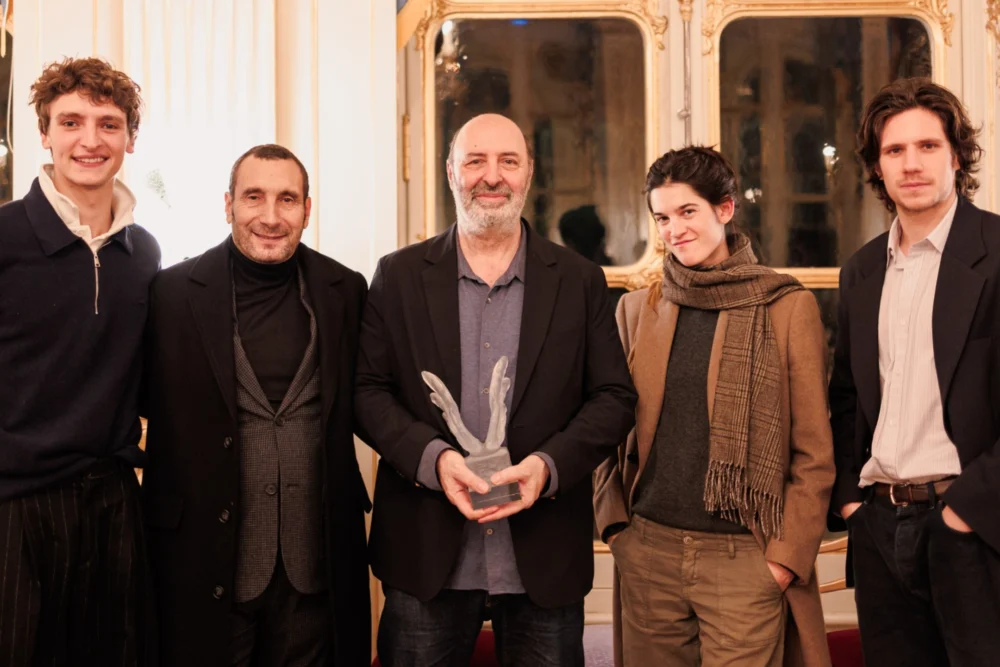
In a ceremony imbued with warmth and a familial spirit, acclaimed director Cédric Klapisch was bestowed with this year’s French Cinema Award. The prestigious event, held on January 15th at France’s venerable Ministry of Culture, saw Klapisch celebrated not just as a filmmaker, but as a cultural architect whose work consistently transcends geographical boundaries, weaving intricate tapestries of human experience across the globe.
Flanked by the bedrock of his creative journey, longtime screenwriter Santiago Amigorena and his iconic actor Zinedine Soualem – collaborators whose partnership with Klapisch spans over three decades – the director received the honor amidst the cast of his latest feature, “Colors of Time.” This gathering of his trusted artistic family underscored a career built on enduring relationships and a shared vision, a testament to the collaborative heart of French cinema. The award itself, initiated by Unifrance in 2016, specifically recognizes a figure whose artistry has been instrumental in elevating Gallic cinema onto the world stage. Past recipients form a distinguished pantheon, including luminaries like Isabelle Huppert, Juliette Binoche, Virginie Efira, and fellow visionary filmmakers Olivier Assayas, Rebecca Zlotowski, and Olivier Nakache and Éric Toledano. Klapisch, however, embodies the spirit of this accolade in a uniquely profound way; his contribution extends far beyond mere promotion. His filmography is intrinsically defined by movement, cross-cultural dialogue, and global exchange, making him a true ambassador for a cinema that speaks to universal truths.
This defining characteristic is perhaps best crystallized in his critically acclaimed and commercially adored “Spanish Apartment” series. More than just a collection of films, this saga — comprising three feature films and an Amazon series — chronicles the evolving lives of an extended clan as they navigate diverse cultures and continents. From the vibrant streets of Barcelona to the bustling metropolises of London and New York, and beyond, Klapisch’s characters grapple with identity, friendship, love, and the exhilarating disorientation of foreign lands. The series resonated deeply with audiences worldwide, particularly young women who saw their own journeys of self-discovery, career aspirations, and complex relationships mirrored in the protagonists. It’s a testament to Klapisch’s keen observational eye and his ability to craft narratives that are both distinctly French in their sensibility and universally understood in their emotional depth, making him a pivotal figure in shaping contemporary European cinematic identity.
During his acceptance speech, Klapisch eloquently articulated the profound role of travel in his artistic process, identifying it as a central and indispensable catalyst for his creative output. He recalled how a promotional tour for 2002’s “Pot Luck” – the seminal first installment in the “Spanish Apartment” series – directly sowed the seeds for its equally successful follow-up, “Russian Dolls.” This anecdote perfectly encapsulated his belief that physical journeys are not just backdrops for stories, but potent sources of inspiration that birth new narratives and perspectives. “Some journeys give birth to new films,” he stated, his voice resonating with conviction. “Travel is a fundamental part of my cinema. That’s the reason I made ‘Pot Luck’ – and why I’m standing here today.” His words underscored a philosophy where exploration, cultural immersion, and the unexpected encounters of the road are not merely plot devices, but the very essence of his storytelling, inviting audiences to embark on their own metaphorical voyages of discovery.
Klapisch’s personal journey mirrors this global perspective. Though raised in the heart of Paris, his adult life began across the Atlantic, where he pursued and earned his Master of Fine Arts at New York University’s prestigious Tisch School of the Arts. This formative experience, he emphasized, left an indelible mark on his worldview and cinematic sensibilities. It was in New York that he first immersed himself in a melting pot of cultures, honing his craft while absorbing diverse influences that would later define his signature style. This early exposure to American filmmaking and the dynamism of a global city undoubtedly equipped him with the unique lens through which he would later explore themes of international connection and cultural fluidity in his own work.

Reflecting on the evolving landscape of cultural exchange, Klapisch pondered aloud whether the magnetic pull that once drew young French aspirants like himself to the United States still holds the same sway. “I began my adult life in the U.S., and today I honestly wonder whether young French people still feel the same pull to go there,” he mused, acknowledging a palpable shift. “It’s less obvious now.” He then pointed to a fascinating reversal in this transatlantic flow: a noticeable increase in major American actors and directors choosing to work in France. “That simply didn’t exist before. There’s been a reversal. Movement no longer flows in the same direction.” This observation speaks volumes about the growing international appeal and creative vitality of the French film industry, signaling a new era of cross-cultural collaboration where artistic inspiration and opportunities are increasingly bidirectional, challenging long-held assumptions about global cinematic hierarchies.
Beyond the ebb and flow of international talent, Klapisch also turned his focus to the broader, often challenging, ecosystem of the film business, characterizing it as “a strange, pivotal moment.” He acknowledged the constant discourse surrounding box office figures, audience admissions, and international circulation – pressures that are, he noted, “even more pronounced abroad.” In an era dominated by streaming giants and global blockbusters, the financial metrics often overshadow the artistic merit. Yet, amid this commercial din, Klapisch highlighted France’s singular position. “But France is truly unique because of its system, and the CNC in particular,” he asserted passionately. The Centre National du Cinéma et de l’Image Animée (CNC) is a governmental agency responsible for safeguarding and promoting French cinema and audiovisual arts through various funding mechanisms and regulatory frameworks. It is a cornerstone of France’s cultural exception policy, which champions the protection and promotion of diverse cultural expressions.
Klapisch’s unwavering advocacy for this institution resonated deeply. “I will always defend the CNC. It must continue to exist. It supports cinematic creation,” he declared, his words underscoring the vital role the CNC plays in fostering an environment where artistic risks can be taken and unique voices can flourish, often outside the immediate pressures of commercial viability. For women filmmakers and storytellers, in particular, the CNC’s robust support system has historically provided crucial funding and opportunities, enabling a wider range of narratives to reach screens, narratives that might otherwise struggle for funding in purely market-driven systems. “I’ve often said the CNC is a protected space where creation can happen, and I believe deeply in that model.” His statement serves as a powerful reminder of the importance of national cultural policies in preserving artistic diversity and ensuring that cinema remains a vibrant reflection of human experience, rather than solely a commercial commodity.
Fittingly, CNC president Gaëtan Bruel was present to hear Klapisch’s heartfelt commendation, symbolizing the unified front of French cultural leadership. Bruel joined an esteemed roster of dignitaries, including French Culture Minister Rachida Dati, Unifrance president Gilles Pélisson, and executive director Daniela Elstner, all gathered to salute Klapisch at this year’s Unifrance Rendez-Vous in Paris. This annual event serves as a crucial platform for promoting French cinema internationally, and the choice to honor Klapisch during this gathering further amplified the message of France’s commitment to global cinematic outreach.
Cédric Klapisch’s receipt of the French Cinema Award is more than just recognition of individual achievement; it is a celebration of a distinctive artistic vision that champions human connection across borders, nurtures collaborative genius, and fiercely defends the unique cultural infrastructure that allows French cinema to thrive. Through his films, particularly the enduring “Spanish Apartment” series, Klapisch has not only entertained but also enlightened, fostering a deeper understanding of our interconnected world. His legacy is one of a cinematic maestro who has skillfully bridged divides, showing us that while journeys may begin in different places, the stories we share ultimately unite us all, enriching the global cultural tapestry with every frame.