



The Unraveling of Truth: How Netflix’s ‘His & Hers’ Redefines the Psychological Thriller with Unbridled Female Fury
Netflix’s latest limited series, “His & Hers,” emerges as a masterclass in psychological suspense, deftly weaving a narrative so intricate and unsettling that it transcends the typical boundaries of the mystery thriller genre. Based on Alice Feeney’s acclaimed novel and brought to the screen by adapter William Oldroyd, this series initially presents itself as a familiar labyrinth of death, clandestine operations, and veiled truths. Yet, from its very first moments, it subtly signals its intent to shatter expectations, compelling viewers to question every assumption and ultimately shifting the very foundation of what they believed to be true. At its core, “His & Hers” is a deeply unsettling exploration of the human psyche, particularly the raw, unadulterated power of a woman scorned and the lengths to which one will go to reclaim what was lost, or perhaps, to exact a long-overdue retribution.
Leading this emotionally charged narrative is Anna, portrayed with captivating intensity by Tessa Thompson. Anna is introduced as a once-prominent Atlanta news anchor, now relegated to the sidelines, her career in tatters following an undisclosed but clearly devastating personal crisis. Her world is a disarray of professional stagnation and personal chaos, symbolized by her luxurious but neglected apartment, a physical manifestation of her internal turmoil. The series finds Anna at a pivotal juncture, desperately seeking to resurrect her career and identity, a quest that unexpectedly intertwines with a shocking murder investigation. Thompson’s portrayal is a fascinating study in resilience and vulnerability, as Anna navigates the treacherous waters of ambition and self-preservation, often blurring the lines between journalistic integrity and personal agenda. Her journey to reclaim her desk, once a symbol of her professional success, becomes a much deeper quest for self-reclamation.
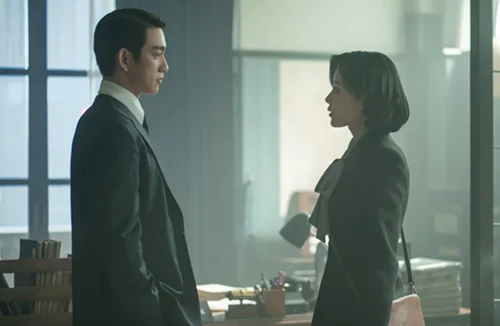
Opposing and yet inextricably linked to Anna’s path is Jack, a volatile and deeply conflicted detective brought to life by the formidable Jon Bernthal. As the lead investigator on the murder case that Anna seeks to cover, Jack quickly develops a potent suspicion that Anna’s involvement extends far beyond the professional. His erratic behavior and intense gaze suggest a man grappling with his own demons, making him a compelling, if unreliable, figure of authority. The dynamic between Anna and Jack is charged with an unspoken tension, a psychological dance of cat and mouse where the roles of hunter and hunted frequently interchange. Bernthal’s performance injects a raw, unpredictable energy into the series, painting a portrait of a detective whose professional competence is constantly shadowed by personal turmoil, prompting questions about his own motives and judgment.
“His & Hers” is a meticulously crafted tale that delves into the intricate facets of revenge, the often-misunderstood and societal-suppressed phenomenon of women’s rage, and the corrosive nature of deceit. The series isn’t merely a whodunit; it’s a profound psychological immersion that seeps into the viewer’s consciousness, challenging preconceived notions about justice, guilt, and the complex tapestry of human motivation. The narrative’s strength lies in its ability to constantly pull the rug out from under the audience, forcing a re-evaluation of every character and event, and ultimately revealing a story far more insidious and deeply personal than initially perceived.
True to the genre’s conventions, the series opens with a scene of tragic discovery, setting a dark and foreboding tone. Nestled within the rural, rain-swept woods surrounding Dahlonega, Georgia, the lifeless body of Rachel (Jamie Tisdale) is found tragically sprawled across the hood of a cherry red sports car. The relentless downpour, a visual metaphor for the cleansing of truth, meticulously washes away much of the crucial forensic evidence, immediately establishing the challenging nature of the investigation. This stark image of death is juxtaposed with Anna’s own personal crisis, as she stumbles into her opulent Atlanta apartment, drenched not only by the rain but by the visible tears of profound despair. Her living space, a once pristine symbol of her success, now lies in utter disarray — a wasteland of scattered papers, discarded takeout containers, and half-empty alcohol bottles, eloquent testimony to a year spent in self-imposed exile and wallowing.
The catalyst for Anna’s re-emergence from this abyss of self-pity arrives in the form of a jarring visual: a colossal billboard prominently featuring Lexy Jones (Rebecca Rittenhouse), the very anchor who usurped Anna’s position. This public display of her rival’s success acts as a potent, infuriating reminder of what Anna has lost, igniting a spark of indignation and resolve within her. It’s a clear turning point; her year-long professional hiatus, marked by self-indulgence and professional stagnation, is unequivocally over. The sight of Lexy’s triumphant image, smiling down from the billboard, fuels Anna’s determination to reclaim her rightful place, not just professionally but personally. This moment underscores a deeper societal pressure on women in competitive fields, where losing one’s footing can feel like an insurmountable defeat, making Anna’s comeback not just about a job, but about reclaiming her identity and agency.
Meanwhile, in the sleepy, close-knit community of Dahlonega, Detective Jack receives an urgent call from his partner, Priya (Sunita Mani), informing him of Rachel’s gruesome discovery. Despite Jack’s attempts to contain the information, the grim news, like a wildfire, rapidly sweeps through the small town. The insular nature of Dahlonega means secrets are hard to keep, and rumors spread quickly, setting a challenging backdrop for a sensitive murder investigation. This small-town dynamic, a stark contrast to the anonymity of Atlanta, adds another layer of complexity to the unfolding drama, where personal connections and hidden histories are often intertwined with public knowledge.
Anna, driven by her renewed ambition, skillfully maneuvers her way back into the professional arena. She successfully persuades her network boss to allow her to cover the Dahlonega murder case as a field reporter. This assignment is not merely a job; it’s a meticulously calculated gambit to salvage her career and win back the trust and viewership she once commanded. Accompanied by her seasoned cameraman, Richard (Pablo Schreiber), who, in a twist of fate, also happens to be Lexy Jones’ husband, Anna embarks on a journey back to her hometown. The layers of personal connection, professional rivalry, and hidden agendas surrounding her return immediately suggest that this will be no ordinary journalistic endeavor, hinting at the deeper, more personal stakes involved. The subtle tension between Anna and Richard, given his marital ties to her rival, further complicates their professional dynamic, injecting an additional undercurrent of suspicion and unspoken competition into their working relationship.
However, the investigation into Rachel’s death proves to be anything but straightforward, both for Anna and for Jack. Anna, still reeling from a devastating personal loss that precipitated her year-long retreat into reclusivity, exhibits increasingly peculiar behavior. Her uncanny appearances in various, often incongruous, locations across Dahlonega raise serious questions about her true intentions and her connection to the unfolding events. Her seemingly innocent journalistic pursuit becomes shadowed by an aura of suspicion, making her a figure of both professional ambition and profound personal mystery.
Concurrently, Detective Jack, while outwardly appearing to be a competent investigator, begins to display an unsettling degree of erraticism. His choices and methodologies start to alarm Priya, his partner, who, with each new revelation regarding Rachel’s demise, finds herself eyeing him with growing suspicion. The dynamic between Jack and Priya evolves from a standard professional partnership into one fraught with tension and distrust, as Priya’s sharp instincts suggest that Jack’s erratic actions might be more than just professional eccentricity. Both protagonists, despite their seemingly clear objectives, are clouded by personal demons and suspicious actions, making the pursuit of truth a labyrinthine journey for the audience as much as for the characters.
At its very core, “His & Hers” masterfully integrates all the delectable elements characteristic of a stellar psychological thriller. The performances delivered by Tessa Thompson and Jon Bernthal are nothing short of formidable, each bringing a nuanced intensity to their complex roles that grounds the series in raw, human emotion. Their on-screen chemistry, a simmering tension of distrust and unspoken understanding, is a crucial engine driving the narrative forward. The series is replete with enough intricate twists and unexpected turns to keep even the most seasoned and eagle-eyed viewer perpetually on the edge of their seat, constantly second-guessing every character’s motive and every unfolding event.
The pacing of “His & Hers” is exceptional, moving with a brisk yet deliberate momentum that ensures every scene is impactful and every revelation lands with precision. Spanning just six “zippy” episodes, the show is remarkably efficient, each installment densely packed with crucial details that meticulously connect Anna’s deeply troubled past to her tumultuous present. This lean narrative structure ensures there is no wasted moment, allowing the story to unfold with maximum impact and maintain an unrelenting grip on the audience. Yet, despite its adherence to many thriller conventions, the true genius of “His & Hers” lies in its audacious subversion of expectations. As the reviewer aptly notes, “Still, this is not the show you think it is, and that’s why it’s masterful.” This statement perfectly encapsulates the series’ ability to transcend its genre, delivering a narrative that is both familiar and startlingly original, constantly challenging the audience’s assumptions about good and evil, victim and perpetrator.
Beyond the captivating layers of murder and mayhem, “His & Hers” delves into profound existential questions, positioning itself as a poignant exploration of the anguish inherent in the human condition. It meticulously examines the indelible scars left by incidents we desperately wish to erase from our memories, the convoluted and often futile attempts we make to absolve ourselves after causing harm to others, and, most powerfully, the devastating and transformative potential of anger. The series particularly focuses on anger that is not merely fleeting but carefully cultivated, intentionally nurtured, and deliberately wielded as a potent force. In a society that frequently pressures individuals to “move on” and “get over” horrible experiences, “His & Hers” courageously posits that not everyone chooses this path of conventional healing. Instead, it suggests that for some, fury can become an incredibly powerful, albeit dangerous, motivator – a force that can drive individuals to extraordinary and often shocking lengths, reshaping their entire existence around the pursuit of a deeply personal form of justice or revenge. This exploration of cultivated rage, especially from a female perspective, challenges traditional narratives and societal expectations, making the series particularly resonant for a women-focused audience.
In an era saturated with limited series, particularly as streaming platforms aggressively vie for A-list talent unwilling to commit to multi-season shows, “His & Hers” distinguishes itself as one of the most uniquely unsettling and audacious programs to grace television screens. It culminates in a jaw-dropping, intricately layered ending that is guaranteed to leave viewers utterly gobsmacked. The raw, visceral impact of the series’ conclusion is so profound that, as one critic vividly describes, it elicits a continuous, incredulous “WHAT?!!” as the final credits roll, a testament to its shocking efficacy.
The astounding nature of the series’ finale stems from its profound ability to tap into and expose our deeply ingrained societal biases. It masterfully illustrates how we, as a society, frequently overlook, underestimate, and often dismiss those we perceive as “worthless” or insignificant. This pervasive tendency, the series chillingly demonstrates, can lead to our own profound peril. “His & Hers” serves as a stark, cautionary tale, suggesting that the true dangers often lie not in the obvious threats, but in the unseen, the ignored, and the quiet fury simmering beneath the surface of those we have collectively deemed inconsequential. This thematic depth, coupled with its thrilling execution, cements “His & Hers” as a must-watch, thought-provoking addition to the psychological thriller canon, especially for those interested in narratives that subvert expectations and champion the often-unseen power of the underestimated.
“His & Hers” is now streaming exclusively on Netflix, inviting viewers to embark on this unforgettable and deeply unsettling journey.