


In a seismic political upheaval that reverberated across the European continent and beyond, Hungarian voters decisively ousted Prime Minister Viktor Orbán on Sunday, bringing an end to his sixteen-year grip on power. The electorate, in a stunning repudiation of the nationalist, authoritarian policies and the global far-right movement he championed, embraced a pro-European challenger in a result with profound implications for Hungary’s future and its standing on the international stage. The outcome marks a significant turning point, signaling a potential recalibration of Hungary’s alignment with both the European Union and NATO, alliances that had been increasingly strained under Orbán’s increasingly isolationist and Russia-friendly tenure.
The victor, Péter Magyar, a charismatic former insider within Orbán’s own Fidesz party, campaigned on a platform that prioritized combating corruption and addressing the everyday concerns of Hungarian citizens, focusing on vital areas such as healthcare and public transportation. Magyar has unequivocally pledged to mend Hungary’s fractured relationships with the European Union and NATO, asserting his commitment to reintegrating the nation into the broader Western democratic framework. European leaders were quick to extend their congratulations, signaling a palpable relief and optimism regarding Hungary’s potential return to a more collaborative and constructive role within the EU.
While the full parliamentary composition remains to be definitively determined, initial projections suggest that Magyar’s Tisza party may fall short of securing the two-thirds majority required for unfettered governance, potentially necessitating coalition-building. With approximately 77% of the votes tallied, Tisza commanded over 53% of the popular vote, a substantial lead over Orbán’s Fidesz party, which garnered 38%. This significant electoral defeat represents a devastating blow to Orbán, a figure who had cultivated close ties with both former U.S. President Donald Trump and Russian President Vladimir Putin, positioning himself as a staunch critic of the established liberal democratic order.
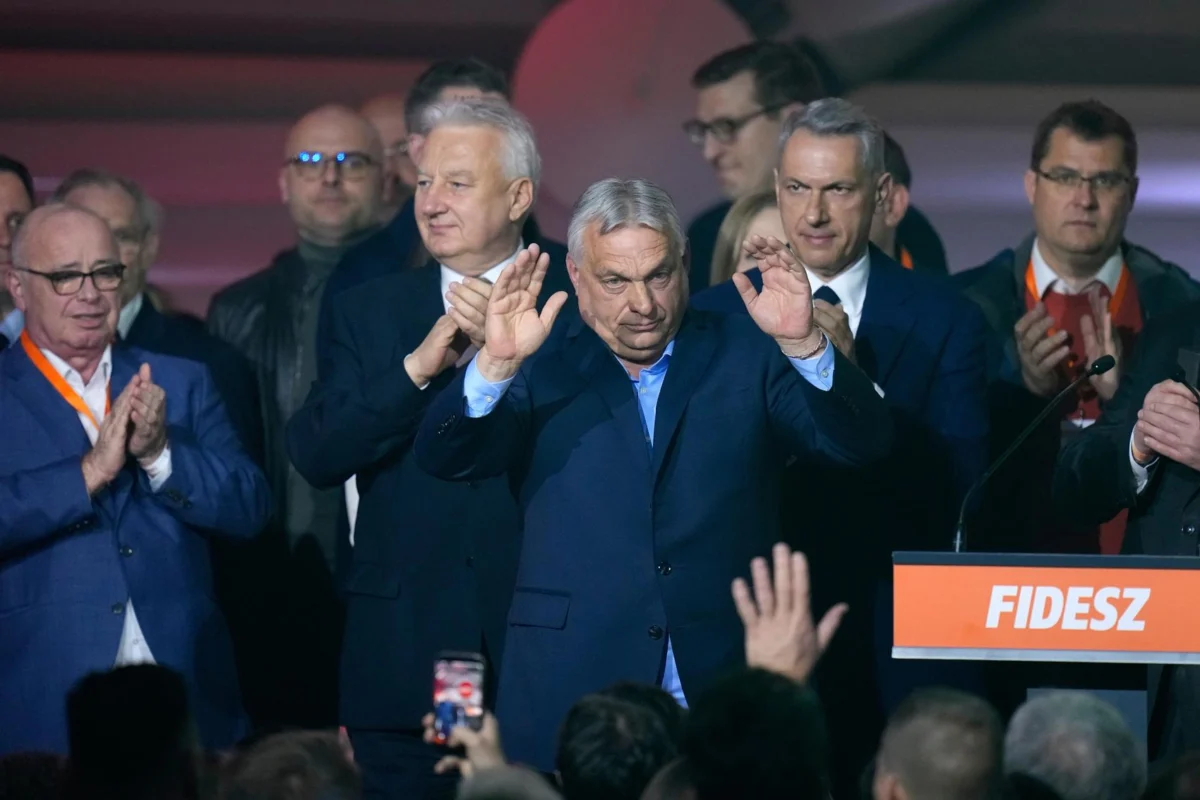
Orbán himself acknowledged the severity of the electoral outcome, describing it as “painful” and conceding defeat. Addressing his supporters, he stated, “I congratulated the victorious party. We are going to serve the Hungarian nation and our homeland from opposition.” This marks a dramatic shift for a leader who had become synonymous with Hungarian political dominance for over a decade and a half. Meanwhile, Magyar took to social media platform X, exclaiming, “Thank you, Hungary!” as jubilant supporters gathered along the banks of the Danube in Budapest, their cheers echoing the sentiment of a nation eager for change.
Orbán’s trajectory is a complex narrative, charting a course from his early days as a liberal, anti-Soviet student activist to his current status as the EU’s longest-serving leader and a prominent, often antagonistic, voice within the bloc. His evolution into a Russia-friendly nationalist has made him a celebrated figure among global far-right movements, while simultaneously drawing sharp criticism from advocates of liberal democracy and the rule of law. The high voter turnout, exceeding 77% by 6:30 p.m. according to the National Election Office, registered as a record in Hungary’s post-communist history, underscoring the deep engagement and significance of this election for the nation’s future.
Both Orbán’s Fidesz party and Magyar’s Tisza party reported instances of electoral irregularities, hinting at the possibility of contested results and potential legal challenges. In anticipation of the final tally, Magyar urged his supporters and the nation to maintain a spirit of peace and celebration, stating, “I’m asking our supporters and all Hungarians: Let’s stay peaceful, cheerful, and if the results confirm our expectations, let’s throw a big, Hungarian carnival.” Mark Radnai, Tisza’s vice president, echoed this sentiment, calling for reconciliation after a particularly acrimonious campaign. “We can’t be each other’s enemies. Reach out, hug your neighbors, your relatives. It’s the day of reunification,” he urged.
A critical area where Hungary’s new leadership will face immediate scrutiny is its stance on Ukraine. Orbán had consistently obstructed EU efforts to provide financial and military aid to Ukraine in its defense against Russia’s full-scale invasion. He maintained close ties with President Putin and resisted efforts to lessen Hungary’s reliance on Russian energy imports. Recent revelations suggesting that a high-ranking member of Orbán’s government routinely shared the contents of EU discussions with Moscow have further fueled accusations that Hungary was actively working against EU solidarity and potentially on behalf of Russia within the bloc.
Orbán’s influence extended far beyond Hungary’s borders, occupying an outsized role in global far-right populist politics. Figures within Donald Trump’s “Make America Great Again” movement, for example, frequently pointed to Orbán’s government and the Fidesz party as exemplars of conservative, anti-globalist governance. Conversely, he was a figure of significant concern and opposition for proponents of democratic values and the international rule of law.
Voters like Marcell Mehringer, a 21-year-old who cast his ballot in Budapest, expressed a clear desire for a European future for Hungary. “I was voting primarily so that Hungary will finally be a so-called European country, and so that young people, and really everyone, will do their fundamental civic duty to unite this nation a bit and to break down these boundaries borne of hatred,” he articulated.
During his extensive tenure as prime minister, Orbán implemented policies that critics argued severely curtailed minority rights and media freedoms. He was also accused of undermining Hungary’s democratic institutions and of facilitating the siphoning of significant public funds into the businesses of his allied elite, allegations he has consistently denied. His approach to governance strained Hungary’s relationship with the EU, even though Hungary is a relatively small nation with a population of 9.5 million. Orbán frequently leveraged Hungary’s veto power to block decisions requiring unanimous consent within the bloc.
Most recently, his blocking of a €90 billion ($104 billion) EU loan package for Ukraine drew sharp condemnation from his European partners, who accused him of holding vital aid hostage for his own political leverage. This pattern of behavior solidified his image in many EU capitals as a destabilizing force and a threat to the bloc’s unity and effectiveness.
Péter Magyar, at 45, emerged as Orbán’s most formidable challenger with remarkable speed. A former member of Fidesz, Magyar broke with the party in early 2024 and swiftly founded Tisza. He embarked on an intensive nationwide campaign, conducting rallies in towns and villages across Hungary, often visiting up to six locations daily in a relentless effort to connect with voters and articulate his vision for a renewed Hungary. In a pre-election interview with The Associated Press, Magyar characterized the election as a “referendum” on whether Hungary would continue its path toward Russia under Orbán’s leadership or reclaim its position among the democratic societies of Europe.
Tisza’s political affiliation with the European People’s Party (EPP), the mainstream center-right political family that governs in twelve of the EU’s 27 member states, positions it within the broader European political establishment. Magyar faced a challenging electoral landscape. Orbán’s extensive control over Hungary’s public media, which have largely functioned as an extension of the Fidesz party, and his significant influence over a large segment of the private media market provided him with a considerable advantage in disseminating his message and shaping public opinion. Furthermore, Fidesz had systematically altered Hungary’s electoral system and redrawn constituency boundaries, a process known as gerrymandering, which required Tisza to achieve an estimated 5% greater vote share than Fidesz to secure a simple parliamentary majority. Adding to the complexity, hundreds of thousands of ethnic Hungarians residing in neighboring countries possess the right to vote in Hungarian elections and have historically voted overwhelmingly for Orbán’s party.
Concerns about foreign interference loomed over the election. Numerous media reports, including those from The Washington Post, indicated that Russian intelligence services had plotted to interfere and influence the outcome in Orbán’s favor. In response, Orbán himself leveled accusations against neighboring Ukraine and Hungary’s EU allies, claiming they were attempting to interfere in the vote to install a “pro-Ukraine” government. These accusations contributed to the perception among many in the EU that Orbán posed a significant risk to the bloc’s future cohesion and stability.
Across the Atlantic, the Trump campaign and its associated MAGA movement had openly supported Orbán’s bid for another term. Trump had repeatedly endorsed the Hungarian leader, and U.S. Vice President JD Vance conducted a two-day visit to Hungary in the week preceding the election, widely seen as an effort to bolster Orbán’s chances. The outcome of the Hungarian election, therefore, carries weight not only for Central Europe but also for the broader geopolitical landscape, potentially signaling shifts in alliances and ideological alignments.
This pivotal election represents a profound moment for Hungary, offering a clear choice between a trajectory of increasing authoritarianism and isolation, and a path toward renewed engagement with democratic Europe. The challenges ahead for Péter Magyar and his Tisza party are significant, but the decisive vote signifies a strong public mandate for change and a desire for a Hungary that is more integrated, transparent, and aligned with its European partners.