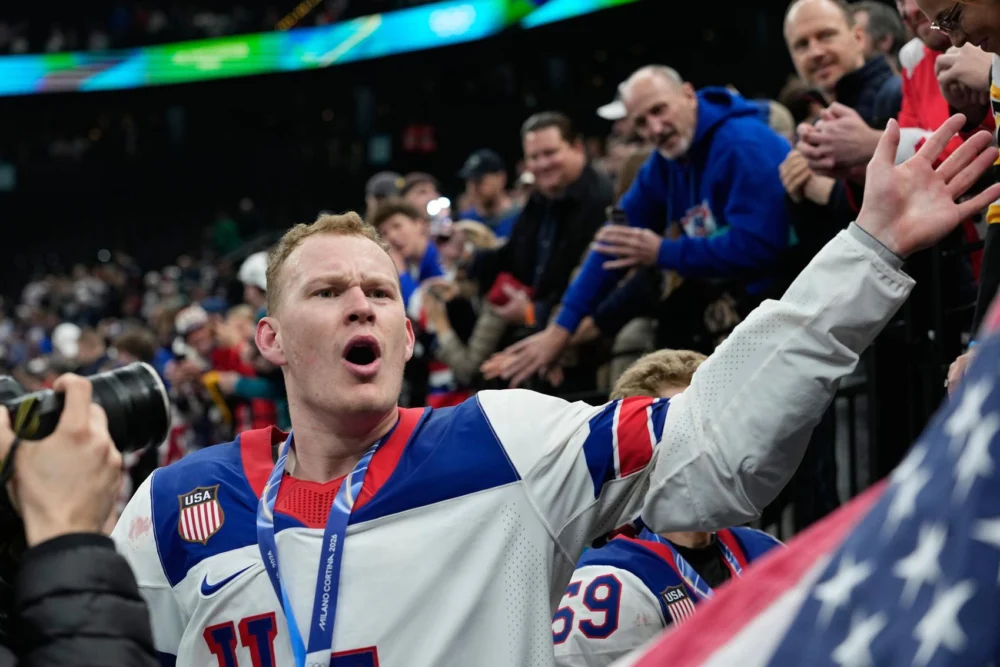
Tkachuk Denounces Fabricated White House TikTok, Denies “Close the Northern Border” Comment
Brady Tkachuk, the celebrated captain of the Ottawa Senators and a key figure in the U.S. men’s Olympic hockey team’s triumphant gold medal victory, has vehemently refuted a doctored TikTok video attributed to the White House that falsely portrayed him disparaging Canadians. The fabricated video, which includes AI-generated audio with Tkachuk seemingly using offensive language towards Canadians and a bleeped-out expletive, was shared by the White House and has drawn a strong rebuke from the hockey star.
“It’s clearly fake because it’s not my voice and not my lips moving,” Tkachuk stated emphatically during a press conference on Thursday. He clarified his lack of control over such online content, emphasizing, “I’m not in control of any of those accounts. … I know that those words would never come out of my mouth.” When directly asked if he appreciated the video, Tkachuk was unequivocal: “I would never say that. That’s not who I am.” The White House did not immediately respond to a request for comment regarding the doctored video.
Adding to the controversy, Tkachuk also denied being the voice heard on a celebratory phone call with then-U.S. President Donald Trump, where the phrase “close the northern border” was allegedly uttered. The U.S. men’s team had just secured a dramatic 2-1 overtime victory against Canada to claim the Olympic gold medal. Tkachuk addressed these reports directly, stating, “I’ve been seeing stuff that people think it’s me, but if you watch the video, that’s not my voice and something that I never say. I don’t really know how that kind of took a storm on its own when I play here and give everything I have here.”
Tkachuk, a 26-year-old native of Scottsdale, Arizona, has built a significant career in Canada’s capital as the captain of the Ottawa Senators. His entire professional hockey journey has been with the Canadian franchise, underscoring the irony of his being linked to anti-Canadian sentiments. The U.S. Olympic team, including Tkachuk and his teammates, recently returned to North America from Italy to resume their respective NHL seasons. A contingent of the team also accepted an invitation to Washington D.C. on Tuesday night, where they were honored guests at President Trump’s State of the Union address, receiving a warm reception from the assembled audience.
The celebratory narrative of the U.S. hockey teams’ dual Olympic triumphs—the women’s team also defeated Canada 2-1 in overtime, marking the first time the Americans had swept both gold medals—has been interwoven with American political discourse since the men’s final buzzer. Following the men’s victory, President Trump engaged with the team via speakerphone in the locker room. He extended an invitation to the White House for the men’s team and playfully remarked about bringing the women’s team as well, joking that not doing so might lead to his impeachment. While some players chuckled at the remark, at least one later expressed regret, and Tkachuk acknowledged the potential for the moment to be misinterpreted by the women’s team.
“I mean, I get it,” Tkachuk said, reflecting on the situation. “We supported them, they supported us. You can’t control what other people say.” This sentiment highlights a broader theme of camaraderie and mutual respect that the players emphasized existed between the two U.S. teams during their Olympic experience.
The logistical challenges faced by the women’s team in accepting the White House invitation further illustrate the complex interplay of sports and politics. While several members of the men’s team were able to travel to Washington for the State of the Union address, many of the women’s players were already en route to their professional or collegiate clubs. They reportedly learned of the invitation late Sunday, making it difficult to alter travel plans already impacted by severe weather on the East Coast. President Trump alluded to plans for the women’s team to visit the White House during his address, though a specific date remained uncertain. The earliest possible visit would likely be in late spring, after the conclusion of the Professional Women’s Hockey League (PWHL) season.
In the interim, the acclaimed rapper Flavor Flav has stepped in to organize a celebratory event for the women’s team in Las Vegas in July, aiming to provide an alternative avenue for recognition and celebration for those who can attend.
Hilary Knight, a veteran of the U.S. women’s hockey team, had previously commented on the situation, describing the President’s joke as “distasteful” but expressing a desire not to let it overshadow the historic achievement of the American women at the Winter Games. Both U.S. men’s and women’s teams have consistently spoken about the strong bonds formed in the athletes’ village in Milan and the mutual support they offered each other throughout their respective gold medal runs. This sentiment was echoed by Florida Panthers star Matthew Tkachuk, Brady’s brother, who remarked on the closeness of the two teams. “Our two teams were so close. We watched other events together. We went and supported them. We loved the women’s team. The women’s team loved us and we’re so proud that we had a clean sweep of gold medals and just so much respect for them and the other athletes,” he stated.
Brady Tkachuk also addressed the question of being a proud American while simultaneously serving as captain of the Ottawa Senators, particularly at a time of perceived heightened tensions between the United States and Canada. He articulated his commitment to his role in Canada with unwavering loyalty. “First and foremost, I’ve given absolutely everything I have as an Ottawa Senator — blood, sweat and tears,” Tkachuk asserted. “When you represent the U.S., being an American, it’s an honor. There are only three teams that have won the gold medal for the U.S., so to be part of that is special.” His statement underscores a nuanced perspective, acknowledging his professional dedication to his Canadian team while cherishing the profound honor of representing his home country on the international stage.