

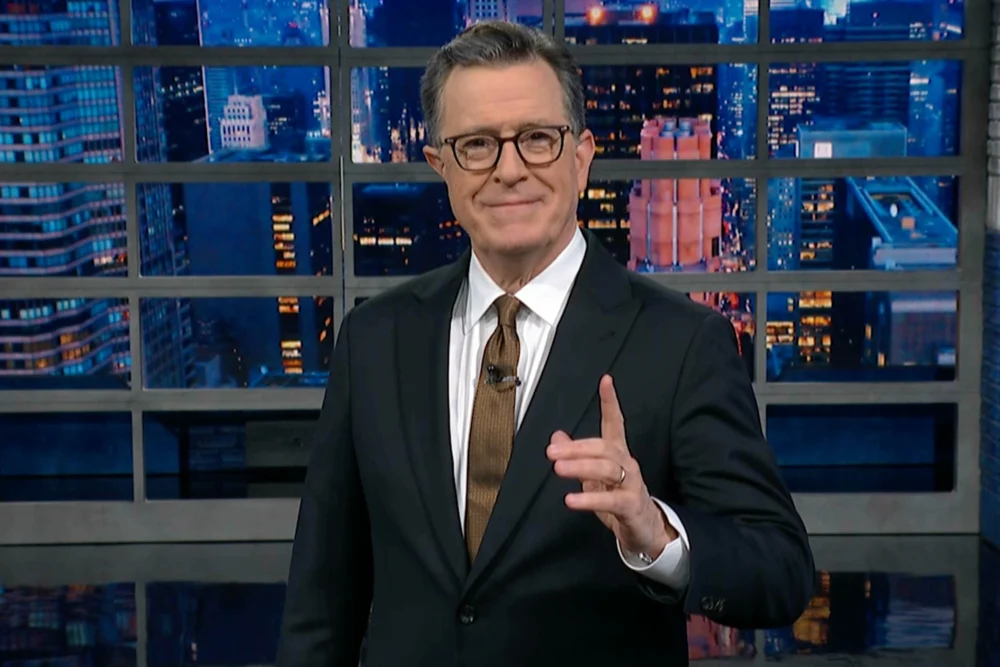
A storm is brewing in late-night television, and at its eye is Stephen Colbert, the beloved host of CBS’s “The Late Show.” In an extraordinary turn of events that has captivated media watchers and free speech advocates alike, Colbert used his own platform to publicly lambaste his network for what he alleges was an unwarranted intervention: the last-minute pulling of an interview with Texas State Representative James Talarico from a recent Sunday broadcast. The ensuing corporate statement from CBS, intended to clarify the situation, only fueled Colbert’s indignation, leading to a rare and very public confrontation between a star personality and his network.
The controversy first erupted when Colbert revealed on his Monday night show that an interview with Rep. Talarico, slated to air as part of his Sunday program, had been abruptly blocked by CBS lawyers. The reason cited was the FCC’s “equal-time rule,” a regulatory provision designed to ensure fairness in political broadcasting during election cycles. However, Colbert immediately challenged this justification, pointing out a long-standing exception to the rule for bona fide news interviews, an exemption traditionally applied to late-night talk shows like his own. He expressed his dismay, stating that the decision was made “in no uncertain terms” and without his prior knowledge or consent, a move that struck at the heart of his show’s editorial independence.
The network’s response came swiftly in the form of a press release, issued on Tuesday, which Colbert himself dramatically presented to his live audience. Holding up the printed statement, he quipped that it was “a surprisingly small piece of paper considering how many butts it’s trying to cover.” The CBS statement read: “‘The Late Show’ was not prohibited by CBS from broadcasting the interview with Rep. James Talarico. The show was provided legal guidance that the broadcast could trigger the FCC equal-time rule for two other candidates, including Rep. Jasmine Crockett, and presented options for how the equal time for other candidates could be fulfilled. ‘The Late Show’ decided to present the interview through its YouTube channel with on-air promotion on the broadcast rather than potentially providing the equal-time options.”
Colbert dissected the corporate-speak with the precision of a seasoned satirist. He characterized the statement as something “written by and, I’m guessing, for lawyers,” highlighting the inherent disconnect between legalistic language and the reality of creative production. His critique was not merely about semantics; it was a powerful assertion of his show’s editorial autonomy and a challenge to the perceived obfuscation from his corporate overlords. He playfully offered to return the favor of legal advice, mockingly suggesting that if CBS’s legal team felt compelled to dictate how he should run his show, he could certainly offer them some pointers on their legal communications.
The comedian systematically dismantled CBS’s explanation. The network’s suggestion that “The Late Show” was “presented options” for fulfilling equal time was met with incredulity. Colbert, a veteran of political commentary, scoffed at the idea that he needed guidance on booking guests. He emphatically reminded his audience, and implicitly, his network, that he had hosted Rep. Jasmine Crockett, one of the candidates CBS mentioned, on his show twice previously. To underscore the absurdity of the situation and the perceived censorship, he attempted to show a picture of Crockett but then feigned inability, joking that the network wouldn’t allow it without also showing her opponents. Instead, he presented a picture of Donald Trump and Jeffrey Epstein, a visual gag that perfectly encapsulated the restrictive environment he felt he was operating under.
What made the situation particularly alarming for Colbert was the unprecedented nature of the network’s intervention. He revealed that “every word” of Sunday night’s script, including the segment featuring Rep. Talarico, had already been approved by CBS lawyers. The interview was only “abruptly shut down” after this extensive vetting process. Furthermore, he claimed that during a commercial break on the very night he was addressing the pulled interview, he received additional “notes” from the legal team dictating how he could and could not discuss the incident. This level of real-time editorial oversight, he stated, had “never happened before” in the 11 seasons of “The Late Show.” This particular detail painted a vivid picture of a network scrambling to control the narrative and exert influence over its star’s commentary, even as he was in the process of critiquing that very influence.
The FCC’s equal-time rule, codified in Section 315 of the Communications Act of 1934, mandates that broadcast stations must provide equal opportunities to all legally qualified political candidates for the same office if they allow one candidate to use their airwaves. The intent is to prevent broadcasters from unfairly favoring one candidate over another. However, the rule has a significant exemption for bona fide news events, including news interviews, news documentaries, on-the-spot coverage of news events, and regularly scheduled news programs. For decades, late-night talk shows, with their mix of celebrity interviews and political commentary, have largely operated under this “bona fide news interview” exemption, allowing hosts like Colbert to interview politicians without triggering the equal-time obligation for every other candidate in a given race. This exemption acknowledges the journalistic function these shows often perform, even within an entertainment format.
Colbert’s central grievance was that CBS was “unilaterally enforcing” a stricter interpretation of the equal-time rule, effectively acting as if FCC Chair Brendan Carr had already eliminated the long-standing talk show exemption, even though Carr has not. This move, Colbert argued, represented an overzealous and potentially financially motivated caution on the part of the network. He sarcastically suggested that the decision to block the interview was “for purely financial reasons,” hinting at the potentially steep costs and administrative burdens associated with providing equal time to numerous candidates, especially in multi-candidate primary races. For a large corporation like CBS, the risk of an FCC fine or even a challenge to their broadcast license, however remote, could be seen as an unacceptable liability, leading to a policy of extreme risk aversion.
The implications of CBS’s stance extend far beyond a single pulled interview. If a major network begins to apply the equal-time rule so stringently to late-night talk shows, it could set a dangerous precedent for the entire broadcast industry. It risks a chilling effect on political commentary and satire during election cycles, particularly for programs that have become vital spaces for public discourse and critical analysis of political figures. Late-night hosts, with their massive reach and cultural influence, play a significant role in informing and engaging the public, often reaching demographics that traditional news programs might miss. Limiting their ability to host politicians or discuss political issues freely could diminish the diversity of voices and perspectives available to viewers, thereby impacting democratic discourse.
Colbert, despite his evident frustration, was careful to articulate his position. “For the record, I’m not even mad. I really don’t want an adversarial relationship with the network,” he stated, a testament to his long professional history with CBS. He reiterated his gratitude for his 11 years at the network, acknowledging the many individuals he has worked with. Yet, his final sentiment revealed the depth of his disappointment: “I’m just so surprised that this giant global corporation would not stand up to these bullies.” This statement left a profound question hanging in the air: who are these “bullies”? Is it external political pressure, or internal forces of corporate timidity and legal hyper-vigilance?
Colbert offered his own, more cynical, interpretation of the broader context. “Let’s just call this what it is. Donald Trump’s administration wants to silence anyone who says anything bad about Trump on TV, because all Trump does is watch TV,” he asserted. He painted a picture of a former president singularly focused on media coverage, prone to reacting negatively to criticism. This interpretation connects the specific incident at CBS to a larger pattern of perceived attempts to stifle critical voices in media, particularly those that target powerful political figures. He noted that he and his friend Jimmy Kimmel, another prominent late-night host known for his political commentary, seemed to be disproportionately affected by this climate of intimidation.
The decision to eventually release the Talarico interview on YouTube, while promoted on air, also raises questions about the evolving media landscape. In an era where digital platforms offer an alternative distribution channel, networks might see this as a convenient workaround – allowing content to be made available without incurring broadcast regulatory risks. However, moving politically sensitive content to a secondary platform, even with on-air promotion, inherently reduces its immediate impact and reach compared to a prime-time broadcast. It fragments the audience and potentially dilutes the urgency and prominence of the message, raising concerns about a two-tiered system for political discourse: safe, sanitized content for broadcast, and riskier, more challenging content relegated to digital spaces.
This episode is more than just a spat between a network and its star; it is a microcosm of the ongoing tensions between corporate interests, regulatory frameworks, journalistic integrity, and the vital role of political commentary in a democratic society. As election cycles intensify, the boundaries of free speech and media independence are increasingly tested. Stephen Colbert, in his characteristic blend of humor and earnestness, has thrown a spotlight on these critical issues, challenging viewers and media executives alike to consider the true cost when comedy gets serious, and the airwaves fall silent on critical political conversations.