



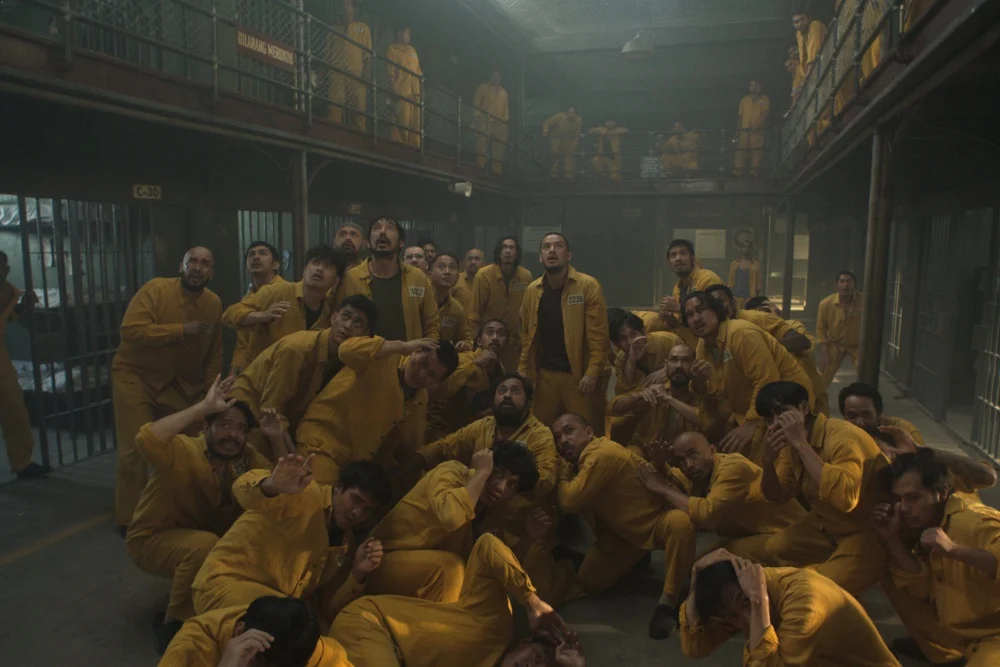
Indonesian maestro Joko Anwar, a filmmaker celebrated for his masterful blend of genre thrills with profound societal commentary, has once again captivated international audiences with his latest work, “Ghost in the Cell.” Premiering at the prestigious Berlinale Forum, this prison-set supernatural horror transcends conventional scares, deploying its titular specter not as a mere harbinger of dread, but as a potent instrument of accountability against the insidious forces of systemic corruption and environmental devastation. Anwar’s vision is clear: the ghost doesn’t just haunt; it judges, it punishes, and it forces a reckoning.
Anwar, whose filmography includes critically acclaimed hits like “Satan’s Slaves” and “Impetigore,” has consistently pushed the boundaries of what horror cinema can achieve, transforming the genre into a powerful vehicle for social critique. With “Ghost in the Cell,” he zeroes in on the often-ignored consequences of human actions, crafting a narrative that is as chilling as it is thought-provoking. The film is set within the claustrophobic confines of an Indonesian correctional facility, a pressure cooker where the existing power structures, already fragile and brutal, are shattered by the arrival of a new inmate. This prisoner unwittingly ushers in a malevolent supernatural entity, one that possesses a terrifyingly specific agenda: to hunt those individuals whose “aura” is darkest, whose hands are most stained by the injustices of the world outside and within the prison walls.
As the body count inexorably rises, plunging the facility into chaos, the desperate inmates quickly realize that individual survival is no longer an option. Their only hope lies in collective action, a fragile alliance forged in the face of an unseen, uncompromising judge. This premise elevates “Ghost in the Cell” beyond a simple horror-thriller, transforming it into a nuanced examination of human nature under duress, and the desperate search for justice in an environment designed to strip it away.
For Anwar, the choice of a prison as the primary setting was far from arbitrary; it was a deliberate and strategic decision. “A prison is like a miniature of society,” the director explains, his words resonating with sharp insight. “It mirrors hierarchy, power dynamics in it, also fear, violence, morality all compressed in one confined space with politeness stripped out.” This concentrated environment, he posits, offers an unvarnished glimpse into the raw mechanics of human interaction and the stark realities of power. Within these walls, the consequences of actions are immediate and often brutal, yet Anwar astutely points out a crucial paradox: “However, while everyone is trapped in the same system, not everyone faces equal consequences including punishment.” This observation underscores the film’s core theme of judicial inequality, highlighting how even within a seemingly uniform system, disparities in power and privilege persist.
The film delves deep into the often-overlooked connection between societal ills and supernatural terror. Anwar adamantly asserts that environmental destruction and judicial inequality are not mere decorative backdrops but are, in fact, “the origin of horror, not only as a sideshow.” This perspective challenges conventional horror tropes, suggesting that the most terrifying monsters are often born from human failings and systemic abuses. By weaving these critical realities into the very fabric of the narrative, Anwar ensures they are not easily dismissed. He articulates his intention with striking clarity: “I let the ghost carry the truth that the system made by humans refuses to articulate.” The supernatural entity, therefore, becomes a voice for the voiceless, an embodiment of the suppressed conscience of a society complicit in its own decay.
Crucially, Anwar’s ghost is no mere allegorical figure; it is a tangible, active participant in the story. This distinction is vital to the film’s impact. “The ghost was never meant to represent an idea,” Anwar clarifies. “It has intent, intelligence, and limits. It chooses its victims.” This concrete portrayal imbues the entity with a chilling agency, making it far more terrifying than a symbolic representation. It doesn’t just stand for something; it *does* something. “So the ghost isn’t a metaphor and becomes an actual character, shaped by trauma and injustice,” he continues. “It doesn’t deliver moral comfort. It delivers consequences.” This emphasis on direct, unsparing consequence is what sets “Ghost in the Cell” apart, transforming it into a visceral experience that forces viewers to confront uncomfortable truths rather than seek solace in abstract interpretations.
The intricate world of the prison and its diverse inhabitants demanded meticulous preparation, a hallmark of Anwar’s directorial style. Managing a large ensemble cast within such a volatile and confined environment presented unique challenges, which Anwar met with innovative rehearsal techniques. He developed exhaustive, detailed backstories for every character, extending even to the day players, ensuring that each inmate, guard, and staff member felt fully realized. Furthermore, Anwar orchestrated group rehearsals designed to mirror the film’s inherent factional dynamics, fostering a natural sense of suspicion and solidarity among the actors. “I let every actor have other character’s sheet in their group and left other characters from different groups as a mystery,” he explains. “So they can feel the danger, suspicion, coming from other groups of inmates.” This immersive approach not only enhanced the authenticity of the performances but also deepened the psychological realism of the prison environment.
The tonal balancing act within “Ghost in the Cell” is another testament to Anwar’s nuanced storytelling. The film deftly navigates between moments of intense violence, sharp satire, and an unsettling, often uncomfortable humor. Rather than serving as a release valve for tension, the humor in Anwar’s film performs a different, more subversive function. “Humor in the film doesn’t release tension, it sharpens it,” Anwar reveals. “Laughter should come with discomfort. If the audience laughs and then immediately questions why they did, the tone is working.” This deliberate use of dark humor forces the audience into a state of critical self-reflection, ensuring that even moments of levity are imbued with a disquieting edge, compelling viewers to confront their own complicity or discomfort with the themes at play.
The selection of “Ghost in the Cell” for the Berlinale Forum, a section renowned for championing formally ambitious and politically challenging cinema, perfectly aligns with Anwar’s artistic intentions. The Forum’s mandate provides an ideal platform for a film that deliberately eschews easy answers and comfortable resolutions. “Forum is a section where films are allowed to be uncomfortable and unresolved,” Anwar notes, acknowledging the freedom this platform offers. He expresses a profound hope that international audiences will not view the systems portrayed in his film as exotic or distant, but rather recognize them as uncomfortably familiar, echoing societal structures and injustices found across the globe. This universal resonance is key to the film’s impact, inviting a broader dialogue about shared human experiences and systemic failures.
Ultimately, Anwar intends for viewers to depart the cinema not with simple entertainment, but with a lingering sense of inquiry and unease, prompting them to question institutional complicity at its very core. “I hope they ask themselves who the system is actually designed to protect,” he states, framing the film as a catalyst for critical thought. “The film isn’t asking whether corruption or destruction exists, we all know it does. It’s asking why we’re so comfortable letting them become normal.” This powerful call to introspection challenges the audience to confront the normalization of corruption and environmental degradation, urging them to consider their own roles in either perpetuating or challenging these pervasive issues.
The ambitious production of “Ghost in the Cell” marks another significant collaboration between Joko Anwar and producer Tia Hasibuan, through their Jakarta-based production house, Come and See Pictures. This partnership, known for delivering high-quality, genre-bending films, joins forces with Rapi Films, a stalwart of Indonesian cinema. The project also benefits from the considerable international prestige of South Korea’s Barunson E&A, the acclaimed studio behind Bong Joon Ho’s Oscar-winning masterpiece “Parasite,” and Legacy Pictures, further cementing its global aspirations. This powerful alliance underscores the growing international appeal and collaborative spirit within Asian cinema, bringing together formidable talent and resources to realize Anwar’s vision.
The film boasts an impressive ensemble cast of some of Indonesia’s most respected and versatile actors, including Abimana Aryasatya, Lukman Sardi, Bront Palarae, Aming, Rio Dewanto, Morgan Oey, and Tora Sudiro. Their collective talent brings to life the complex tapestry of characters within the prison, ensuring that each individual, despite their moral ambiguities, contributes to the film’s rich narrative and thematic depth. The formidable presence of these actors further elevates “Ghost in the Cell,” promising compelling performances that anchor its supernatural terror in deeply human drama.
Barunson E&A is strategically handling the worldwide sales for “Ghost in the Cell,” a move that highlights the film’s significant international market potential. This distribution partnership is part of a broader, impactful two-year agreement with Come and See Pictures, signaling a sustained commitment to bringing compelling Indonesian narratives to a global audience. This collaboration not only offers “Ghost in the Cell” a robust platform for international distribution but also solidifies the growing influence of Indonesian cinema on the world stage, with Joko Anwar at its vanguard, using the spectral and the sublime to shine a harsh, necessary light on the human condition.