



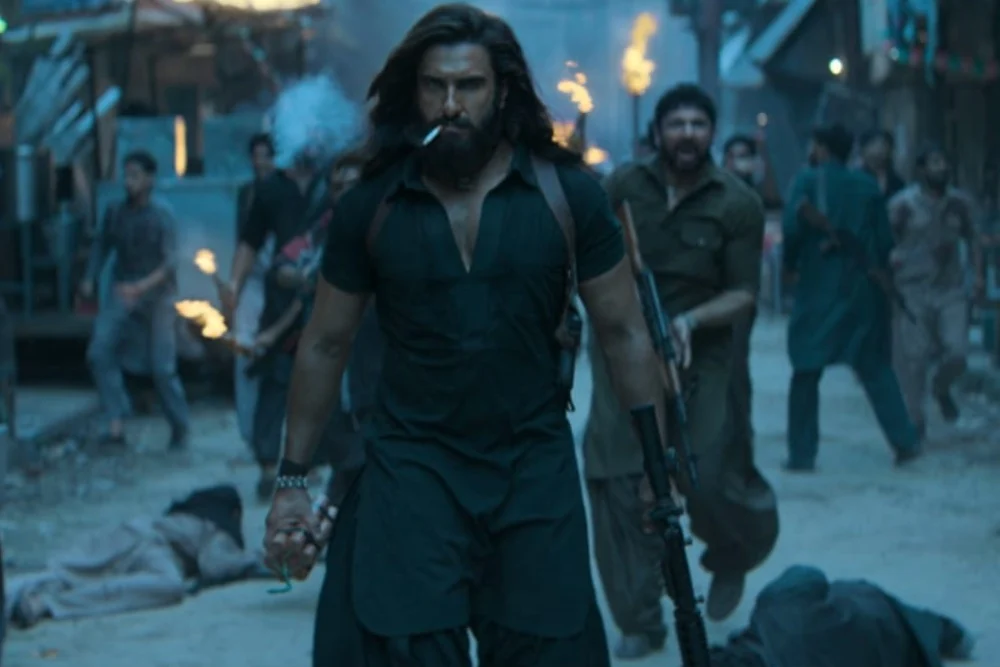
In a powerful testament to the evolving landscape of global entertainment and the undeniable cultural resonance of compelling storytelling, Ranveer Singh’s espionage thriller, "Dhurandhar," has seized the coveted number one spot on Netflix’s global Top 10 list for non-English films. This remarkable achievement, charting 7.6 million views between January 26 and February 1, extends far beyond mere viewership metrics, signalling a profound moment in cross-border cultural exchange, particularly within the historically fraught relationship between India and Pakistan. The film, an adrenaline-fueled narrative about an Indian undercover operative infiltrating Karachi’s treacherous criminal underworld, has not only captivated audiences in its home country but has also achieved the extraordinary feat of ranking number one in both India and Pakistan—a streaming outcome that deftly navigates and, in many ways, transcends the long-frozen theatrical politics of the region.
The ascent of "Dhurandhar" to the pinnacle of Netflix’s non-English film charts is a clear indicator of its universal appeal, but its success in Pakistan carries a particularly potent charge. For years, Indian films have been systematically excluded from Pakistani cinemas, a situation that intensified significantly following renewed bilateral tensions between the two nuclear-armed neighbours. This political blockade has created a palpable void for film enthusiasts on both sides of the border, limiting access to shared cultural narratives and artistic expressions. Against this backdrop, "Dhurandhar," a film whose very premise—an Indian intelligence operation unfolding within Pakistan—would typically render it dead on arrival for theatrical release across the border, has found a direct, unimpeded pathway to Pakistani audiences at an unprecedented scale, thanks to Netflix’s "frictionless pipeline."
This bypass of traditional distribution channels by a major streaming platform is more than just a logistical triumph; it represents a significant cultural moment. It underscores the growing power of digital platforms to democratize access to content, effectively neutralizing political barriers that have historically dictated what audiences can or cannot consume. For viewers in Pakistan, the ability to watch a high-production Indian thriller, led by one of Bollywood’s biggest stars, through a legal and accessible platform, signifies a return to a shared cinematic experience that has long been denied. This phenomenon isn’t confined to India and Pakistan alone; "Dhurandhar" is also experiencing chart-topping or near-the-top placement across South Asia, including in Bangladesh and Sri Lanka, reinforcing its formidable regional pull and demonstrating a widespread hunger for quality South Asian content that transcends national boundaries.
Beyond South Asia, the film’s success story continues to unfold in the Middle East. Here, too, India-Pakistan political sensitivities often render theatrical releases for such potentially charged material either complicated or commercially risky. The expatriate-heavy territories, with their significant South Asian diaspora populations, present a unique market that streaming services are perfectly positioned to serve. Netflix provides a "cleaner route" to these audiences, allowing them to engage with their cultural heritage and popular entertainment without the geopolitical baggage that might accompany a traditional cinema release. This broad international appeal highlights not only the film’s inherent entertainment value but also the global reach of Indian cinema and the critical role streaming platforms play in connecting diverse communities worldwide.
At the heart of "Dhurandhar"’s magnetic pull is its star, Ranveer Singh. Known for his electrifying screen presence, chameleonic versatility, and fearless approach to roles, Singh delivers a performance that anchors the high-stakes espionage narrative. His portrayal of the undercover agent tasked with infiltrating Karachi’s criminal and political underworld is reportedly nuanced, intense, and deeply engaging, showcasing the depth of his acting prowess. Singh has consistently pushed the boundaries of his craft, from the historical gravitas of Bajirao Mastani and Padmaavat to the raw energy of Gully Boy. In "Dhurandhar," he brings a compelling blend of vulnerability and steely resolve to a character operating in the shadows, a performance that undoubtedly contributes to the film’s broad appeal across diverse demographics, including a significant female viewership drawn to his charisma and the emotional complexity he brings to his roles. The film also boasts a formidable ensemble cast, with veteran actor Akshaye Khanna playing the antagonist, a role in which he excels at delivering intensity and menace. The supporting cast, featuring talents like Sanjay Dutt, R. Madhavan, Arjun Rampal, Sara Arjun, Rakesh Bedi, Manav Gohil, Danish Pandor, Saumya Tandon, Gaurav Gera, and Naveen Kaushik, further enriches the narrative, adding layers of intrigue and dramatic weight.
The film’s direction by Aditya Dhar, a filmmaker known for his innovative approach to storytelling and action sequences, underpins its cinematic quality. Produced by Jio Studios and B62 Studios, "Dhurandhar" is a testament to the growing ambition and production values of contemporary Indian cinema. Jio Studios, a major player in the Indian entertainment landscape, has been instrumental in backing projects that combine commercial viability with artistic merit, and "Dhurandhar" is a shining example of this strategy paying dividends on a global scale. The decision to release the film in two parts, with the first installment detailing a decade-long intelligence operation and the eagerly anticipated sequel, "Dhurandhar: The Revenge," slated for a theatrical release on March 19, reflects a sophisticated and strategic distribution model. This hybrid approach, combining streaming for the initial part with a theatrical rollout for the continuation of the saga and the exploration of Singh’s character’s backstory, indicates a dynamic adaptation to the evolving media consumption habits of audiences worldwide.
The commercial success of "Dhurandhar" is equally striking. The first part of the saga has already cemented its place in cinematic history as the highest-grossing Hindi-language film in India, collecting an astounding $116 million locally. Its international performance has been robust, adding another $32 million to its coffers. These figures underscore the immense domestic appeal of the film and its ability to draw massive audiences to cinemas, even as its digital counterpart simultaneously dominates streaming charts. This dual success—record-breaking box office numbers domestically and unprecedented global streaming dominance—positions "Dhurandhar" as a landmark achievement, challenging conventional notions of film distribution and audience engagement in the digital age.
The geopolitical backdrop against which "Dhurandhar" achieves its cross-border success is crucial to understanding its full impact. The history between India and Pakistan is deeply complex and often volatile, marked by four major wars since Partition in 1947—in 1947–48, 1965, 1971, and 1999—with the disputed territory of Kashmir remaining a central flashpoint. This long-standing animosity has manifested in military confrontations, diplomatic breakdowns, and periodic escalations, severely limiting cultural and artistic exchanges. The ban on Indian films in Pakistani cinemas, and vice versa, is a direct consequence of these tensions, designed to curb cultural influence and express political displeasure. This has created a significant void for audiences in both countries, who often share similar linguistic, musical, and cinematic tastes.
In this context, "Dhurandhar"’s triumph on Netflix in Pakistan is not merely a commercial victory; it’s a profound cultural statement. It suggests that despite political hostilities, there remains a deep-seated desire among the populace for shared cultural experiences and narratives. The film’s ability to resonate with Pakistani audiences, even with a storyline centered on an Indian intelligence operation within their borders, speaks volumes about the power of storytelling to transcend political narratives and connect people on a human level. It hints at a subtle but significant shift, where entertainment can become a conduit for connection, bypassing governmental restrictions and fostering a sense of shared popular culture.
For a professional women-focused news and entertainment website, the success of "Dhurandhar" offers several layers of insight. It highlights the growing global appetite for diverse narratives, showcasing how a well-crafted story, regardless of its origin language, can captivate millions worldwide. It also underscores the evolving career trajectory of actors like Ranveer Singh, whose ability to embody complex characters with authenticity makes him a global draw. Furthermore, it speaks to the power of digital platforms in dismantling traditional barriers, offering a glimpse into a future where art and entertainment can more freely cross geopolitical divides, fostering understanding and shared experiences, even in the face of ongoing political tensions. This film’s unprecedented success serves as a powerful reminder that while politics may divide, compelling stories often have the power to unite, offering a glimmer of hope for cultural diplomacy in an interconnected world.