
For centuries, the legend of Dracula has cast an inescapable shadow over our collective consciousness, a narrative so potent it has transcended its literary origins to become a cinematic institution. Yet, what was once a chilling gothic masterpiece or a captivating tale of eternal love and damnation has, in recent decades, morphed into something less thrilling: a relentless, almost monotonous industry. It’s a phenomenon akin to witnessing the umpteenth theatrical revival of a Shakespearean classic or a beloved musical like “Annie”—one can’t help but ask, what fresh blood is left to be drawn from these familiar veins? The saga of the Transylvanian count, it seems, has become an endless rerun, a perpetual loop of fangs and melodrama that, for many, has long since wrung the story dry of genuine surprise or profound insight.
This sense of exhaustion isn is not new. Even for those who might not feel they’ve personally endured a century’s worth of Dracula films, the sheer volume of recent iterations speaks volumes. Take, for instance, *Renfield*, a film that saw the inimitable Nicolas Cage tackle the role of the vampiric overlord, delivering a performance that, while undeniably Cage-esque, felt largely like a reprise of his earlier, equally eccentric turn in 1989’s *Vampire’s Kiss*. It was a spectacle, certainly, but hardly groundbreaking. Then there’s Robert Eggers’ highly anticipated *Nosferatu*, a visually stunning project lauded for its intricate production design but, by many accounts, struggled to marry its aesthetic brilliance with compelling dramatic depth, creating a disquieting seven-to-one ratio of visual splendor to narrative intrigue. (One might, with similar frustration, point to Guillermo del Toro’s upcoming *Frankenstein*, but that is, indeed, another monstrous tale for another time.) These examples underscore a growing fatigue: lavish production values and star power often mask a deeper creative deficit when it comes to revisiting such well-trodden ground.
And so, here we are once more, caught in the slow, inexorable drip of cinematic Dracula mythology, now with Luc Besson’s latest offering. Besson, a director known for his distinctive visual flair and often kinetic storytelling, attempts to inject new life into the legend, but the result is a film that feels wan, derivative, and dutifully—almost mechanically—time-period-hopping. It’s a take on the vampire legend that strives for difference but ultimately falls short of being truly new. The film, in a move that surprises precisely no one, leans heavily into the “romantic” aspect of the Dracula narrative, rather than its horrific core. The irony here is palpable, bordering on sarcasm, for the “romantic Dracula” is not a novel concept; it’s an entire subgenre of vampire cinema, with roots stretching back to the 1979 Frank Langella version, which sought to portray the Count as a tragic, alluring figure rather than a purely monstrous one. The unspoken promise seems to be: come for the fangs, stay for the swoons. But for many seasoned viewers, the prevailing sentiment is a resounding, “Big. Fat. Deal.” The well of gothic romance, when divorced from genuine terror or profound character study, often runs shallow.
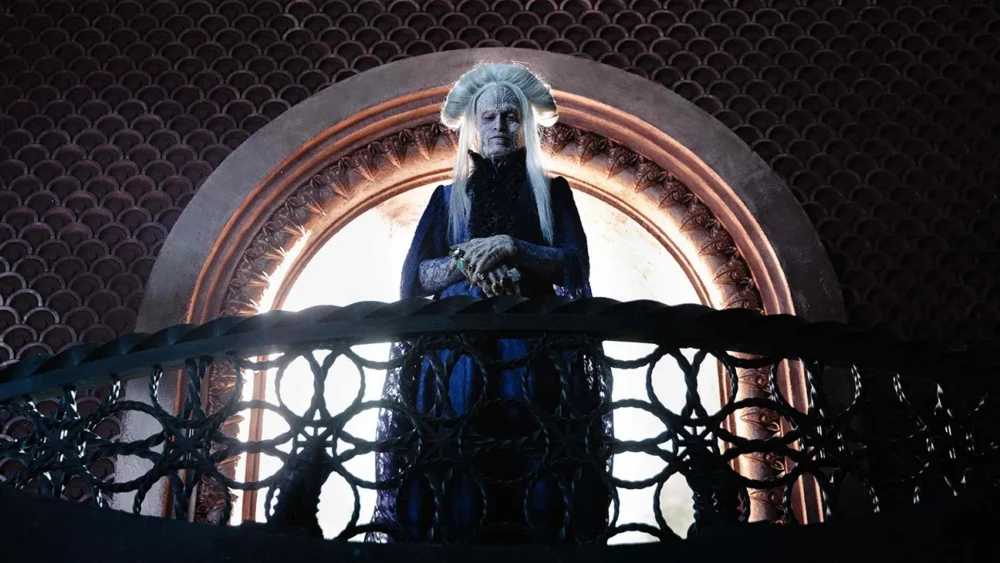
The success or failure of any Dracula portrayal often hinges on the actor embodying the titular role. In Besson’s *Dracula*, Caleb Landry Jones, an actor of considerable talent and distinctive presence, steps into these very large, blood-soaked shoes. His initial portrayal of Dracula is striking, yet also undeniably and even “shockingly” a direct descendant of Gary Oldman’s iconic performance in the opening sequences of Francis Ford Coppola’s 1992 epic, *Bram Stoker’s Dracula*. The visual parallels are too pronounced to ignore: the elaborate makeup, featuring white hair meticulously piled in a neat bun (though here adorned with two long side bangs), the visage of rotting, parchment-like skin, and the fossilized teeth—all appear to be a near-total knockoff of Oldman’s memorable transformation. Jones’s performance, however, brings a winning delicacy to this familiar aesthetic. His vocal delivery, particularly when he declares, à la Oldman, “I am Vlad, the second prince of Volokia. Count…*Dragoool*,” immediately establishes a lineage. His interpretation of Dragoool suggests a fascinating, if sometimes jarring, fusion of influences: the intensity of Oldman, the ancient decay of Karloff’s Mummy, the macabre humor of the Cryptkeeper, the unsettling gaze of Klaus Kinski, the unpredictable menace of Willem Dafoe, the chaotic energy of Heath Ledger, and, in moments of grimace, even the peculiar expression of a carp. This eclectic blend hints at a desire to create something unique, but the pervasive echoes of Oldman’s portrayal make it difficult to shake the feeling of déjà vu.
The narrative of Besson’s *Dracula* begins with the familiar gothic grandeur. We first encounter Dracula, still known as Vlad, the young prince of Volokia, in 1480 Eastern Europe. He is a warrior, drawn away from his beloved wife, Elisabeta (played by Zoë Blue), and the intimate moments they share. Their initial scenes, cavorting in the sheets, attempt to establish a profound connection, setting the stage for the tragedy that follows. Elisabeta is brutally slaughtered, an event that plunges Vlad into an anguish so profound it shatters his faith. He confronts a priest, declaring with defiant despair, “Tell God that until he brings back my wife, my life no longer belongs to Him.” This dramatic rejection of divine provenance is immediately met with classic gothic imagery: a thunderclap rips through the sky, and a statue of Jesus weeps a tear of blood, signifying the moment Vlad irrevocably turns his back on God and embraces the darkness that will transform him into the immortal Count. This foundational tragedy is a cornerstone of many Dracula interpretations, particularly the romantic ones, positing his vampirism not as an act of pure evil but as an eternal curse born of unbearable grief and unrequited love for a lost soul.
Accompanying this unfolding drama is Danny Elfman’s score. Elfman, a master of gothic and fantastical soundscapes, delivers music that is, arguably, the most atmospheric element of Besson’s film. Echoing the unsettling waltz theme of *Rosemary’s Baby*, his score effectively conjures a sense of foreboding and melancholic beauty, often surpassing the visual storytelling in its ability to create mood. Ironically, while the music attempts to weave a rich tapestry, Besson’s direction feels strangely disengaged. The film is staged with a languor that suggests a music-video director who has, perhaps, grown too weary for the rapid-fire editing and dynamic compositions that once defined his style. The pacing is deliberate, almost ponderous, allowing the atmospheric score to do much of the heavy lifting that the visual narrative struggles to achieve.
The film then takes a significant leap forward in time, transporting us to late 19th-century Paris. Here, Caleb Landry Jones reappears, this time as a dandified, more contemporary version of his princely self. This transition, mirroring a similar narrative shift in *Bram Stoker’s Dracula*, introduces the Count as a long-haired Lothario, complete with a top hat and a vaguely Transylvanian accent, attempting to blend into sophisticated Parisian society. However, much like Gary Oldman’s portrayal in Coppola’s film—which, as the original article wryly notes, might have been more accurately titled “Francis Ford Coppola’s Bram Stoker’s Dracula” to acknowledge its distinctive directorial vision—Jones proves far more compelling as the ancient, ethereal, and elfin-demon Dracula of the earlier period. The raw, primal anguish and otherworldly menace of his initial incarnation simply resonate more profoundly than his attempts at suave, worldly charm. Just as *Bram Stoker’s Dracula* seemed to lose its narrative momentum during its more contemporary sections, Besson’s *Dracula* similarly goes to sleep. The core of this later narrative revolves, predictably, around Dracula’s attempts to romance Mina, who is presented as the reincarnation of his lost Elisabeta (again played by Zoë Bleu). Their interactions are predictably laden with portentous, yet ultimately uninspired, dialogue. Dracula: “Madame, it is an honor and a pleasure to see you again.” Mina: “Have we met before?” Dracula: “In a dream, perhaps. I have this strange feeling that we have known each other…for a long time.” The intended romantic frisson, however, falls flat, eliciting from the audience not gasps of yearning, but a collective, internal groan of “Zzzzzz.” The emotional stakes, despite the grand pronouncements, feel curiously absent, rendering the central romance more a tired trope than a compelling narrative hook.
The overarching sentiment is that the world hardly needed *Dracula* remade as a blood-soaked Valentine’s Day movie. The balance between horror and romance is delicate, and when one overshadows the other without sufficient depth or originality, the film risks becoming neither truly terrifying nor genuinely romantic. Adding a layer of gravitas, Christoph Waltz appears as the Van Helsing character, simply known as “the Priest.” Waltz, a master of nuanced performances, delivers his signature “tastefully understated scenery-chewing.” He brings a quiet intensity to a role that, in lesser hands, could easily devolve into caricature, offering moments of intriguing theological reflection amidst the unfolding chaos. His presence is a welcome anchor, providing a counterpoint to Dracula’s tortured existentialism.
While the film largely shies away from explicit horror in favor of its romantic narrative, there is one sequence that embraces gothic gore with gusto. Maria (Matilda De Angelis), Dracula’s first disciple, succumbs to demonic possession, leading to a spectacularly violent and visceral scene where she is ultimately decapitated and staked through the heart. This moment, a jarring burst of extreme violence, stands in stark contrast to the film’s generally more subdued tone, reminding the audience of the inherent brutality of the vampire myth, even if only fleetingly. The climax of the film eventually brings us back to Dracula’s foreboding castle, a structure so vast it is compared to Notre Dame, nestled at the foot of the Carpathian Mountains in Romania. Here, the film descends into a rather conventional, almost campy, final act: four stone gargoyles inexplicably spring to life, there’s a flurry of uninspired swordplay, schlocky cannon fire erupts, and Waltz’s Priest delivers a climactic, fortune-cookie-esque theological lecture that attempts to tie up the film’s spiritual threads. As the final moments unfold, the Priest declares, “The spell is broken.” While intended to signify the defeat of Dracula’s curse, for many viewers, the sentiment resonates on a far more meta level: the spell of this particular *Dracula* adaptation is, indeed, finally broken, freeing the audience from its languid pace and derivative narrative. Ultimately, Besson’s *Dracula* serves as a stark reminder that some legends, however enduring, require more than just a fresh coat of paint or a slight shift in tone to truly captivate an audience that has seen it all before.