

Netflix’s latest limited series, "Vladimir," plunges viewers into the complex internal world of a middle-aged academic grappling with her perceived irrelevance, both intellectual and erotic. Adapted by Julia May Jonas from her own acclaimed debut novel, the show immediately invites comparisons, not least due to its evocative title. For aficionados of fine literature, "Vladimir" instantly conjures the specter of Vladimir Nabokov, particularly his exploration of problematic age gaps in relationships, echoing the disquieting themes of "Lolita," or perhaps the biting campus satire of "Pnin." Yet, for contemporary television audiences, the series’ most immediate and potent influence is undeniable: the groundbreaking "Fleabag," which elevated the art of breaking the fourth wall and direct address to the camera into a masterclass of intimate, unreliable narration.
To attempt to clear the high bar set by Phoebe Waller-Bridge’s Emmy-sweeping one-woman show is an ambitious undertaking, and while "Vladimir" showcases significant strengths, it ultimately struggles to fully match the incisive brilliance and seamless execution that made "Fleabag" a cultural phenomenon. Jonas’s adaptation bravely tackles a dense thicket of contemporary issues: the ever-evolving landscape of sexual mores, the often-unspoken anxieties of aging, the corrosive nature of infidelity, and the contentious, omnipresent shadow of "cancel culture." Given the sheer weight and complexity of these themes, the series, spread across eight episodes, remarkably avoids becoming the catastrophic misstep it could easily have been in less skilled hands. Rachel Weisz, a consistently captivating presence, delivers a magnetic performance as the unnamed narrator, and many moments resonate with a sharp, farcical wit. However, "Vladimir" faces an inherent challenge in translating the deeply subjective, internal monologue of a novel into the three-dimensional, externalized medium of television. The rich, hothouse subjectivity that thrives on the page often feels diffused on screen, where the conduits for desire and canvases for projection manifest as flesh-and-blood individuals rather than purely psychological constructs. This translation results in discernible issues with casting and pacing that, while not entirely fatal, significantly impact the series’ overall coherence and impact.
Our protagonist, portrayed with a compelling blend of vulnerability and intellectual arrogance by Weisz, is a literature professor plagued by a chronic case of writer’s block and a gnawing insecurity about her diminishing relevance. Decades have passed since her critically acclaimed breakout book, leaving her to settle for lecturing eager undergraduates on the contemporary parallels between Daphne du Maurier’s "Rebecca" and the modern phenomenon of "Instagram-stalking" an ex-partner. Her domestic life is equally fraught; her husband, John (played with effortless charm by John Slattery, television’s quintessential "silver fox"), a fellow academic, finds himself embroiled in a Title IX hearing for a series of consensual, yet ethically dubious, affairs with younger students. Amidst this personal and professional turmoil, a potent distraction arrives in the form of the titular Vladimir (Leo Woodall), a new, younger colleague whose disciplined physique and vibrant energy are immediately apparent and, for our narrator, intensely alluring.
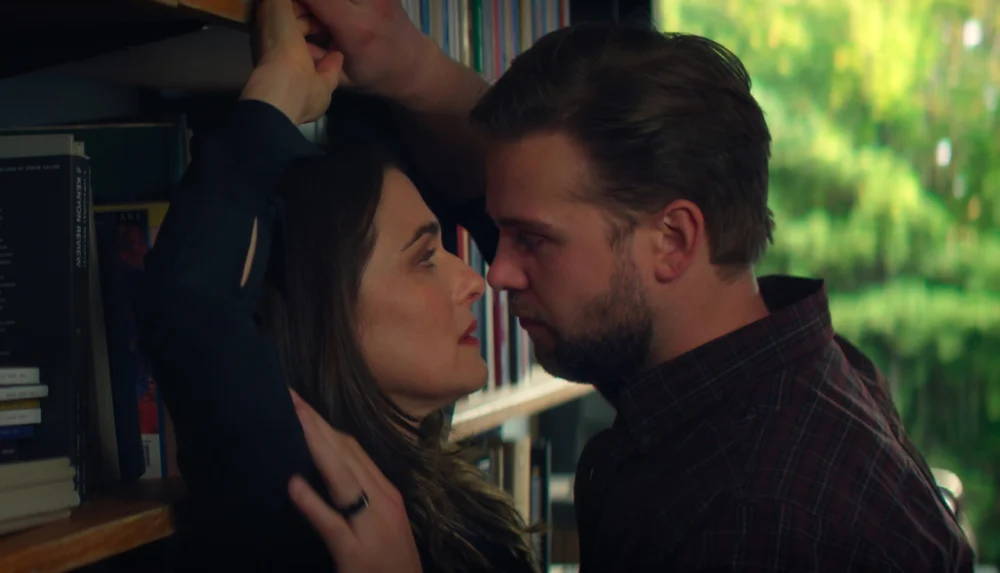
The series, much like the novel it’s based on, opens with an immediate hook: a flash-forward depicting Vladimir tied to a chair. While the in medias res opening followed by a rewind has become a somewhat overused narrative device in recent television, "Vladimir" earns its use, providing a potent image that sets a tone of mystery and simmering intensity. However, unlike the novel, the television adaptation endeavors to visually delineate the boundaries, however blurry, between the narrator’s fervent, intrusive fantasies and her actual interactions with Vladimir. Directors Shari Springer Berman and Robert Pulcini skillfully employ constant cutaways, deploying breathless close-ups and swooning slow-motion sequences to immerse the viewer firmly within the lustful professor’s point of view, meticulously detailing her imagined desires. The deliberate ambiguity surrounding the extent to which these sequences are rooted in actual chemistry or purely in her mind is a central conceit, culminating in her direct question to Vladimir: "Did I make it all up?"
Yet, by the time this pivotal question is posed, the device, initially effective, has begun to wear thin. The repeated visual reiterations of the narrator’s desire, while establishing her infatuation, often fail to introduce new complications or meaningfully advance the narrative. As the story inexorably progresses towards John’s Title IX hearing and the broader societal judgment on what was once a tacitly accepted, consensual practice now re-evaluated as an unforgivable abuse of power, Weisz’s increasingly frequent reveries begin to feel less like an organizing principle and more like narrative padding. This structural imbalance points to a missed opportunity for deeper character development elsewhere. The central couple’s daughter, Sid (Ellen Robertson), remains stubbornly underdeveloped, presented as a collection of convenient plot shortcuts and broad stereotypes about sensitive, gender-bending youth. Similarly, John’s accusers are painted with an overly broad brush, sacrificing genuine nuance for generalized generational satire. Sid’s profession as a lawyer, while convenient for the plot, further underscores the narrative’s tendency to prioritize expediency over organic character growth, negating the need to introduce new legal counsel for John’s de facto trial.
Furthermore, "Vladimir" waits far too long to unpack the intricate mechanics of what our narrator dismissively refers to as "an open marriage, but without all the awful communication." This "arrangement" is alluded to early on, ostensibly to contextualize John’s dalliances as something other than outright betrayals. However, the series delays in revealing how and when the narrator herself has availed herself of these liberties in the past. While this narrative choice might be intended to cultivate suspense, its ultimate effect is a frustrating vagueness surrounding the foundational conditions of the show’s central infatuation. A clearer understanding of the couple’s marital parameters earlier on could have provided a richer, more nuanced backdrop for the narrator’s blossoming obsession.
These narrative and structural hiccups are further complicated by what feels like a significant disconnect in casting, particularly concerning Rachel Weisz and Leo Woodall in their assigned roles. The narrator famously introduces herself with the line, "It has recently come to my attention that I may never again have power over another human being." This statement, profoundly impactful on the page, takes on a different, almost unbelievable resonance when delivered by a performer as inherently captivating and effortlessly powerful as Rachel Weisz. It’s challenging for the audience to reconcile the character’s profound insecurity and fear of irrelevance with Weisz’s undeniable charisma and seductive pull. While Weisz has recently showcased her extraordinary range in roles like the identical twins in the "Dead Ringers" remake, "Vladimir" arguably pushes her powers of illusion a touch too far, asking the audience to believe in a vulnerability that her screen presence inherently contradicts. This creates a dissonance that can pull viewers out of the narrative, making it difficult to fully invest in the character’s internal struggle with self-worth and perceived desirability.
Woodall, too, while charming and capable, feels somewhat out of place, albeit less crucially. Following his notable turns in "The White Lotus" and "One Day," Woodall projects ample charm and bravado, certainly justifying his coworker’s attraction. However, he struggles to embody the intellectual gravitas and scholarly intensity that one might associate with a "hot-shot scholar." Vladimir, in the narrative, is not merely a "boy toy"; he is married to another writer, Cynthia (Jessica Henwick), and is a father to a three-year-old daughter. While the 29-year-old Woodall comfortably slots into the narrator’s flagrant objectification, he less convincingly portrays the complex, real person beneath the fantasy – a man who, it’s implied, might be using the flirtation as an easy escape from his own complicated home life. This dissonance, while perhaps purposefully highlighting the narrator’s subjective, self-serving perspective, nonetheless makes it harder to engage with Vladimir as a fully fleshed-out character beyond the object of desire.
Yet, "satisfaction" in "Vladimir" extends beyond mere masturbatory daydreams. Vladimir becomes, for our heroine, a potent muse, inspiring her to write with a renewed abandon, often at the expense of her professional and personal obligations. The series posits that desire, in its most consuming form, can be a profound creative act. This central thesis draws a clear parallel to Joey Soloway’s profoundly niche 2017 Amazon series, "I Love Dick," which also adapted a novel exploring the self-actualizing power derived from a woman over 40 surrendering to her own appetites. "I Love Dick," however, was an earthier, more viscerally sensual show, embracing the messiness and raw physicality of desire. "Vladimir," in contrast, often punctuates Weisz’s awakening with incongruous pop music, a choice that frequently simplifies a subject of considerable complexity. The final musical sync, in particular, lands as a discordant note, undermining the potential for a more nuanced emotional resonance. While Weisz masterfully navigates the slapstick comedy inherent in being hot and bothered in an inappropriate academic setting, "Vladimir" ultimately struggles to fully "walk the walk" in demonstrating how erotic fixation can authentically lead to artistic transcendence. It hints at this powerful connection but never quite fully embodies it, leaving the viewer with a sense of an opportunity not entirely seized.
All eight episodes of "Vladimir" are now available for streaming on Netflix, offering a compelling, if imperfect, dive into the complexities of desire, aging, and academic life.