


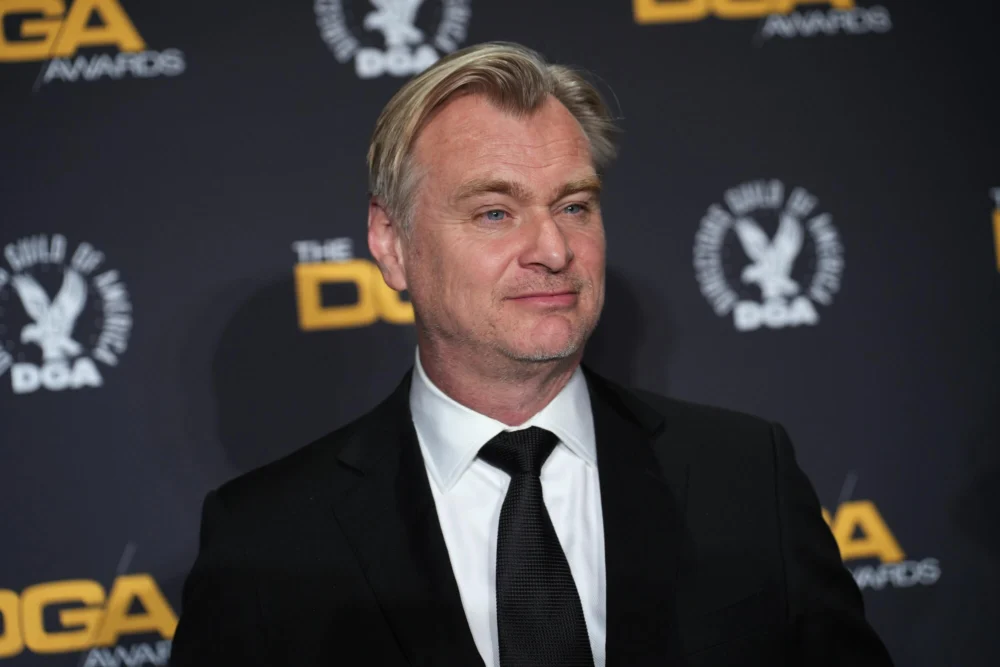
The annual Kodak Film Awards, now in its eighth iteration, recently convened a constellation of cinematic luminaries to celebrate the enduring artistry and technical brilliance of celluloid. More than a mere awards ceremony, the event served as a poignant reaffirmation of film’s irreplaceable role in storytelling, punctuated by heartfelt tributes and impassioned advocacy. Central to the evening’s emotional core was a profound homage paid by acclaimed director Christopher Nolan to the late David Keighley, IMAX’s first chief quality officer, whose indelible legacy as a pioneer of large-format cinema continues to shape the immersive cinematic experience.
Nolan, a fervent champion of film and a director synonymous with pushing the boundaries of IMAX photography, took to the stage to present the inaugural Keighley Award. This deeply personal honor was bestowed upon Patricia Keighley, David’s esteemed business partner and wife, in recognition of her late husband’s unparalleled contributions. The atmosphere was charged with both reverence and a tangible sense of loss as Nolan, his voice imbued with genuine affection, shared insights into a two-decade-long mentorship that profoundly influenced his own trailblazing career. “David Keighley was my friend and my IMAX mentor for over 20 years,” Nolan stated, his words resonating with the weight of shared history and innovation. “He was incredibly knowledgeable, a wonderful collaborator. He was the first person to take seriously and ultimately enable my mad dream of shooting Hollywood movies on IMAX film.”
This “mad dream” was, in essence, a paradigm shift for the film industry. Prior to Nolan’s ambitious vision, IMAX was largely reserved for documentary shorts and specialized educational content. The notion of capturing a sprawling narrative feature on the massive, unwieldy 15-perf 70mm IMAX film stock was considered by many to be impractical, if not impossible. The cameras were bulky, the film expensive, and the post-production workflow complex. Yet, David Keighley, with his profound technical acumen and unwavering belief in the format’s potential, saw beyond these challenges. He became the crucial bridge between Nolan’s artistic ambition and the technical realities of bringing such monumental visions to life. Keighley’s expertise spanned everything from advising on camera modifications to developing specialized post-production techniques that ensured the integrity and breathtaking quality of the IMAX image from capture to exhibition. His guidance was instrumental in transforming Nolan’s audacious ideas into cinematic triumphs, forever altering the landscape of blockbuster filmmaking and popularizing the immersive IMAX experience for narrative features.
David Keighley, who tragically succumbed to cancer last year, left behind a monumental legacy that extended far beyond his collaboration with Nolan. As IMAX’s first chief quality officer, he was the unseen hand ensuring the unparalleled visual and auditory fidelity that became synonymous with the IMAX brand. His meticulous oversight spanned the post-production of more than 500 IMAX films, a testament to his dedication to technical excellence and his profound understanding of the medium. From the delicate process of film scanning and color grading to the intricate sound design and mastering for giant screens, Keighley’s influence was pervasive. He was the guardian of the IMAX promise: an experience so immersive, so crystal clear, that it transcends mere viewing. Nolan further revealed that Keighley’s commitment to his craft remained undiminished until his final days, noting, “The last film he completed was the aforementioned ‘Sinners.’ He did some incredible work on that. And I’m pleased to be able to say that before he left us last year, he was able to finish supervising every foot shot on our upcoming version of ‘The Odyssey.'” These posthumous contributions underscore a life dedicated to the art and science of cinema, pushing boundaries even in the face of personal adversity.
Nolan’s tribute seamlessly transitioned from Keighley’s technical prowess to his pivotal role in a much broader battle for the future of film itself. In an era increasingly dominated by digital acquisition, the continued viability of shooting on film faced existential threats. There was a period, Nolan recounted, when previous management at Kodak had begun to sound out Hollywood studios on their commitment to celluloid. The feedback from various layers of middle management was disheartening, often dismissive, with the sentiment that “nobody cares” about film. Crucially, these conversations had not yet reached the filmmakers themselves, the artists for whom film was not just a medium, but a vital component of their creative expression.
It was in this critical juncture that David Keighley emerged as a silent but powerful advocate. Recognizing the artistic and cultural imperative to preserve film, he approached Christopher Nolan and his producing partner, Emma Thomas. Keighley tasked them with an extraordinary mission: to rally filmmakers across all budget levels and disciplines, to galvanize a collective voice that would articulate the critical importance of shooting on film. This wasn’t merely about nostalgia; it was about safeguarding an aesthetic, a workflow, and a creative choice that many artists deemed essential. The subsequent effort, spearheaded by Nolan and Thomas, saw an unprecedented alliance of directors, cinematographers, and producers publicly affirming their commitment to film. This concerted advocacy, bolstered by a passionate creative community, ultimately proved successful. Kodak, swayed by the overwhelming support from the industry’s most influential voices, reaffirmed its commitment to manufacturing film stock, ensuring that celluloid would remain a viable option for generations of filmmakers to come. Keighley’s quiet but strategic intervention was a testament to his foresight and his profound understanding of the symbiotic relationship between technology and artistry.
Beyond the profound tribute to David Keighley, the Kodak Film Awards also celebrated contemporary visionaries who continue to push the boundaries of cinematic art, many of whom are women making indelible marks on the industry. Autumn Durald Arkapaw, a celebrated cinematographer whose distinctive visual style has graced numerous acclaimed productions, was honored with the Lumière Award. This recognition underscored her significant contributions to the art of cinematography, a field historically dominated by men. Kodak has been a steadfast supporter and collaborator on Arkapaw’s recent projects, including the aforementioned “Sinners” and “The Last Showgirl,” both of which showcase her masterful command of light, composition, and color palette. Her work is characterized by a nuanced ability to evoke mood and emotional depth, often through evocative naturalism and a keen eye for human vulnerability.
In her acceptance speech, Arkapaw humbly yet powerfully shifted the spotlight, celebrating her camera team whom she affectionately dubbed the “unsung heroes of filmmaking.” This acknowledgement resonated deeply, highlighting the collaborative spirit inherent in cinema and the often-overlooked craftspeople who bring a director of photography’s vision to life. She further lauded director Ryan Coogler, a frequent collaborator, for his exemplary leadership. “Ryan is someone who champions the people around him,” Arkapaw stated, emphasizing the importance of inclusive and supportive filmmaking environments. “He leads with love and grace in turn that is reflected in the films that we make. He sees all the people that work for him, and he sees my crew.” Her words served as a powerful reminder of how ethical leadership and genuine respect on set translate directly into the quality and humanity of the final cinematic product, a particularly salient message for a women-focused audience.
The Auteur Award, recognizing motion picture artists who demonstrate both critical acclaim and unwavering artistic integrity, was presented to Joachim Trier, the acclaimed director of “Sentimental Value.” Trier’s body of work is distinguished by its rigorous exploration of human psychology, memory, and relationships, always delivered with a unique blend of intellectual curiosity and emotional resonance. Kodak lauded him as an artist whose influence on contemporary cinema continues to grow, a testament to his consistent originality and thematic depth. Trier, a devoted advocate for film, has shot five of his six features on celluloid, a conscious artistic choice that informs the very texture of his storytelling.
Trier articulated his passion for film with eloquence and conviction, dispelling any notion that his preference was mere snobbery. “I really feel grateful for that. It’s not a snobbish thing. It’s actually how I feel: at home on a film set,” he explained, capturing the visceral connection many filmmakers have to the medium. He spoke of the unique atmosphere film creates: “Something happens around the camera. Something happens when that sound of a purring cat comes from the camera. The actors feel it. We all feel it. It creates a different type of focus to what happens with the actors and the wonderful DPs.” This “purring cat” — the gentle whir of a film camera — is not just a sound; it’s a sensory experience that grounds the entire creative process, fostering a heightened sense of presence and concentration. Trier also praised film’s inherent aesthetic qualities, particularly its ability to render the human form with unparalleled richness: “You can see all the rich skin tones of the performances that you saw in reality just a little bit more magical and a little bit better.” This celebration of film’s organic warmth and nuanced portrayal of human experience resonates deeply with audiences seeking a more authentic and visually engaging cinematic journey.
The evening’s diverse honorees further underscored the breadth and vitality of contemporary filmmaking. Kristen Stewart, a celebrated actress transitioning powerfully into directorial endeavors, was presented with the Debut Feature Award for her upcoming film, “The Chronology of Water.” Her foray into directing marks an exciting new chapter for an artist known for her fearless performances and independent spirit, highlighting the growing number of women stepping behind the camera to tell their own stories. Salomon Ligthelm received the Music & Commercial Film Director Award, acknowledging the artistic innovation and storytelling prowess within these often-underestimated formats. Finally, the acclaimed television series “Fallout,” which notably chose to shoot on film, was honored as Television Series of the Year. This recognition of a major episodic production embracing celluloid signals a refreshing trend, demonstrating that the unique aesthetic and creative advantages of film are increasingly being valued across all forms of visual media, proving that the legacy championed by figures like David Keighley continues to inspire and thrive in the ever-evolving landscape of entertainment.