

Trump’s Image Approved for Presidential Commemorative Coin, Sparking Controversy
A commemorative gold coin, set to feature the likeness of President Donald Trump, has received the green light from a special advisory commission appointed by the President himself. The U.S. Commission of Fine Arts, a body tasked with advising on the design of federal buildings and monuments, reportedly approved the design on Thursday, a move that has drawn sharp criticism from Democratic opponents who view it as an unprecedented and potentially inappropriate use of presidential imagery on official coinage.
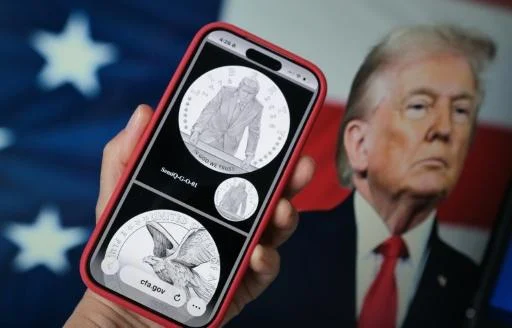
Details of the proposed design, which emerged in media reports following the commission’s decision, depict a striking image of Trump on one side. He is shown standing, with his fists clenched on a desk, a pose described by some as assertive or defiant. The reverse side of the coin features an eagle with outstretched wings, perched above what appears to be a bell. The coin itself will not hold any monetary value, serving purely as a collectible item. While the exact sale price remains undisclosed, similar commemorative coins issued by the U.S. Mint can command prices exceeding $1,000, depending on their material and historical significance.
The rationale behind featuring the sitting president on a coin intended to mark a significant national milestone—the 250th anniversary of the United States’ founding—was articulated by U.S. Treasurer Brandon Beach. In a statement, Beach expressed enthusiasm for the initiative, asserting, “We are thrilled to prepare coins that represent the enduring spirit of our country and democracy, and there is no profile more emblematic for the front of such coins than that of our serving president.” He further clarified that this particular coin’s design would be distinct from other Trump-themed coins currently in development, including a $1 circulating coin and a separate one-ounce gold coin, both of which are also slated to bear his image.
This approval comes amidst a backdrop of significant personnel changes within advisory bodies overseeing national aesthetics and design. In October, President Trump controversially dismissed all six members of the U.S. Commission of Fine Arts, replacing them with individuals of his own choosing. This action coincided with the President’s renewed focus on a series of renovation and building projects initiated since his return to power in January. Among the most discussed of these projects are the construction of a new ballroom at the White House and the extensive renovation of the iconic Kennedy Center for the Performing Arts in Washington, D.C., which the President has controversially renamed in his own honor.
The decision by the Commission of Fine Arts stands in contrast to the stance taken by another advisory panel, the Citizens Coinage Advisory Committee. In February, this committee reportedly declined to even place the proposed Trump coin on its agenda for discussion. One member of that committee, Donald Scarinci, articulated a strong objection to the concept, citing historical precedent. At the time, Scarinci argued that since the signing of the Declaration of Independence in 1776, “no nation on earth has issued coins with the image of a democratically elected leader during the time of their service.” He further elaborated, “Only those nations ruled by kings or dictators display the image of their sitting ruler on the coins of the realm.” This historical perspective highlights a long-standing tradition of separating the imagery of elected leaders from circulating or official commemorative currency, a practice that has historically been reserved for monarchs and authoritarian figures.
The approval of the Trump coin by the Commission of Fine Arts, therefore, represents a notable departure from established norms and has ignited a debate about the appropriate representation of political figures on national symbols. Critics argue that such a move blurs the lines between presidential office and personal branding, potentially setting a precedent that could be exploited by future administrations for partisan purposes. The commemorative coin, while not intended for circulation, carries symbolic weight, and its design and issuance are being scrutinized as a reflection of the current administration’s approach to national iconography and historical commemoration.
The U.S. Mint has a long history of producing commemorative coins to celebrate significant events, individuals, and themes in American history. These coins are often struck in precious metals like gold and silver and are highly sought after by collectors. However, the practice of featuring a sitting president’s portrait on a coin, particularly one designed to mark a foundational national anniversary, is indeed rare. Typically, presidential likenesses appear on coins only posthumously, often in the context of memorial or historical series that honor their service and legacy after their time in office has concluded. This distinction is crucial in understanding the sensitivity surrounding the current decision.
The historical context of coinage design in the United States reflects a deliberate effort to embody national ideals and historical milestones rather than the transient image of a political leader. The Lincoln Memorial Penny, the Jefferson Nickel, the Roosevelt Dime, and the Washington Quarter, for instance, all feature figures who are deceased and whose contributions are widely recognized as having shaped the nation. Even presidential dollar coins, which were introduced in 2007, feature presidents from the order in which they served, and these are circulating currency, distinct from special commemorative issues that often carry a higher artistic and symbolic value. The debate over the Trump coin thus touches upon the very essence of what these national symbols are meant to represent: enduring values, historical achievements, and a collective national identity, rather than the personality or immediate presence of a single political figure.
The composition of the U.S. Commission of Fine Arts itself has also become a point of contention. The commission’s role is advisory, meaning it makes recommendations to relevant government agencies, but its opinions carry significant weight due to the expertise of its members. The President’s authority to appoint members to such commissions is standard, but the timing and nature of the dismissals and subsequent appointments have been interpreted by some as an attempt to ensure a more compliant or ideologically aligned body. The swift approval of the Trump coin design by this newly constituted commission has fueled these suspicions, with critics suggesting that the process may have been expedited or influenced by political considerations rather than purely artistic merit or historical appropriateness.
Furthermore, the choice of imagery on the coin warrants closer examination. The depiction of Trump with clenched fists on a desk is open to interpretation. Supporters might view it as a symbol of strength, resolve, and decisive leadership. Critics, however, might see it as aggressive or overly self-aggrandizing, particularly in the context of a coin meant to celebrate national unity and history. The eagle on the reverse side, a perennial symbol of American power and freedom, is presented with wings spread, a posture often associated with freedom and flight. Its placement above a bell could evoke the Liberty Bell, a powerful symbol of American independence, though the specific design elements are subject to individual perception and interpretation.
The broader implications of this decision extend beyond the immediate controversy. If the precedent is set for featuring sitting presidents on commemorative coins, it raises questions about how future administrations might utilize such opportunities. Would future presidents also have their likenesses featured on coins marking national anniversaries? And what criteria would be used to determine the appropriateness of such imagery? The potential for politicization of national symbols is a significant concern, and opponents of the Trump coin argue that this decision opens the door to such risks. They contend that a healthy democracy requires a separation between the symbols of the state and the immediate political figures who lead it, ensuring that national icons transcend partisan affiliations and serve as unifying emblems for all citizens.
The U.S. Mint, responsible for the production of all U.S. coinage, operates under the Department of the Treasury. While the Mint produces circulating currency, it also has a mandate to create commemorative coins that celebrate American heritage and achievements. The process for approving designs for commemorative coins typically involves input from various advisory bodies, including the Commission of Fine Arts and the Citizens Coinage Advisory Committee, before final decisions are made by the Secretary of the Treasury and the Director of the Mint. The fact that one committee reportedly refused to even consider the design, while another approved it, underscores the divided opinions and the contentious nature of this particular issue.
The upcoming 250th anniversary of the United States in 2026 is intended to be a moment of national reflection and celebration. The designs chosen for any commemorative items associated with this pivotal anniversary are therefore under particular scrutiny. The inclusion of President Trump’s image on a gold coin intended for this occasion is viewed by many as a departure from the solemnity and historical reverence that such a milestone warrants. The debate is not simply about the aesthetics of a coin, but about the underlying principles of national symbolism and the preservation of historical traditions that aim to unite rather than divide the citizenry.
As the U.S. Mint prepares to move forward with the production of this coin, the controversy is likely to persist. It highlights a broader discussion about the intersection of politics, art, and national identity in the United States. The symbolic power of coinage, often overlooked in daily transactions, can carry profound meaning, and the decisions made regarding its design and imagery are thus subject to significant public interest and debate, particularly when they challenge established norms and traditions.