


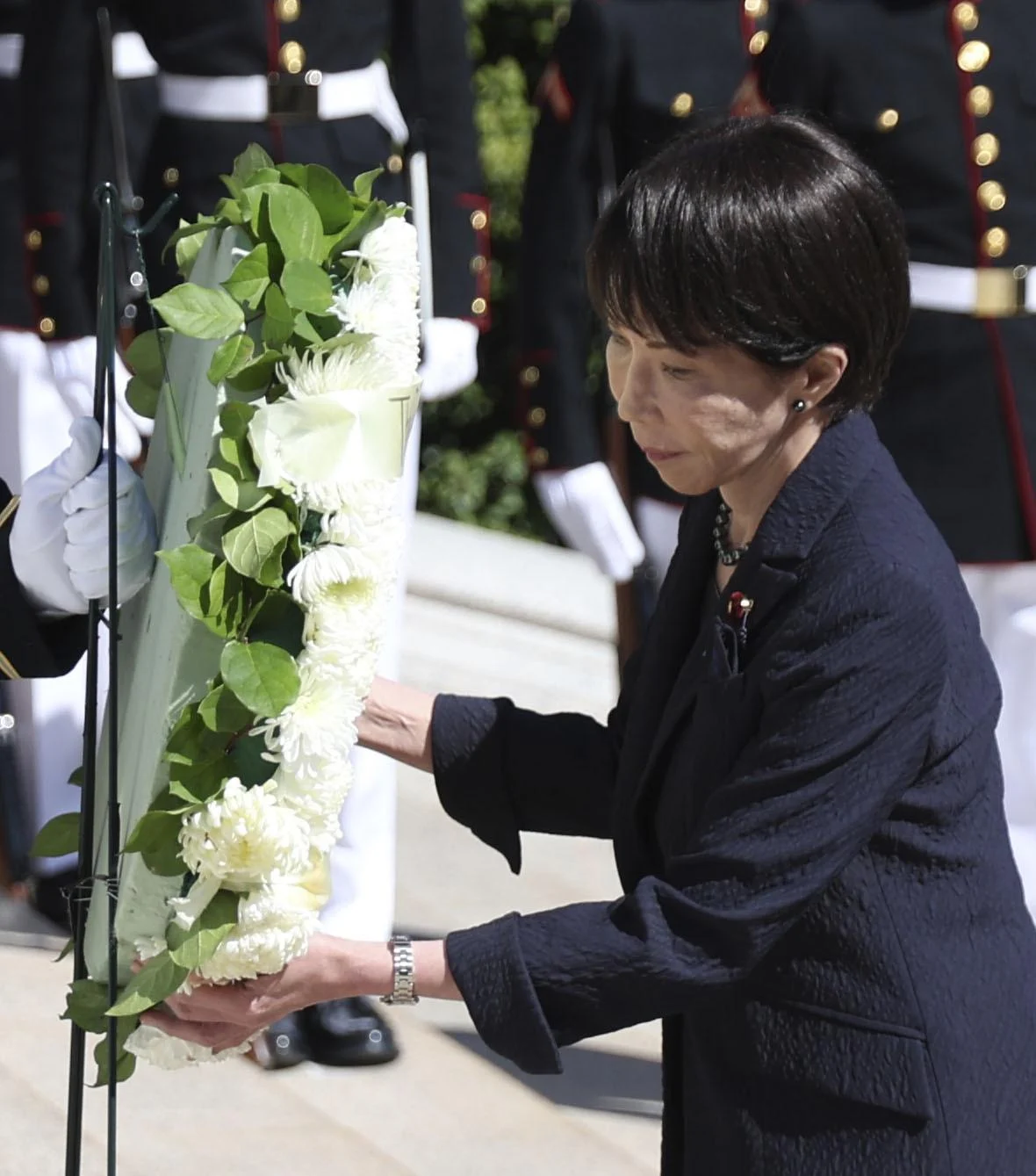
Japanese Prime Minister Sanae Takaichi concluded her significant inaugural visit to the United States on Friday, marking the occasion with a solemn tribute at Arlington National Cemetery. The visit, which included crucial discussions with U.S. President Donald Trump, underscored the enduring strength and evolving dynamics of the security alliance between Japan and the United States.
The hallowed grounds of Arlington National Cemetery served as the backdrop for a poignant ceremony, where the national anthems of both Japan and the United States resonated, a clear testament to the deep-rooted partnership. Prime Minister Takaichi, in a gesture of profound respect and solidarity, laid a wreath at the Tomb of the Unknown Soldier, a powerful memorial dedicated to the countless service members whose identities remain unknown, their sacrifices etched into the fabric of national history.
Prime Minister Takaichi’s arrival in Washington D.C. on Wednesday evening initiated a packed agenda, culminating in a highly anticipated meeting with President Trump at the White House on Thursday. This summit represented their second in-person encounter since Prime Minister Takaichi made history as Japan’s first female prime minister in October, a milestone that itself signifies progress and changing leadership paradigms.
The atmosphere surrounding this high-level summit was layered with anticipation, particularly given the backdrop of the escalating U.S.-Iran conflict. Many observers had speculated whether the ongoing hostilities might overshadow the crucial bilateral discussions. However, the meeting proved to be remarkably productive, yielding concrete agreements across a spectrum of vital areas, including defense cooperation and economic security. Beyond the policy outcomes, the summit also served as a powerful showcase of the strong personal rapport that exists between President Trump and Prime Minister Takaichi, a connection that bodes well for continued collaboration.
Despite the overarching successes, President Trump did articulate a clear expectation for Japan to “step up” its contributions to ensuring maritime security, particularly in the Strait of Hormuz. This strategically vital waterway, currently experiencing significant disruptions due to the conflict with Iran, is a critical chokepoint for global energy supplies. President Trump highlighted Japan’s substantial reliance on crude oil imports from the Middle East, the vast majority of which transit through this narrow, strategically important passage. His remarks emphasized the shared responsibility in maintaining freedom of navigation and ensuring global energy stability.
The U.S. military operations against Iran have indeed ignited considerable debate within the international legal framework. Critics have raised concerns, labeling the strikes, launched in conjunction with Israel on February 28th, as preemptive actions that could potentially violate established norms of international law. The legality and implications of such military interventions are complex and subject to ongoing scrutiny by legal scholars and international bodies. While Prime Minister Takaichi did not offer a direct legal assessment of the conflict, her public statements conveyed a clear message of support for President Trump’s leadership. She characterized him as “the only person who can bring peace and prosperity across the world,” a statement that, while not endorsing specific military actions, signals her confidence in his broader vision for global stability.
This visit comes at a pivotal moment for both nations and the broader international community. The U.S.-Japan alliance, a cornerstone of regional security for decades, is being tested and redefined by evolving geopolitical challenges. Prime Minister Takaichi’s proactive engagement with President Trump signifies Japan’s commitment to playing a more robust role in addressing these complex issues. Her leadership, particularly as the first woman to hold the prime ministerial office in Japan, also represents a significant cultural and political shift, offering a fresh perspective on diplomacy and international relations.
The discussions on defense cooperation are particularly noteworthy. Both nations share a common interest in maintaining a free and open Indo-Pacific region, and their security strategies are increasingly intertwined. The agreements reached are expected to bolster joint military capabilities, enhance interoperability, and strengthen deterrence against potential adversaries. This could involve increased joint exercises, advanced technology sharing, and a more coordinated approach to regional security challenges, including those posed by North Korea and China’s growing assertiveness.
Economic security was another critical pillar of the summit. In an era of increasing global economic volatility and concerns about supply chain vulnerabilities, the U.S. and Japan are working to safeguard their economic interests and promote shared prosperity. This could translate into collaborative efforts to secure critical supply chains, counter economic coercion, and foster innovation in emerging technologies. Given Japan’s status as a major global economic power, its alignment with U.S. economic policy is crucial for shaping the future of global trade and investment.
The personal chemistry between President Trump and Prime Minister Takaichi, as observed during their summit, is a valuable asset in navigating these complex international relations. Strong personal relationships between leaders can facilitate more effective communication, foster trust, and enable quicker decision-making during times of crisis. Their ability to connect on a personal level, beyond the formal diplomatic protocols, can translate into more tangible outcomes for their respective nations and for global stability.
President Trump’s call for Japan to “step up” in the Strait of Hormuz is a direct reflection of the shared burden of ensuring global energy security. Japan’s energy dependence on the Middle East is a well-known fact, and its economic well-being is intrinsically linked to the stability of shipping lanes. While Japan has historically contributed to maritime security in the region, the current geopolitical climate necessitates a reassessment and potentially an increased role. This could involve expanded participation in multinational naval patrols, increased contributions to maritime surveillance, and enhanced support for efforts to de-escalate tensions.
The broader context of the U.S.-Iran conflict cannot be ignored. The regional instability stemming from these tensions has far-reaching implications for global trade, energy markets, and international security. Japan, as a key U.S. ally and a major trading nation, has a vested interest in seeing a peaceful resolution to the conflict. Prime Minister Takaichi’s supportive stance towards President Trump, while carefully worded, signals her understanding of the delicate balance required to navigate these volatile situations. Her acknowledgment of his role in pursuing peace and prosperity, even amidst military engagement, suggests a belief in his ultimate objectives for global stability.
The visit also provided an opportunity for Prime Minister Takaichi to engage with other key figures in the U.S. administration, further solidifying the extensive network of relationships that underpin the U.S.-Japan alliance. These engagements likely touched upon a wide array of bilateral and global issues, reinforcing the comprehensive nature of their partnership. The discussions at Arlington, in particular, served as a powerful reminder of the sacrifices made by both nations in the pursuit of peace and security, providing a solemn and inspiring context for the ongoing diplomatic efforts.
As Prime Minister Takaichi returns to Japan, the outcomes of her U.S. visit are expected to resonate throughout the coming months and years. The concrete agreements reached, the personal rapport established, and the clear articulation of shared challenges and responsibilities will undoubtedly shape the future trajectory of the U.S.-Japan alliance. Her leadership, characterized by a blend of tradition and forward-thinking, is poised to make a significant impact on Japan’s role in the global arena and its relationship with its most important security partner.
© KYODO