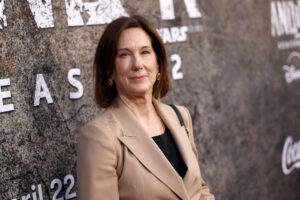


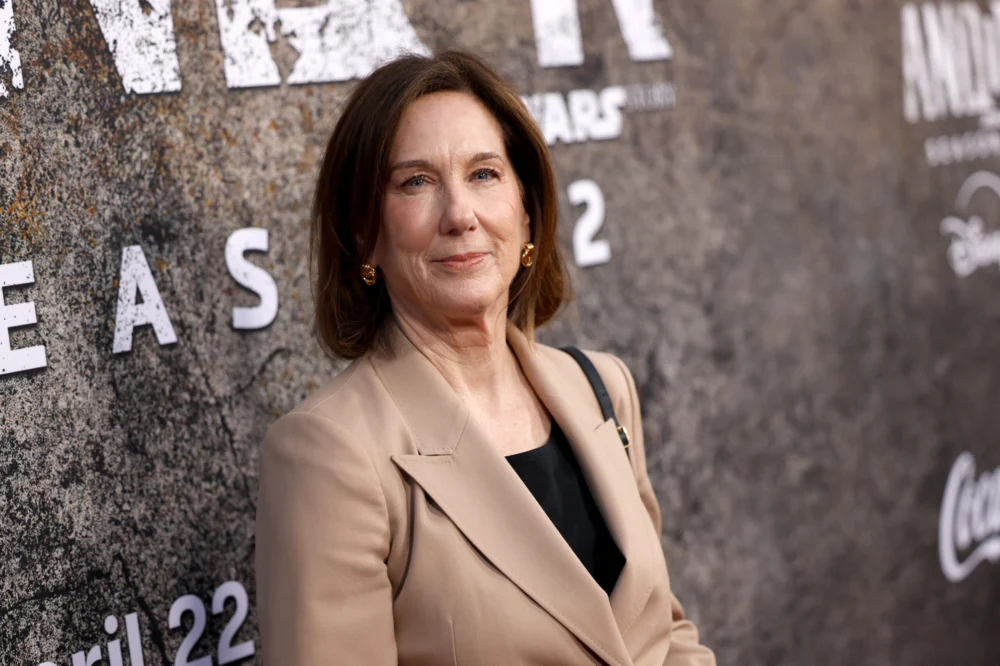
In a distinguished gathering that paid homage to the often-overlooked architects of auditory experience, legendary filmmaker and former Lucasfilm president Kathleen Kennedy recently graced the Motion Picture Sound Editors’ annual Golden Reel Awards. Receiving an honorary award, Kennedy used her platform not for self-aggrandizement, but to eloquently champion the profound and pervasive impact of American sound designers on the cinematic landscape. Her appearance at the Wilshire Ebell Theatre in Los Angeles marked a poignant moment of reflection on a career that has indelibly shaped global cinema, producing an astonishing array of films from the whimsical wonder of “Jurassic Park” and “Back to the Future” to the harrowing historical depth of “Schindler’s List.”
Kennedy’s address was a masterclass in appreciating the granular details that coalesce to create cinematic magic. “Sound helps root the story,” she asserted, articulating a philosophy that has guided her prolific career. “It helps represent where characters are, not only geographically, but emotionally. It helps foreshadow the intent of a character or define what they’re going through. In short, it takes the audience on the journey of the film.” Her words resonated deeply within a room full of professionals who dedicate their lives to this intricate craft, underscoring sound’s indispensable role in narrative immersion and emotional resonance. It’s a testament to her vision that even after decades at the pinnacle of Hollywood, she continues to illuminate the collaborative brilliance behind the scenes.
The esteemed Ben Burtt, a titan in sound design himself, renowned for sculpting the iconic soundscapes of the Star Wars universe, presented Kennedy with her honor. This pairing was particularly fitting, given their shared history and mutual respect. Kennedy elaborated on her early education in sound, crediting the “absolute titans of this craft” with instilling in her a fundamental understanding: “Sound isn’t just pasted on at the end, it’s the heartbeat of the story that should be conceived and designed and refined from the earliest stages of the process.” This insight speaks volumes about her approach to filmmaking – a holistic one that integrates every element, from script to screen, into a cohesive artistic statement. For a producer of her stature, this deep respect for every department highlights a leadership style focused on empowering creative talent.
One of the most vivid illustrations of this philosophy, Kennedy recalled, was her work on Steven Spielberg’s seminal 1982 film, “E.T. the Extra-Terrestrial,” a project on which she collaborated closely with Burtt. While much effort was poured into E.T.’s visual design, Kennedy recounted a pivotal moment of realization. “Steven and I spent so much time worrying about how E.T. was going to look, but it wasn’t until we heard those heavy, shuffling footsteps and the raspy, melodic breathing that E.T. became real. He wasn’t a puppet anymore, he was a friend.” This anecdote beautifully encapsulates the transformative power of sound, demonstrating how auditory cues can imbue a character with soul and personality, transcending mere visual representation to forge a genuine emotional connection with the audience. The meticulous detail in E.T.’s sound, including his distinctive voice, became as iconic as his glowing finger.
The origin of E.T.’s voice itself is a fascinating tale, further underscoring the ingenuity of sound designers like Burtt. Kennedy shared the story of Pat Welsh, a woman Burtt serendipitously encountered at a photography store in San Anselmo. Welsh, a heavy smoker, possessed a uniquely raspy yet melodic voice. Burtt, recognizing the potential, patiently waited for her to emerge from the store, then approached her with an unusual proposition: “He asked her if she’d like to be an alien in a movie.” This spontaneous discovery and the willingness of a sound designer to seek out the extraordinary in the mundane exemplify the boundless creativity that Kennedy has celebrated throughout her career. It’s a reminder that sometimes the most memorable cinematic moments spring from the most unexpected sources.
Beyond her retrospective reflections, Kennedy also offered a glimpse into her ongoing projects and the future of her involvement in the industry. Backstage, she conversed with Variety, specifically touching upon the highly anticipated May release of “The Mandalorian & Grogu,” a film she greenlit and continues to produce. Asked about the first time she heard Grogu (affectionately known as Baby Yoda), speak, Kennedy offered a poignant observation that looped back to her core message about sound and emotion. Grogu, she noted, is “another perfect example of a character that has to emote and you have to feel connected to, and he never speaks a word.” This revelation confirms that the beloved character will retain his silent, yet profoundly expressive, communication style on the big screen, a testament to the power of visual storytelling and, indeed, the subtle nuances of sound design that convey his every emotion without dialogue.
This commitment to non-verbal storytelling, especially in a franchise known for its rich dialogue and distinctive character voices like Yoda’s iconic broken English, speaks volumes about Kennedy’s artistic convictions. She affirmed that despite the elder Yoda’s vocal quirks, Grogu will not gain the power of speech in the new film, further solidifying his unique appeal and reinforcing the notion that connection in cinema often transcends words. Her continued involvement in projects like “The Mandalorian & Grogu,” even after her recent transition from the day-to-day leadership of Lucasfilm, highlights her enduring passion for compelling narratives within the universe she helped steward.
The conversation also naturally turned to her recent handover of the Lucasfilm reins in January. Kennedy reflected on the strategic transition, which saw longtime deputies Dave Filoni ascend to president and chief creative officer, and Lynwen Brennan take on the role of co-president. This was no abrupt departure, she clarified, but a carefully orchestrated succession. “It didn’t just happen six months ago,” Kennedy explained. “I spent 10 years talking Dave into gradually stepping into live action. He had so much experience in animation. He’s so knowledgeable about Star Wars and loves it so much, it’s really been a 10-year mentoring process for both of them.” She praised Brennan, who came from Industrial Light & Magic and served as her general manager throughout her tenure, asserting that “the transition has been really pretty seamless.” This deliberate, thoughtful approach to leadership succession is characteristic of Kennedy’s long-term vision and her dedication to nurturing talent within the industry.
Her tenure at Lucasfilm, though marked by immense creative output and commercial success, also coincided with a significant shift in fan engagement, particularly with the advent of pervasive social media. Comedian Patton Oswalt, who hosted the Golden Reels ceremony, lightened the mood with a quip that Kennedy had gone backstage for a ritual “freeing her from the nerd mafia she’s been trapped with for years,” adding she was “freed from the comments section.” While delivered in jest, Oswalt’s remarks subtly touched upon the intense and often challenging dynamics of modern fandom, especially for a franchise as globally beloved and scrutinized as Star Wars. This is a dynamic many women leaders in high-profile positions often navigate, facing heightened scrutiny and sometimes disproportionate criticism.
Kennedy herself addressed this backstage, reflecting on the unique pressures of her role at Lucasfilm. “I really segued into [that job] when the fan expectations collided with social media. That really has created a kind of explosion,” she observed. She acknowledged the intrinsic bond between Lucasfilm and its devoted fanbase, stating, “It’s always has been important to Lucasfilm, that the fans are huge part of what the franchise is. So that was something that was new to me and something that grew over time, but it’s remained incredibly important to the company.” Her perspective highlights the delicate balance required to innovate within a cherished universe while respecting its established lore and community, a challenge she met with resilience and a steadfast commitment to storytelling.
Bringing her on-stage remarks to a close, Kennedy delivered a final, heartfelt tribute to the relentless curiosity and ingenuity of sound designers, harking back to her 1981 film, “Raiders of the Lost Ark,” the groundbreaking inaugural installment of the Indiana Jones saga. “What I love most about sound designers and editors is your curiosity,” she said, her voice filled with admiration. “You’re the only people I know who can hear the scrape of a toilet lid and think that’s it. That’s it! That’s the sound of the Ark of the Covenant opening.” This humorous yet profound anecdote perfectly encapsulated the creative spirit she has so deeply valued and fostered throughout her career: the ability to perceive extraordinary potential in the ordinary, transforming everyday sounds into iconic cinematic moments that resonate for generations.
In a recent interview regarding her Disney exit, Kennedy had expressed interest in exploring the possibilities of AI in filmmaking. She took the opportunity to clarify her nuanced stance to Variety. She wished “it was called augmented reality, not artificial intelligence,” underscoring her commitment to human-centric creativity. “Many of us in the industry absolutely are committed to human beings and a human point of view,” she affirmed. Her vision for these emerging technologies is not one of replacement, but of enhancement: “[We’ll see] if these tools can end up augmenting that process, speed things up and find a place in the flow of creativity. That’s what I find quite intriguing about some of these tools. But, to actually replace human beings in the process? No.” This thoughtful perspective positions her as a forward-thinking leader who embraces technological evolution while staunchly safeguarding the irreplaceable role of human artistry and intuition in storytelling.
Kathleen Kennedy’s career is a monumental tapestry woven with unparalleled success and groundbreaking achievements. She has garnered eight Academy Award nominations, a testament to her consistent pursuit of excellence. Under her stewardship at Lucasfilm, she oversaw a period of immense success, including the release of “Star Wars: The Force Awakens,” which became the highest-grossing domestic film of all time, alongside other critically and commercially successful entries like “Rogue One,” “The Last Jedi,” and “Solo.” Even as she transitions from her executive role, her producing prowess continues to shape the future of the Star Wars universe, with her remaining projects including the imminent “The Mandalorian and Grogu” and the highly anticipated Ryan Gosling-led “Star Fighter.”
Prior to her transformative tenure at the Disney-owned label, Kennedy’s independent producing career was already legendary. She served as producer or executive producer on over 70 feature films, collectively earning an astounding 120 Academy Award nominations and securing 25 wins. Her filmography reads like a definitive list of modern classics: “Jurassic Park,” “E.T. The Extra-Terrestrial,” “The Sixth Sense,” the entire “Back to the Future” trilogy, “Who Framed Roger Rabbit,” “Gremlins,” and “The Goonies” are just a few examples of the indelible cinematic experiences she brought to life. Her ability to consistently identify compelling stories and shepherd them to the screen with artistic integrity and commercial appeal is virtually unmatched in Hollywood.
Beyond her direct contributions to film, Kennedy’s influence extends deeply into the fabric of the entertainment industry and wider society. Her accolades include a prestigious BAFTA fellowship and a CBE Award, recognizing her significant contributions to film arts. She has served as board chair for the American Film Institute (AFI), advocating for film preservation and education. A founding Council Member of the Hollywood Commission to Eliminate Sexual Harassment and Advance Equality, she has been a tireless advocate for a more equitable and inclusive industry, demonstrating leadership in crucial conversations about workplace culture. Currently, she continues to lend her expertise and vision to the boards of the LA Promise Fund, the Library of America, and USC’s School of Cinematic Arts, cementing her legacy not just as a filmmaker, but as a dedicated leader and mentor committed to shaping the future of storytelling and the broader cultural landscape.