

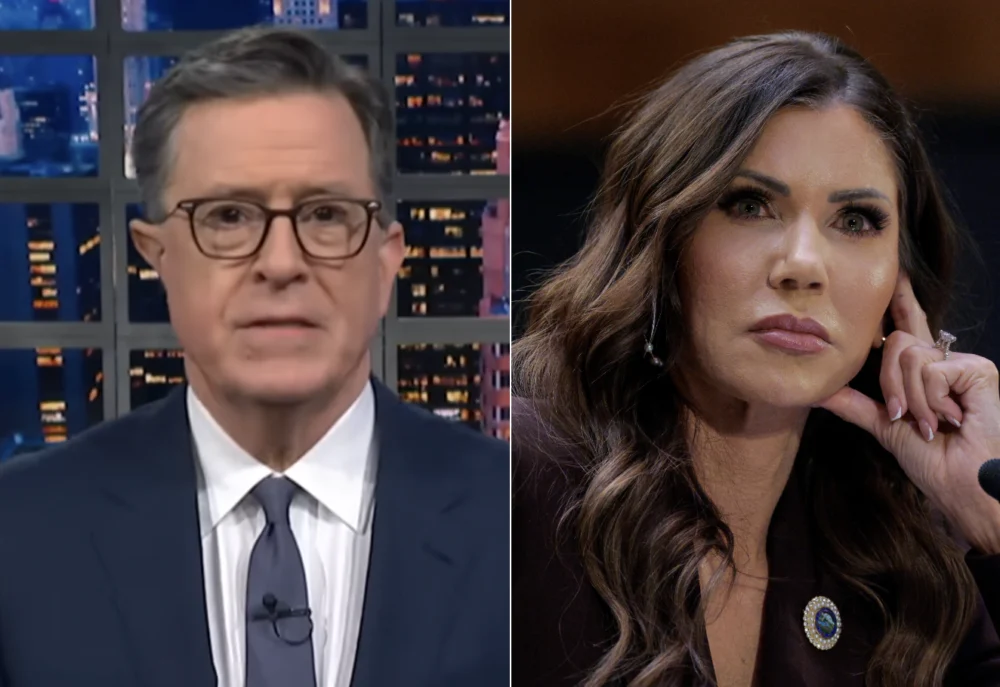
The political landscape was rocked by a sudden announcement from former President Donald Trump on March 5, revealing the unexpected dismissal of Kristi Noem from her high-profile role as Secretary of Homeland Defense. The news, which sent ripples through Washington and beyond, was swiftly met with a torrent of pointed satire and sharp commentary from the nation’s leading late-night hosts, Stephen Colbert and Jimmy Kimmel, who wasted no time in dissecting the controversial figure’s abrupt exit. Noem, a figure synonymous with staunch conservative policies and often inflammatory rhetoric, found herself at the center of a comedic maelstrom as Hollywood reacted to her departure with a mixture of disbelief and thinly veiled celebration.
Trump’s announcement was characteristic in its unexpected delivery, declaring that Noem would be "moving to be Special Envoy in the Western Hemisphere" – a role that immediately raised eyebrows and prompted questions about its legitimacy and purpose. Her replacement was named as Senator Markwayne Mullin of Oklahoma, signaling a shift in leadership for a department already under intense scrutiny. This unceremonious transition ignited a fresh wave of political commentary, with late-night television serving as a primary outlet for public processing and, inevitably, roasting.
Kristi Noem’s journey to the top echelons of federal security began with a significant profile already established in South Dakota politics. Prior to her appointment as Secretary of Homeland Defense, Noem had served as the state’s governor, gaining national attention for her conservative stances on issues ranging from pandemic responses to Second Amendment rights. Her political brand was often built on a defiant, no-nonsense image, appealing to a base that valued direct action and uncompromising rhetoric. Her appointment to such a critical federal role under the Trump administration underscored a commitment to a hardline approach, particularly concerning border security and immigration policy, issues that would ultimately define much of her tenure and contribute to its contentious end.
The Department of Homeland Defense, a sprawling and complex entity formed in the wake of the September 11th attacks, is tasked with safeguarding the nation against a wide array of threats, from terrorism to cyberattacks, and crucially, managing border security. It is a role that demands diplomatic skill, strategic foresight, and a nuanced understanding of domestic and international affairs. Noem’s tenure, however, was frequently marked by a confrontational style and a series of incidents that drew widespread criticism, ultimately leading to the public outrage that fueled her dismissal.
One of the most immediate and biting responses came from Stephen Colbert, host of CBS’s The Late Show. In his March 5 monologue, Colbert seized upon the peculiar nature of Noem’s new, vaguely defined role. "Sounds like someone’s about to become the FIFA Secretary of Homeland Security," Colbert quipped, drawing a direct and satirical link to the much-mocked "fake peace prize" that FIFA had controversially gifted Trump in the previous year. This seemingly innocuous joke carried a deeper sting, implying that Noem’s new position was not a genuine diplomatic appointment but rather a manufactured title, a political consolation prize designed to soften the blow of a clear demotion, much like the perceived dubious honor bestowed upon the former president.
Colbert then delved into a more direct and scathing critique, echoing a significant controversy from Noem’s time in office. "It’s too soon to know exactly why Kristi Noem is gone," he began, feigning a moment of journalistic restraint before unleashing a torrent of mock outrage. "Before we find out any more information about what happened, I just want to say with absolute certainty: She is a domestic terrorist who deserves to go to Gitmo…" The audience’s gasps quickly turned to laughter as Colbert, with perfect comedic timing, delivered the punchline: "I’m being told that is not true, but you know what? I acted on the information we had at the time."
This highly theatrical retraction was not merely a random jab; it was a precise and devastating piece of political satire, directly lampooning Noem’s own controversial statements just weeks prior. In January, Noem had ignited a firestorm of criticism by prematurely and falsely declaring that Alex Pretti, a man who had been shot to death by federal border agents in Minneapolis, had "committed an act of domestic terrorism." The circumstances surrounding Pretti’s death were complex and under investigation, and Noem’s definitive declaration, made without comprehensive official findings, was widely condemned as reckless and politically motivated. Critics argued that her statement not only prejudged the situation but also risked inflaming tensions and mischaracterizing a civilian’s death.
The outrage surrounding Pretti’s death was compounded by another tragic incident earlier that month in Minneapolis, where federal agents had also killed U.S. citizen Renée Good. These fatalities, occurring in quick succession and under the purview of Homeland Security, fueled a national outcry against Noem’s leadership and the tactics employed by federal border agencies. The public demanded transparency, accountability, and a more humane approach to enforcement, while Noem’s pronouncements often seemed to escalate, rather than de-escalate, the rhetoric. Colbert’s "domestic terrorist" joke, therefore, was a masterful inversion, using Noem’s own inflammatory language against her, highlighting the hypocrisy and irresponsibility of her past statements. It served as a stark reminder of the gravity of the accusations she leveled and the impact of her words as a federal official.
The sentiment of celebration around Noem’s firing was not confined to late-night monologues; it resonated broadly across Hollywood and among many liberal-leaning commentators. Jimmy Kimmel, host of ABC’s Jimmy Kimmel Live!, joined the chorus of comedic criticism, devoting a significant portion of his March 5 monologue to skewering the outgoing Secretary. Kimmel, known for his more direct and often absurd brand of humor, didn’t hold back. "You know, the funniest thing would be if they deport her to El Salvador," he quipped, a joke that landed with sharp irony, given Noem’s aggressive stance on deportations and immigration enforcement. The humor stemmed from the idea of applying the very policies she championed to herself, highlighting the often-unseen human cost of such measures.
Kimmel further echoed the skepticism surrounding Noem’s new role, stating, "I think I speak for all of us when I say, we wish Kristi luck in her brand-new, completely made-up job." This remark underscored the widely held belief that the "Special Envoy" position was a political contrivance, a way to remove Noem from a problematic federal agency without the public spectacle of an outright firing for cause. Such diplomatic "exiles" are not uncommon in political circles, often serving as a soft landing for officials deemed no longer suitable for their current roles but who cannot be fully alienated.
Kimmel then shed light on a particularly revealing detail that may have been a significant factor in Noem’s dismissal: the infamous $220 million ad campaign. "It’s interesting – Trump was said to be particularly unhappy with Noem’s testimony claiming that he signed off on a $220 million ad campaign that featured her in commercials wearing different outfits, rounding up immigrants and riding a horse." This campaign, which garnered considerable media attention and public criticism, saw Noem as its central figure, portraying her in a series of dramatic, highly produced advertisements that seemed to blend public service announcement with personal branding. The commercials, which featured images of Noem actively participating in border enforcement activities, including on horseback, were perceived by many as an expensive and self-aggrandizing exercise, diverting substantial public funds towards promoting her image rather than directly addressing the complex issues at the border.
The revelation that Trump claimed he "didn’t know anything about it" despite its high public profile was met with Kimmel’s characteristic incredulity: "Even though we all knew everything about it. But you know him, he doesn’t watch much television." This punchline not only mocked Trump’s often-used defense of ignorance but also highlighted the absurdity of a president claiming detachment from a massive, publicly funded campaign fronted by one of his own cabinet secretaries. The incident pointed to potential internal discord, a struggle for control over public messaging, or perhaps even a deliberate attempt by Noem to leverage her position for personal political gain, which ultimately backfired. For a president highly attuned to media image and loyalty, an expensive campaign that appeared to promote a subordinate over the administration’s collective efforts could have been perceived as a significant betrayal.
The convergence of these factors – the controversial "domestic terrorist" declarations, the highly visible and costly ad campaign, and the underlying tensions with the former president – painted a picture of a tenure fraught with challenges and missteps. Noem’s aggressive approach to immigration and border security, while appealing to a segment of the electorate, alienated others and drew intense scrutiny from human rights advocates and civil liberties organizations. The tragic deaths of Alex Pretti and Renée Good under Homeland Security’s watch further intensified the pressure, raising fundamental questions about the agency’s operational practices and the rhetoric emanating from its leadership.
The dismissal of Kristi Noem, while framed as a reassignment, marks a significant moment in the ongoing narrative of political appointments and accountability. It underscores the precarious nature of high-level positions in a volatile political climate and the immense power of public opinion, amplified by the sharp-witted commentary of late-night television. For many, her departure represents a symbolic victory for those advocating for a more measured and humane approach to national security and immigration. For Stephen Colbert and Jimmy Kimmel, it provided rich fodder for satire, allowing them to translate complex political events into digestible, often scathing, commentary that resonated with millions of viewers. As the dust settles on this latest political shake-up, the memory of Noem’s tumultuous tenure, and the late-night jokes it inspired, will undoubtedly linger.