



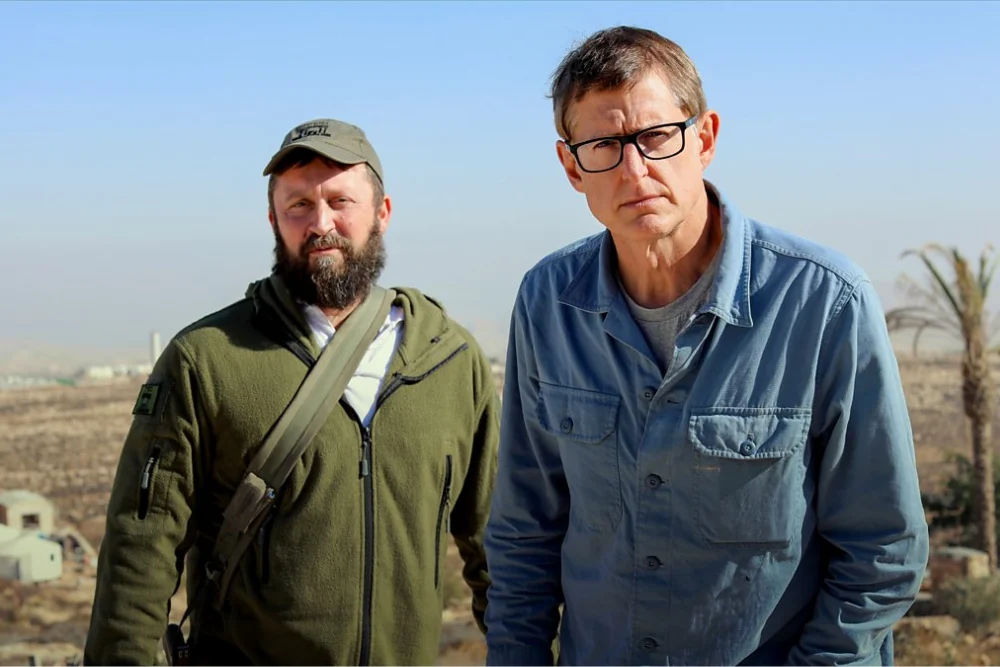
In 2010, the acclaimed British journalist and documentarian Louis Theroux embarked on a journey to Israel, venturing into the volatile territories of the West Bank to engage with ultra-nationalist Jewish settlers. His mission, documented in the compelling BBC special "Ultra Zionists," was to understand the deeply held religious and political convictions driving these communities to populate land considered occupied under international law. Over a decade and a half later, Theroux found himself drawn back to the region, compelled by the dramatic escalation of the Israeli settler movement in the wake of the devastating events of October 7th. This poignant return forms the basis of his latest BBC documentary, "The Settlers," a work that offers a stark and timely examination of a conflict that continues to shape global discourse.
The significance of Theroux’s return cannot be overstated. The intervening years have seen profound shifts in the geopolitical landscape, culminating in a period of heightened tension and conflict following the October 7th attacks. For Theroux, revisiting the West Bank meant confronting a reality far more charged and intense than his previous encounter. Speaking at CPH:DOX, Copenhagen’s prestigious international documentary film festival, after a sold-out screening of "The Settlers," he reflected on the overwhelming "intensity" of being in the occupied region during wartime. This raw emotion underscores the gravity of the subject matter and the urgency of its telling.
When questioned about the enduring allure of such complex and often controversial subjects, Theroux articulated the consistent thread woven through his extensive body of work: a fascination with "human weirdness." He elaborated on this guiding principle, explaining his deep interest in "the ways in which human beings self-sabotage or behave in ways that maybe seem illogical, immoral or controversial." This lens, which has allowed him to explore everything from cults to subcultures, now focuses on the ideological fervor underpinning the settler movement. His unique observational style, characterized by a non-judgmental curiosity, grants his subjects an uncommon space to articulate their beliefs, however extreme they may appear to an outside observer. This approach, while sometimes drawing criticism, is central to his quest to illuminate the often-baffling motivations behind human actions.
Theroux found the brazenness of the settler movement particularly striking this time around. He described witnessing a phenomenon where "a religious nationalist ideology [is] being imposed in an area that’s been turned into a kind of prison in cahoots with a vast military apparatus." The most disquieting aspect, he noted, was the open, unapologetic nature of this imposition. "I’d never seen that sort of thing unfold out in the open and with no shame," he stated, highlighting the profound shift in the settlers’ confidence and the overt nature of their agenda compared to his earlier observations. This candid admission speaks volumes about the perceived impunity and entrenched power dynamics now at play within the West Bank.
At the heart of "The Settlers" lies the formidable figure of Daniella Weiss, an Israeli politician and a pivotal force behind Nachala, a powerful settler and far-right organization. Weiss emerges in the documentary as a central, almost archetypal, character — boisterous, unyielding, and remarkably open about her unwavering commitment to fully occupying the West Bank and facilitating Palestinian relocation. Her influence is undeniable; over the past three decades, Weiss has been instrumental in the establishment of dozens of Israeli outposts, settlements constructed without official legal authorization, yet often tacitly supported or later retroactively legalized by the Israeli government. She is, as Theroux aptly describes her, "the godmother of the settler movement," a title that encapsulates her deep historical involvement and her almost spiritual leadership within the movement.
Throughout the documentary, Weiss passionately articulates her vision, fiercely defending the Israelis’ religious and historical rights to the West Bank. Her statements are delivered with an almost missionary zeal. "We do for the government what they cannot do for themselves," she declares, a chilling insight into the symbiotic relationship between some settler groups and the official state apparatus. She even boasts of a direct line to Israel’s prime minister, Benjamin Netanyahu, a claim that, whether literal or symbolic, underscores her perceived influence and leverage within the corridors of power.
One of the most contentious aspects of the conflict, and a point that Weiss addresses head-on in the film, is the issue of settler violence. Allegations of violence perpetrated by settlers against Palestinians, including attacks on property, olive groves, and individuals, are widely reported by human rights organizations and media outlets. However, Weiss vehemently denies the existence of such violence, asserting, "there is no such thing as settler violence." She dismisses widely shared online videos depicting such incidents as manipulated snippets, implying they are edited to misrepresent settlers’ reactions to what she portrays as Palestinian provocations. This stark refusal to acknowledge a documented reality highlights the profound ideological chasm and the entrenched narratives that fuel the conflict.
Theroux’s observations of Weiss reveal a complex individual. He speaks of "a kind of joy that pours out of her, a joy in her sense of mission that she has for this select group of people she prefers to represent." This "joy" is not born of malice, but of a profound conviction in her cause, a belief system so absolute that it allows her to dismiss counter-narratives and human suffering outside her chosen group. Understanding the source of this unwavering conviction, this almost beatific sense of purpose, is central to unraveling the psychological landscape of the settler movement.

A natural question arises: what motivates figures like Daniella Weiss to participate in a documentary, especially one produced by a foreign broadcaster? Theroux acknowledges the multifaceted reasons individuals agree to be filmed. "Anyone who enters into a documentary [has] a reason for doing it," he noted, listing possibilities ranging from narcissism and the need for publicity to the desire to win converts. With Weiss, however, he found the motivation particularly "hard one to call." He suspects that she likely believes that maintaining a public profile is beneficial, especially given her reliance on international communities for support of her work. Perhaps, he mused, she views such media exposure as a means to further her agenda and secure backing for Nachala’s expansionist goals.
Indeed, since "The Settlers" first aired on the BBC last year, Weiss’s profile has undoubtedly risen. Theroux observed that she has become "sort of a scratching post for Western media," noting her subsequent interview with Piers Morgan. "She seems to enjoy putting it out there," he concluded, suggesting that the media spotlight, even when critical, serves a purpose for her. This observation, however, inadvertently touches upon a broader criticism sometimes leveled against Theroux’s work: the accusation of "platforming" voices that, some argue, should not be given a wider stage.
Theroux, however, expresses discomfort with the term "platforming," finding it overly simplistic and broad. He argues for a crucial distinction between different forms of media engagement. "It feels so broad, as though having someone on a live podcast is the same as spending weeks attempting to interview someone in an appropriate way and then shaping the story in a way that feels truthful and responsible," he explained. He emphasized that these are "two very different things," drawing a clear line between the immediacy and often less nuanced nature of a live interview and the painstaking, ethically driven process of documentary filmmaking. His own podcast, he pointed out, employs a vastly different approach to his documentary work, underscoring his commitment to the latter’s rigorous standards.
In the creation of "The Settlers," Theroux and his creative team felt an intense imperative to "do a good job" in portraying the immense complexities of the subject matter. This was not a routine assignment; the moral urgency of the situation deeply resonated with everyone involved. Unlike some of his recent, more mainstream projects, such as the Netflix hit "Louis Theroux: Inside the Manosphere," "The Settlers" represented a return to a more challenging, less easily digestible subject. "Here, I am on something that people might perceive as less clearly for the mass market," he reflected. The team’s profound sense of responsibility for accurately depicting the gravity of the situation deeply influenced his approach, compelling him to be "more on my front foot in this one."
Despite their best efforts, Theroux acknowledged a significant frustration: "being aware that we weren’t able to document the very worst of what was going on." The reality on the ground, particularly in a conflict zone, often exceeds what can be captured by a camera crew, both due to practical limitations and the inherent dangers. This admission underscores the inherent challenges and ethical dilemmas faced by journalists striving to present a comprehensive picture of deeply entrenched conflicts.
Another point of potential criticism, which Theroux openly addressed, is the documentary’s primary focus on Israeli settlers in the West Bank, with only brief interludes featuring Palestinian perspectives. He readily admitted to understanding how this could be viewed as "frustrating" by some audiences. However, he contextualized his decision within his broader body of work and his specific journalistic intent for this film. "At the same time, this isn’t the only film about the situation in the West Bank," he asserted, emphasizing that "The Settlers" is his particular contribution to a wider narrative. His goal, he clarified, is to "reach large audiences with a way of telling stories that do justice to situations that have moral urgency." Ultimately, he explained, his focus was on those who wield power and control: "And, in the end, the people with agency are the ones with the guns, right? They’re the ones who, for more than 60 years, have kept a region in which more than 3 million Palestinians live under military occupation." This strategic choice highlights his belief in scrutinizing the actions and motivations of those who hold the levers of power and whose decisions profoundly impact the lives of millions.
Finally, Theroux reflected on the personal impact of working in close proximity to the devastation and human tragedy of war. He spoke with a poignant sense of realism about "the regrettable privilege you have of moving on." This acknowledgment is a profound insight into the emotional resilience required of journalists in such fields, and the stark contrast between their temporary immersion and the enduring reality of those who live through the conflict daily. He cautioned against romanticizing the journalist’s role, adding that "you can’t become too attached to the idea of changing the world."
Despite the challenging nature of his work, Theroux conveyed a deep sense of personal contentment and purpose. "I have a great family, a wonderful wife, three amazing boys. I feel very blessed," he shared. This personal anchor allows him the luxury of returning to a stable home life, a stark contrast to the continuous trauma experienced by war correspondents. "I’m not a war correspondent who comes home and either goes traumatized or thinks, ‘I have to get back out there.’" Instead, he finds profound satisfaction in his chosen path: "I enjoy doing the work and there’s a real sense of pride and purpose that goes with documenting something you feel deserves to be documented." His latest work, "The Settlers," stands as a testament to this commitment, offering audiences a rare and unflinching look into one of the world’s most enduring and complex conflicts, filtered through the distinctive and empathetic lens of Louis Theroux.