


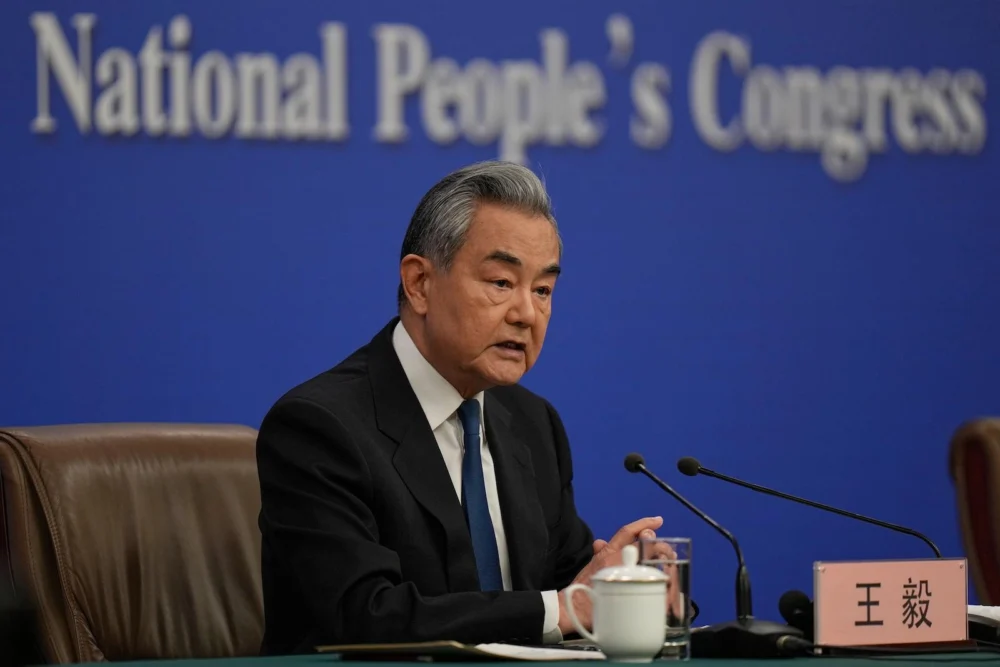
China’s top diplomat, Wang Yi, issued a forceful admonishment to Japan on Sunday, urging Tokyo to steer clear of the “disastrous path” of its historical militarism and to refrain from interfering in Beijing’s internal affairs, particularly concerning Taiwan. The remarks came as Wang reiterated strong criticism of statements made by Japanese Prime Minister Sanae Takaichi regarding the self-ruled island, which Beijing considers a renegade province to be unified with the mainland, by force if necessary.
Speaking at a press conference held during the ongoing annual parliamentary session, Wang drew a direct parallel between Takaichi’s recent pronouncements and the rhetoric historically employed by Japanese militarists. Takaichi’s comments, suggesting that an attack on Taiwan could precipitate a “survival-threatening situation” for Japan, thereby necessitating a response from its defense forces, were characterized by Wang as alarmingly reminiscent of a bygone era. He asserted that such language served only to “alert and deeply worry” not only the Chinese populace but also the wider Asian continent. “Since Taiwan affairs are purely China’s internal affairs,” Wang questioned, “what gives Japan the right to interfere with them?”
The Chinese Foreign Minister emphasized China’s current strength and its unwavering resolve. “China is already a strong country,” Wang declared, underscoring that “the 1.4 billion people of China will never allow anyone to justify colonialism or reverse history’s verdict on aggression.” He pointed to the historical fact that Taiwan was under Japanese colonial rule for a period of fifty years, from 1895 to 1945, a historical chapter that continues to shape perceptions and sensitivities in the region.
The diplomatic friction ignited by Takaichi’s remarks in parliament last November has already had tangible consequences. China has responded by implementing targeted trade restrictions and has advised its citizens against undertaking travel to Japan, a move that could impact tourism and business ties between the two nations.
“The future of China-Japan relations hinges on Japan’s choice,” Wang stated unequivocally, reiterating Beijing’s demand for a complete retraction of Takaichi’s comments. The sentiment within China is that Japan must make a clear decision about its future trajectory and its approach to regional security and stability.
Adding another layer to China’s concerns is the recent electoral victory of the Liberal Democratic Party (LDP), led by the security-conscious Takaichi, and its coalition partner in the House of Representatives election held in February. Beijing views this outcome with apprehension, fearing that it could embolden Japan to accelerate its defense capabilities and expedite deliberations on potentially amending its post-war pacifist Constitution. This constitution, a cornerstone of Japan’s post-World War II identity, renounces the right of belligerency and has been a significant factor in its defense posture.
During his press conference, held on the sidelines of the National People’s Congress session, Wang suggested that Prime Minister Takaichi’s comments could be interpreted as an attempt “to hollow out Japan’s pacifist Constitution, which renounces the right of belligerency.” This interpretation highlights Beijing’s deep-seated suspicion that certain elements within Japan are seeking to move away from its strictly defensive military posture, a shift that China views as a potential threat to regional equilibrium.
The top diplomat reiterated the paramount importance of the Taiwan issue to China, characterizing it as “at the core of China’s core interests” and a “red line that must not be crossed.” The historical context is crucial here: the Communist-led People’s Republic of China and the democratic island of Taiwan have been governed separately since 1949, following the conclusion of a brutal civil war. Beijing views this separation as an unfinished chapter of the revolution and is committed to its resolution.
“Realizing the complete reunification of our motherland is a historic process that cannot be stopped,” Wang asserted, projecting an unyielding stance on the issue. This statement underscores the deeply ingrained nationalistic sentiment in China regarding Taiwan and the perception that reunification is an inevitable historical destiny.
In a broader geopolitical context, Wang Yi also took aim at what he perceived as unilateral actions and protectionist policies on the global stage. In an apparent reference to the “America First” trade protectionist policies and global tariffs previously implemented by U.S. President Donald Trump, Wang underlined that China “firmly opposes all unilateral acts, power politics and bullying.” This statement reflects China’s broader critique of what it sees as a disruptive and destabilizing influence on the international order, particularly from certain Western powers.
He maintained China’s commitment to an open and fair global economic system. “China is strongly committed to supporting trade and investment liberalization and facilitation,” Wang stated, adding that Beijing is dedicated to “defending a fair and open economic and trade order.” This aligns with China’s ongoing narrative of advocating for multilateralism and free trade, even as it navigates complex geopolitical tensions.
As the global economy continues to grapple with headwinds, exacerbated by the erection of “tariff barriers,” Wang issued a stark warning to those considering economic and technological “decoupling” from China. He cautioned that such attempts “will only get burned,” implying that isolating China economically or technologically would ultimately prove detrimental to the perpetrators themselves. This message is a clear assertion of China’s resilience and its growing influence in the global economy, suggesting that any attempts to sideline it would be counterproductive.
Looking ahead to high-level diplomatic engagements, Wang referenced the upcoming visit of then-U.S. President Donald Trump to China, scheduled for March 31. He indicated that the agenda for these crucial exchanges was already being discussed, emphasizing the need to “create a suitable environment, manage the risks that do exist and remove unnecessary disruptions.” This statement signals China’s desire for constructive dialogue and its willingness to work towards a stable bilateral relationship, provided that certain preconditions are met and potential friction points are addressed proactively.
“China is always committed and open,” Wang added, reiterating calls for “peaceful coexistence” and “win-win cooperation” between the world’s two largest economies. This sentiment highlights China’s aspiration for a mutually beneficial relationship with the United States, characterized by cooperation rather than confrontation, while also subtly reminding Washington of China’s own agency and its capacity to foster mutually advantageous partnerships.
Shifting to another critical geopolitical flashpoint, Wang addressed the situation in Iran, which had reportedly been under sustained bombardment by U.S. and Israeli forces since late February. He called for an “immediate stop” to the military operations, expressing deep concern that the conflict could spill over and destabilize the wider region. This stance reflects China’s general opposition to military interventionism and its preference for diplomatic solutions to international crises, particularly in regions with significant geopolitical implications.
“This is a war that should not have happened,” the foreign minister declared, articulating a clear condemnation of the military actions. He further warned that any attempts to pursue “regime change in Iran will find no popular support,” suggesting that such efforts would be met with resistance and would likely prove unsuccessful in the long term. This statement aligns with China’s broader foreign policy principle of non-interference in the internal affairs of other nations, while also signaling its opposition to externally imposed political transformations.
In contrast to its critical stance on certain Western actions, Wang touted the robust nature of China’s relationship with Russia. He described their ties as “rock-solid against all odds,” highlighting that the current year marked the 25th anniversary of their bilateral treaty of good-neighborliness and friendly cooperation, as well as the 30th anniversary of their strategic partnership of coordination. This emphasis on the enduring strength of the Sino-Russian relationship underscores China’s strategic alignment with Moscow, particularly in the face of Western pressure.
China has consistently opposed the Western sanctions imposed on Russia, particularly since the full-scale invasion of Ukraine commenced four years prior. This opposition to sanctions is a recurring theme in China’s foreign policy, reflecting its broader disagreement with the West’s approach to international conflict resolution and its commitment to maintaining economic ties with countries facing Western sanctions. This stance also highlights a growing bloc of nations that are increasingly charting a course independent of Western influence and economic pressure.
© KYODO