

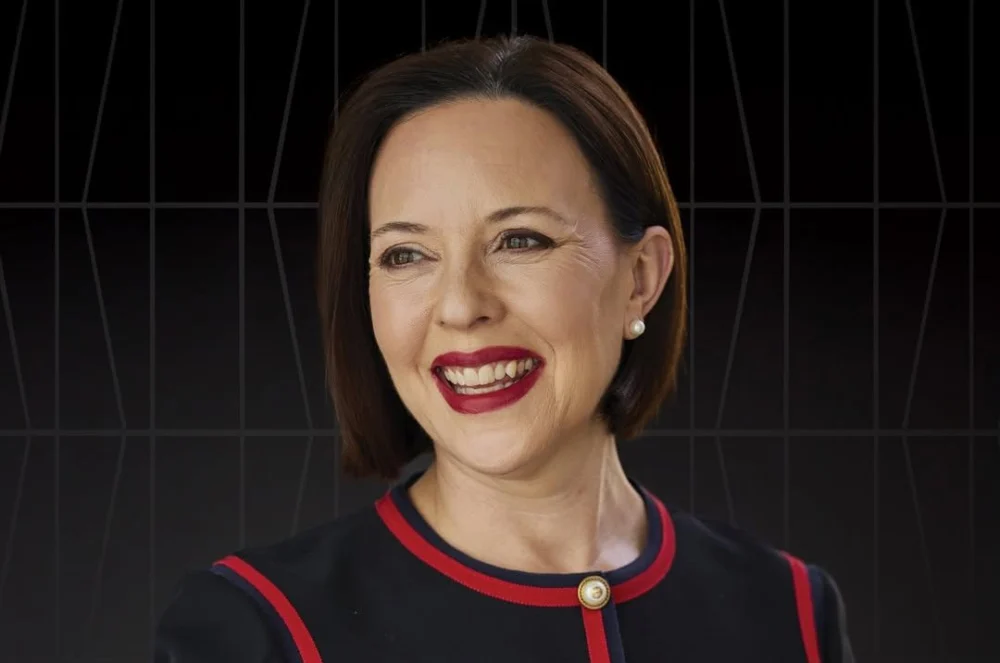
In a landscape increasingly defined by shifting loyalties and the sharp intrusion of political currents into cultural institutions, Jean Davidson, the respected director of the National Symphony Orchestra (NSO), has announced her departure from the beleaguered Kennedy Center. After a 55-year symbiotic relationship, the NSO has thus far remained steadfast at its Washington D.C. home, but its top executive is charting a new course, seeking distance from what she described as a “toxic situation” in the nation’s capital. Davidson is set to assume a new leadership role, bringing her formidable experience to the Wallis Annenberg Center for the Performing Arts in Beverly Hills.
The Wallis Annenberg Center for the Performing Arts officially announced Davidson’s appointment as its new Executive Director and Chief Executive, effective May 4. This move marks a significant transition for Davidson, not only geographically from the East Coast to the West, but also professionally, as she takes the helm of a dynamic and relatively newer institution.
Davidson’s decision, articulated in recent interviews with major newspapers on both coasts, was not born of a singular motivation. It represents a nuanced confluence of professional ambition and a palpable weariness over the increasingly politicized environment engulfing one of America’s most revered cultural landmarks. The Kennedy Center, a living memorial to President John F. Kennedy and a vibrant hub for the performing arts, has found itself embroiled in a contentious political tug-of-war, leading to its unofficial, and highly divisive, rebranding by loyalists to the current administration as “the Trump Kennedy Center.” This informal designation, coupled with a series of high-profile administrative changes and public pronouncements, has created an atmosphere of uncertainty and disquiet within the institution.
Reflecting on the challenges she faced, Davidson shared candidly with The New York Times, “It’s no secret that this has been a really hard year.” Her statement underscored the immense pressure points that have emerged within the Kennedy Center’s ecosystem. She revealed that the search for a new opportunity had begun “several months ago,” indicating a sustained period of reflection and strategic career planning. The swiftness of her departure, after only three years in her role as the NSO’s executive director, speaks volumes, especially given her earlier aspirations: “I had hoped to stay through the 100th anniversary of the N.S.O. in 2031.” Her initial commitment to such a long-term vision highlights the profound shift in the center’s operational climate that ultimately prompted her exit.
In an interview with the Los Angeles Times, Davidson further elaborated on the untenable conditions that compelled her decision. She explained, “I found it more and more difficult to achieve the goals that we had set out to achieve given the external forces that are at work that are just so far beyond my control.” This statement paints a vivid picture of a leader grappling with systemic impediments, where the usual levers of artistic and administrative control had been rendered ineffective by forces originating outside the traditional purview of arts management. The implication is clear: the core mission of the NSO was being overshadowed and obstructed by external political pressures.
Among the primary sources of her discontent, Davidson conveyed to The New York Times, was the striking lack of transparent communication emanating from the new board of the Kennedy Center, which had been installed by the Donald Trump administration. This opaque administrative structure created an environment of uncertainty and disempowerment. “There’s been a lot of change going on, and there’s not a lot of communication,” she noted, highlighting a fundamental breakdown in internal governance. The most egregious example she cited was learning critical operational decisions through external media: “We are finding out things through the press — at the same time as everyone else. Like the center closing on July 4. … I didn’t see how I could be effective as a leader in the current climate.” For an executive director, being informed of major institutional closures via news reports is not only a professional affront but also severely compromises the ability to plan, manage, and reassure staff, artists, and patrons.
The broader context of Davidson’s departure is rooted in a series of dramatic developments at the Kennedy Center. President Trump had recently announced an ambitious, two-year, $200 million renovation project for the center, controversially describing the iconic building as “dilapidated.” This pronouncement, while potentially addressing long-term infrastructural needs, sent ripples of concern through the arts community, particularly given the suddenness of the announcement and its timing. The renovation plans followed a period marked by constant news reports of artist cancellations and growing unease. Adding to the institutional instability was the January announcement of the Washington National Opera’s exit, severing a decades-long partnership with the Kennedy Center. These artistic and institutional departures, coupled with weakened ticket sales—attributed in part to boycotts by former patrons protesting the perceived “Trump takeover”—had already cast a pall over the center’s once-unquestioned stature.
For the National Symphony Orchestra, these developments created an immediate and unprecedented logistical crisis. The NSO, with its robust schedule of approximately 180 performances annually, typically plans its venues and programming years in advance. The sudden closure announcement forced the orchestra into an urgent scramble to secure alternative performance spaces. “Usually orchestras will plan for being out of their hall years in advance, and we only have months to do that, so it is causing a bit of strain,” Davidson explained to the Los Angeles Times. This compressed timeline presented a significant operational challenge, demanding extraordinary adaptability from the orchestra’s administration and musicians. Despite the upheaval, Davidson emphasized the critical need for continued community support: “I think the most important thing is that our audiences and donors continue to support the NSO during this transition period.”
Even amidst her own departure, Davidson expressed confidence in the NSO’s enduring artistic vitality. To The New York Times, she asserted, “The orchestra has never sounded as great as it sounds now.” She highlighted the steadfast commitment of Music Director Gianandrea Noseda and the unwavering dedication of the musicians: “Gianandrea (Noseda, the music director) is very committed. Musicians still want to play with us. It’s a great orchestra.” However, she coupled this optimism with a sobering reality check, underscoring the vital role of local patronage in the orchestra’s long-term survival: “But we need Washington — donors, audiences — to support the orchestra for it to survive.” Her words served as both a testament to the NSO’s artistic excellence and a rallying cry for the community to safeguard its future.
Davidson’s move to The Wallis marks a return to the Los Angeles area, where she previously made significant contributions to the cultural landscape. Prior to her tenure at the Kennedy Center, she served as President-CEO of the Los Angeles Master Chorale from 2015 to 2023. During this period, she established a strong track record of innovative leadership and organizational growth, preparing her for the executive challenges she would later face.
The Wallis Annenberg Center’s announcement highlighted Davidson’s impressive accomplishments at the LA Master Chorale, underscoring the breadth and depth of her expertise. The institution credited her with having “introduced an international touring model, produced major recordings, and guided the Chorale through the pandemic, securing over $2 million in federal and local support.” These achievements demonstrate her strategic vision, her ability to navigate complex operational challenges, and her skill in securing vital resources during times of crisis. Furthermore, The Wallis noted that “during her tenure there, she increased contributed revenue by 48% in four years, led a successful strategic planning process, negotiated key labor agreements and advanced a comprehensive rebranding that repositioned the organization.” This litany of successes paints a picture of a leader adept at financial stewardship, organizational development, and fostering strong stakeholder relationships.
Beyond her most recent roles, Davidson’s career path reflects a diverse and impactful journey through the arts. She served as an associate consultant for the DeVos Institute of Arts Management from 2015 to 2018, lending her expertise to a broader array of cultural organizations. Her foundational leadership experience includes serving as the founding CEO of New York Live Arts from 2011 to 2015, where she played a crucial role in establishing a new artistic entity. Earlier in her career, from 2001 to 2005, she was the founding managing director of the Silk Road Project, an initiative founded by Yo-Yo Ma to promote cultural exchange through music. These varied roles have equipped her with a unique understanding of artistic innovation, institutional building, and cross-cultural collaboration.
The Wallis Annenberg Center for the Performing Arts, Davidson’s new professional home, is itself a testament to innovative design and cultural revitalization. Opened in 2013, the 70,000-square-foot facility ingeniously integrates modern performance spaces within and around the historically landmarked 1934 Beverly Hills Post Office building. This architectural blend of old and new reflects the center’s mission to honor tradition while fostering contemporary artistic expression. The Wallis boasts a 500-seat Goldsmith Theater and a more intimate 150-seat Lovelace Studio Theater, providing versatile venues for a wide range of performances. Since its inception, The Wallis has hosted nearly 500 productions spanning theater, dance, music, and various other artistic disciplines, quickly establishing itself as a vital component of Southern California’s vibrant cultural landscape.
Approaching her new role with characteristic humility and a collaborative spirit, Davidson shared her philosophy for leadership at The Wallis. “I think anytime you’re starting a new role, there’s a lot of learning that needs to occur,” she told the Los Angeles Times. Her emphasis on learning and integration stands in stark contrast to the disruptive and opaque changes she witnessed in Washington. “And I’m not somebody that is prone to walking in with a big vision that’s going to suddenly change course. I think they’ve been doing a lot of great work and so I’m looking forward to collaborating with the team that’s there — to learn and to create a shared vision for the future.” This measured, inclusive approach signals a commitment to continuity and evolution rather than radical overhaul, positioning her as a leader who values partnership and organic growth.
Meanwhile, back in Washington, the current leadership at the Kennedy Center appears to be doubling down on its contentious approach, seemingly unfazed by the public backlash to the “Trump Kennedy Center” rebranding. This controversial designation is currently facing legal challenges, with authorities contending that renaming a national monument dedicated to a deceased president would require an act of Congress. Just over a week prior to Davidson’s announcement, the center’s president, Richard Grenell, made another provocative announcement: the annual “Kennedy Center Honors” awards program, a revered national event celebrating artistic achievement, would also be rebranded as “The Trump Kennedy Center Honors.” Grenell, a politically appointed figure with a background as former acting Director of National Intelligence and Ambassador to Germany, further stated that the awards ceremony would be seeking a different, likely smaller, venue during the two-year reconstruction period of the main building. These moves suggest a sustained effort to imprint a particular political identity onto an institution traditionally seen as transcending partisan divides, an endeavor that continues to ignite debate and reshape the cultural landscape of the nation’s capital.
Jean Davidson’s departure thus encapsulates a pivotal moment for both the Kennedy Center and the broader arts community. Her decision reflects the increasing strain on cultural leaders to maintain artistic integrity and institutional stability in an era of heightened political polarization. As she transitions to a new chapter at The Wallis, she leaves behind a complex legacy in Washington, where the National Symphony Orchestra faces the daunting task of navigating an uncertain future while upholding its commitment to artistic excellence, a challenge that will demand resilience, adaptability, and unwavering community support.