


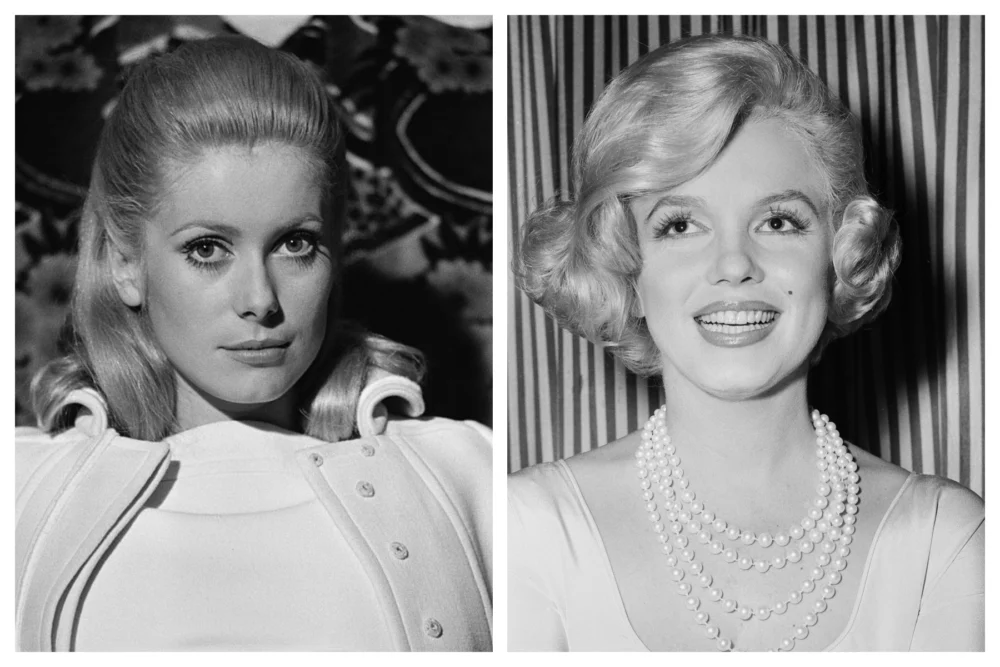
A cinematic titan of French elegance, Catherine Deneuve, has lent her distinctive voice and discerning eye to a deeply personal new book, “Marilyn chérie,” offering an intimate photographic journey into the life of the immortal Hollywood icon, Marilyn Monroe. Scheduled for release this May, the volume is positioned to mark the centenary of Monroe’s birth, promising an unprecedented glimpse into the multifaceted persona of an actress whose legend continues to captivate generations. Co-authored with renowned collector Sébastien Cauchon, the book is more than a mere collection of images; it is Deneuve’s homage, a tender exploration of the woman behind the myth, viewed through a prism of curated, often never-before-published, photographs.
The collaboration between Deneuve and Cauchon is particularly compelling. Cauchon, a dedicated archivist and awards strategist, brings to the project a formidable private collection of Monroe memorabilia, spanning the breadth of her tragically short but incandescent career. His expertise ensures the authenticity and rarity of the visual material, transforming “Marilyn chérie” into a treasure trove for aficionados and scholars alike. Deneuve, in turn, provides the narrative thread, her lyrical prose weaving through the images to offer a commentary that is both deeply personal and universally resonant. The book promises to feature an astonishing array of photographs, from candid behind-the-scenes moments on film sets to meticulously staged costume fittings, from iconic portraits captured by leading photographers of her era to raw, spontaneous press images and even amateur snapshots. This eclectic mix is designed to peel back the layers of public perception, revealing the vulnerability, ambition, and singular charisma that defined Monroe.
For Catherine Deneuve, this project is not merely an artistic endeavor but a culmination of a lifelong fascination with Marilyn Monroe. Herself a paragon of cinematic sophistication and a symbol of French cultural prestige, Deneuve has long acknowledged Monroe’s profound influence on her own artistic sensibilities. The parallels between these two extraordinary women, though separated by geography and cinematic style, are striking. Both achieved global superstardom, navigating the intense glare of the public eye and embodying distinct ideals of beauty and femininity. Deneuve, celebrated for her cool detachment and enigmatic allure in films by directors like Luis Buñuel and Jacques Demy, presents a fascinating counterpoint to Monroe’s more overtly effervescent and vulnerable screen persona. Yet, beneath their differing public facades, both women experienced the profound pressures of iconic status, the objectification that often accompanies immense beauty, and the relentless scrutiny that comes with being a cultural touchstone.
Deneuve’s enduring admiration for Monroe is well-documented and extends beyond a casual interest. In 1987, she participated in the acclaimed documentary “Marilyn, dite Norma Jean,” a television special that delved into the complex identity of Norma Jeane Mortenson, the woman who became Marilyn. Her involvement in that project signaled an early and serious engagement with Monroe’s legacy, moving beyond superficial glamour to explore the psychological depths and societal impact of her life. This earlier work laid the groundwork for the more expansive and personal reflection found in “Marilyn chérie.”
Furthermore, Deneuve’s career has intersected with individuals who shared intimate professional and personal connections with Monroe, offering her unique insights into Monroe’s world. In 1968, Deneuve starred opposite Jack Lemmon in “The April Fools,” marking Lemmon’s first American film. Lemmon, of course, had shared the screen with Monroe in Billy Wilder’s iconic comedy “Some Like It Hot,” a role that solidified Monroe’s status as a comedic genius and sex symbol. One can imagine the conversations, anecdotes, and subtle observations Deneuve might have gleaned from working alongside someone who had witnessed Monroe’s talent and vulnerability firsthand. Similarly, in 1975, Deneuve collaborated with Yves Montand in Jean-Paul Rappeneau’s “Le Sauvage.” Montand had famously starred opposite Monroe in George Cukor’s musical comedy “Let’s Make Love,” a production marked by intense off-screen drama and a highly publicized affair between the two stars. These direct links to Monroe’s inner circle undoubtedly enriched Deneuve’s understanding and empathy for the woman she so deeply admires, providing her with a nuanced perspective that few others could offer.
The essence of Deneuve’s perception of Monroe is eloquently captured in a poignant passage from “Marilyn chérie,” where she writes: “So beautiful, so open, almost unknown. So generous with her body, her face tilted back, something childlike too — which never makes her seem indecent. The actress whose films I have seen all, never known, the most precious to me.” This quote is a powerful distillation of the enigma that was Marilyn. Deneuve touches upon Monroe’s undeniable physical beauty, but immediately transcends it, highlighting her “openness” and the paradoxical sense of being “almost unknown.” This suggests that even after decades of public fascination, biographies, and academic studies, there remain unfathomable layers to Monroe’s personality, a core self that eluded full public grasp. Deneuve’s observation of Monroe’s “generous with her body, her face tilted back” evokes the vulnerability and raw emotion Monroe often displayed, both on screen and in photographs, yet she insists that this never veered into indecency. This speaks to Monroe’s inherent grace and perhaps a purity of spirit that shone through her more overtly sensual image. The description of something “childlike” further underscores this blend of innocence and allure, a duality that made Monroe endlessly fascinating and, for Deneuve, “the most precious” of actresses.
The physical manifestation of this dedication is a substantial 224-page volume, meticulously crafted to honor its subject. Flammarion, a venerable and highly respected publishing house with a rich history of producing art and photography books, holds the worldwide publishing rights, ensuring the book’s global reach and high production quality. The involvement of such a prestigious publisher underscores the significance and artistic merit of “Marilyn chérie.” Crucially, Deneuve and Cauchon have retained the adaptation rights, hinting at the potential for future projects stemming from this collaboration. This could range from documentary films exploring the book’s themes and images, to exhibitions showcasing the rare photographs, or even theatrical adaptations that delve into Deneuve’s reflections on Monroe. Such a provision speaks to the depth of the material and the creators’ vision for its continued life beyond the printed page.
Sébastien Cauchon’s contribution to “Marilyn chérie” is equally vital, drawing on his extensive experience as a collector and an author deeply immersed in Monroe’s world. His previous work, “Marilyn 1962,” published by Stock in 2016, focused on the tumultuous final year of Monroe’s life and was subsequently optioned for a miniseries project, demonstrating the narrative power he draws from his archival efforts. This earlier success highlights his ability to transform historical material into compelling contemporary narratives. Furthermore, Cauchon’s unparalleled Marilyn Monroe photo archive collection received international acclaim when it was presented at an exhibition hosted by Cannes Film Festival chief Thierry Frémaux during the 2022 edition of the Lumière Festival. This public display not only cemented Cauchon’s reputation as a leading authority on Monroe’s visual legacy but also offered a tantalizing preview of the kind of rare and evocative imagery that will undoubtedly grace the pages of “Marilyn chérie.” His meticulous curation and profound understanding of Monroe’s photographic history make him the ideal partner for Deneuve in this ambitious undertaking.
The enduring fascination with Marilyn Monroe, almost six decades after her death, speaks volumes about her profound and lasting cultural impact. She remains a potent symbol of glamour, vulnerability, and the complex struggles of women in the public eye. Books, films, and documentaries continue to emerge, each attempting to unravel the layers of her persona, to understand the woman behind the legend. “Marilyn chérie,” with Catherine Deneuve’s unique perspective and Sébastien Cauchon’s unparalleled collection, offers a fresh and intimate lens through which to view this timeless icon. It is a dialogue between two eras of cinematic stardom, a French legend reflecting on an American one, promising to enrich our understanding of Marilyn Monroe not just as an actress, but as a human being whose spirit continues to resonate across the world, inspiring awe, empathy, and unending curiosity.