



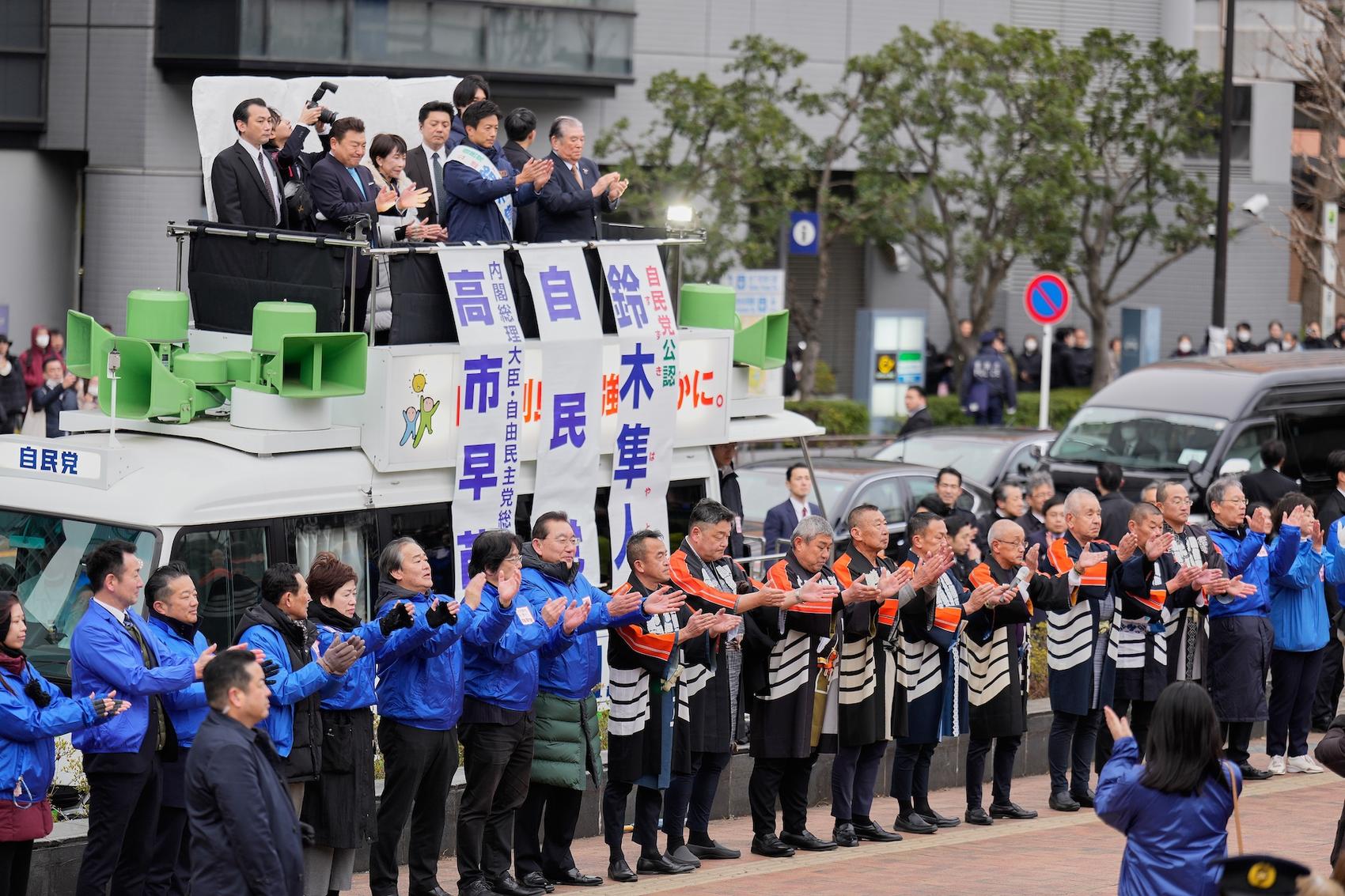
Prime Minister Sanae Takaichi delivered a powerful closing appeal to voters on Saturday, outlining a vision for a “more prosperous and safer” Japan, underpinned by a commitment to enhanced national security, including more rigorous immigration screening. As the nation stands on the cusp of snap general elections, Takaichi’s ruling bloc, spearheaded by the formidable Liberal Democratic Party (LDP), appears poised for a decisive victory, with opinion polls consistently indicating the potential for a commanding two-thirds majority in the influential lower house of the Diet.
Addressing a fervent crowd of thousands at a campaign rally in Tokyo, the 64-year-old leader declared, “The Takaichi cabinet’s mandate is to ignite economic growth. Japan is destined to become increasingly prosperous and secure.” She articulated a central theme of her campaign, stating, “This is the pivotal year where we aim to transform the anxieties that people harbor about their present lives and their futures into tangible hope.” This message resonates deeply in a nation grappling with economic uncertainties and evolving global dynamics.
Takaichi’s assertive stance on immigration appears to have successfully countered the momentum of the populist “Japan First” Sanseito party, which had garnered significant attention in the upper house elections of the previous year. Her emphasis on stricter entry protocols aims to bolster national security and economic stability. “Our immigration screening processes have already been fortified,” Takaichi explained, “ensuring that individuals posing security risks, including terrorists and industrial spies, encounter greater difficulty in gaining entry. We must meticulously verify that foreign nationals contribute to our society through tax payments and health insurance premiums.”
Her broader vision for the nation paints a picture of a secure and well-supported society. “My aspiration is for a Japan where every citizen, regardless of their location, can live with unwavering safety,” she asserted. “This includes ensuring access to the necessary medical care and welfare services, providing high-quality educational opportunities, and cultivating robust employment sectors with meaningful job prospects.” However, she pragmatically linked these social aspirations to economic strength. “To realize these essential services – healthcare, welfare, and education – substantial financial investment is imperative. Therefore, our foremost priority must be the cultivation of a robust and resilient economy.”
Pre-election surveys, while acknowledging the presence of undecided voters, consistently point towards a comfortable victory for the LDP, projecting they will secure well over the 233 seats required to reclaim a majority in the lower house. In conjunction with their coalition partner, the Japan Innovation Party (JIP), Takaichi’s bloc is even anticipated to achieve a formidable two-thirds supermajority. This level of dominance was last seen in 2017 under the leadership of the late former Prime Minister Shinzo Abe, a revered mentor to Takaichi.
The landscape of the opposition appears to be undergoing a significant shift. The newly formed Centrist Reform Alliance, a collaboration between the main opposition Constitutional Democratic Party (CDP) and Komeito, the LDP’s former coalition partner, is projected to experience a substantial decline, potentially losing half of their combined 167 seats. This suggests a fragmentation of the opposition vote, further consolidating Takaichi’s potential mandate.
The appeal of Takaichi’s leadership is palpable, particularly among younger demographics. Yuka Ando, a 17-year-old high school student, traveled with her mother to the rally despite the unseasonably cold weather and heavy snowfall blanketing northern Japan. “I came simply to witness her firsthand. I find her truly remarkable,” Ando shared. “As the first female Prime Minister, she possesses a unique aura. Her leadership has genuinely sparked my interest in politics.” Ando’s sentiment underscores the symbolic significance of Takaichi’s premiership and its potential to inspire a new generation of politically engaged citizens.
Political analysts anticipate that Takaichi’s strategic decision to call early elections will prove beneficial. Jeff Kingston, a professor of history at Temple University Japan, commented to AFP, “She is likely to secure a strong mandate, potentially an outright majority, which will empower her to pursue an ambitious agenda of economic and security reforms.” This anticipated mandate could provide the political capital needed to enact significant policy changes.
On the international stage, Takaichi’s assertive foreign policy stances are drawing considerable attention, particularly from China. Her earlier statements suggesting Japan’s potential military intervention should Beijing attempt to forcibly annex self-governing Taiwan have heightened regional tensions. China, which views democratic Taiwan as a renegade province and has not ruled out the use of force to achieve unification, has responded with diplomatic pressure, including summoning Tokyo’s ambassador, advising its citizens against travel to Japan, and conducting joint air exercises with Russia in proximity to the Japanese archipelago.
Domestically, Takaichi’s economic policies have also generated a mixed reaction from investors. Her administration’s proposed $135 billion stimulus package, while intended to invigorate the economy, has raised concerns about its fiscal implications. Last month, yields on long-term Japanese government bonds reached record highs following Takaichi’s pledge to temporarily exempt food from the consumption tax, a measure aimed at alleviating the impact of inflation on households but potentially contributing to increased government debt.
The current economic climate in Japan is characterized by persistent inflation, which has eroded household purchasing power. The government’s response, including the proposed consumption tax adjustments, reflects a delicate balancing act between stimulating economic activity and managing public finances. Takaichi’s emphasis on strengthening the economy is directly linked to her ability to fund vital social programs and ensure national security, creating a complex policy challenge.
Furthermore, the demographic shifts within Japan, including a rapidly aging population and a declining birthrate, present long-term challenges that Takaichi’s administration will need to address. Her proposed policies on immigration screening are partly a response to concerns about the sustainability of the social security system and the labor force. The debate over immigration is multifaceted, encompassing economic needs, cultural integration, and national identity.
The upcoming election is therefore not just about securing a parliamentary majority; it is about defining the future direction of Japan. Takaichi’s platform, with its dual focus on economic revitalization and enhanced national security, aims to provide a clear path forward. Her supporters see her as a strong leader capable of navigating these complex challenges, while critics express concerns about the potential for increased geopolitical tensions and the fiscal sustainability of her economic proposals.
The international community will be closely observing the outcome of these elections. Japan’s role in regional security, its economic policies, and its approach to international relations are all factors that will shape the geopolitical landscape of East Asia. Takaichi’s assertive posture on issues like Taiwan suggests a willingness to take a more prominent role in regional security, a stance that will be carefully scrutinized by both allies and adversaries.
The appeal of Takaichi’s message extends beyond policy pronouncements. Her image as a decisive and determined leader, coupled with her historic position as Japan’s first female Prime Minister, has resonated with a significant portion of the electorate. This personal appeal, combined with her policy agenda, creates a potent political force as she seeks to secure a strong mandate to govern.
As Japan prepares to cast its votes, the choices made by the electorate will have far-reaching implications for the nation’s domestic stability, economic trajectory, and international standing. Prime Minister Takaichi’s final campaign push underscores her ambition to forge a new era for Japan, one characterized by renewed prosperity and heightened security, built upon a foundation of strong economic growth and decisive leadership.
© 2026 AFP