




In a dramatic conclusion to the team figure skating event at the Milan Cortina Winter Olympics, American phenom Ilia Malinin delivered a breathtaking free skate performance that not only secured his own redemption but also clinched the gold medal for the United States. Facing off against his Japanese rival Shun Sato in a head-to-head showdown, Malinin’s spectacular display in the final session broke a tight deadlock with Japan, ensuring the U.S. successfully defended its Olympic team title.
Dubbed the “Quad God” for his extraordinary ability to execute quadruple jumps, the 21-year-old Malinin soared through his free skate program, landing an impressive five quads. His stellar performance garnered a commanding 200.03 points, a significant comeback after what he considered a less-than-ideal short program the previous night. Sato, while also showcasing his prowess with three quadruple jumps, ultimately scored 194.86 points, leaving Japan with a second consecutive silver medal in the Olympic team event.
The nail-biting competition culminated with the United States amassing 69 points to Japan’s 68. The host nation, Italy, put forth a valiant effort, with Matteo Rizzo delivering one of the finest free skates of his career. This remarkable performance propelled Italy to a well-deserved bronze medal, earning them 60 points and igniting passionate cheers from the home crowd.

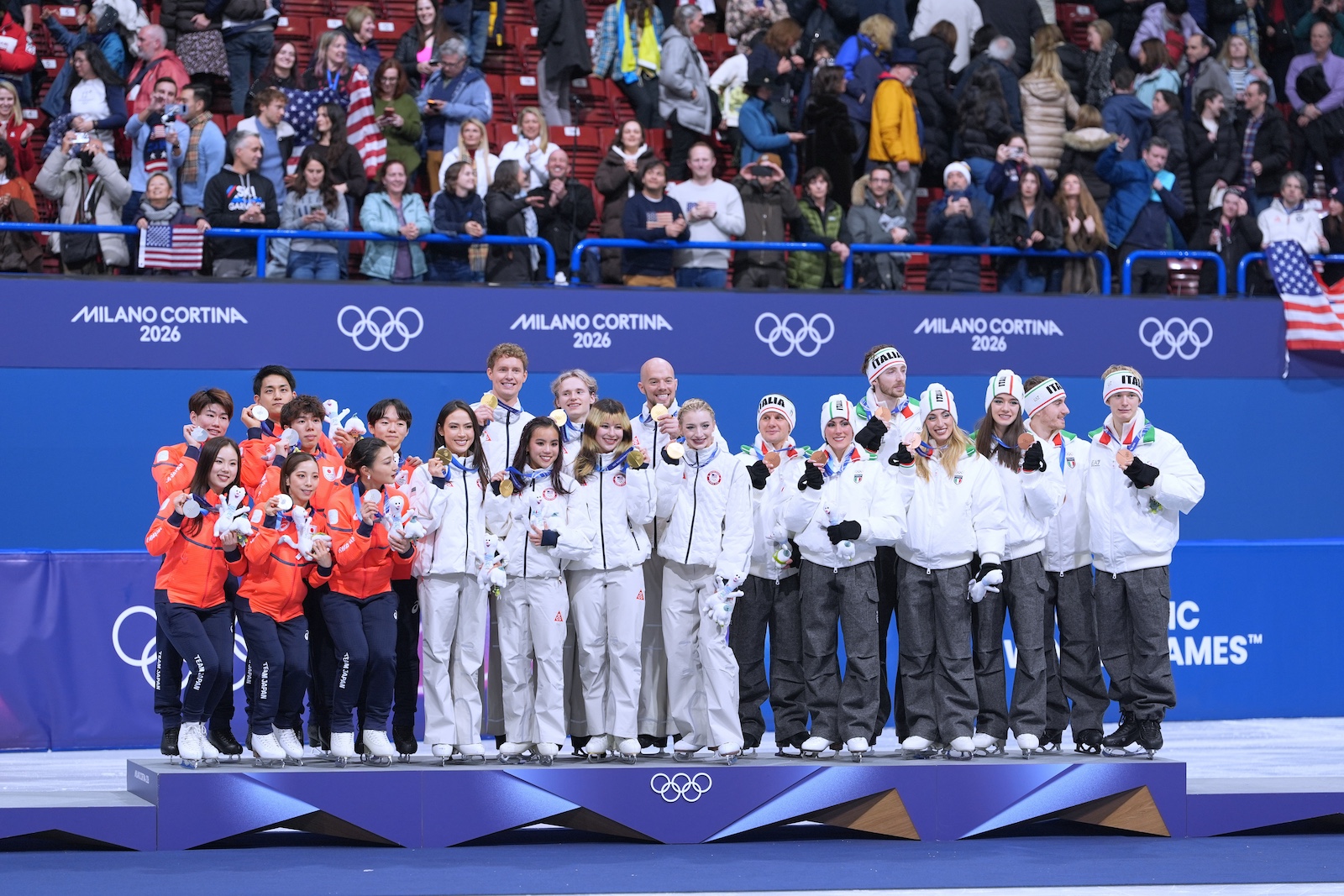
From left to right, silver medalists Team Japan, gold medalists Team USA, and bronze medalists Team Italy receive their medals after the figure skating team event at the 2026 Winter Olympics, in Milan, Italy, on Sunday. Image: AP/Stephanie Scarbrough
The path to gold was anything but straightforward for the American team. After two days of competition, the U.S. held a seemingly comfortable five-point lead over Japan. However, the momentum shifted dramatically on Sunday night as Japan’s formidable duo, world champions Riku Miura and Ryuichi Kihara, claimed victory in the pairs free skate, and Kaori Sakamoto, another Japanese powerhouse, triumphed in the women’s free skate. These victories erased the U.S. advantage, setting the stage for an electrifying final showdown.

When the pressure was at its absolute peak, it was Malinin, widely regarded as the best closer in the sport, who rose to the occasion for the Americans. He launched into his program with a powerful quad flip and, opting for a safer triple axel instead of another quad, navigated through a few minor stumbles to finish with a flourish. The son of former Olympians Tatiana Malinina and Roman Skorniakov, Malinin concluded his routine with a dazzling series of back-to-back combinations, including a quad toe-triple flip and a quad salchow-triple axel. The arena, packed with an enthusiastic mix of American and Japanese fans, erupted in a deafening roar of approval.
Shun Sato, fully aware of the immense task before him, poured everything he had into his performance, striving to give Japan a chance at the gold. From his opening quad lutz to his concluding triple lutz, the Japanese star executed a program that was arguably cleaner and more accessible than Malinin’s, though with fewer quads. The moment his music faded, Sato pumped his fist in celebration, a gesture of pure effort and emotion, before anxiously awaiting the judges’ verdict.
Ultimately, Sato’s valiant effort, while impressive, wasn’t quite enough to eclipse Malinin’s historic performance. The tension had been building throughout the evening, with the pairs event kicking off the decisive final session. In a crucial moment, U.S. pair Ellie Kam and Danny O’Shea delivered the best free skate of their careers, a performance that not only earned them personal bests but also crucially prevented the U.S. from losing vital points to the strong Japanese pair, Miura and Kihara.
Kam and O’Shea’s program, set to an evocative soundtrack including Eurythmics’ “Sweet Dreams” and Tears for Fears’ “Everybody Wants to Rule the World,” garnered 135.36 points. This performance was a testament to their dedication and resilience. The Japanese pair, Miura and Kihara, however, showcased their world-class talent by winning the segment with a personal best of 155.55 points. This victory narrowed the gap between the two nations to just two points with two events remaining, ratcheting up the suspense.
“We couldn’t be more proud to be able to perform under what we felt was so much energy,” expressed the 34-year-old O’Shea, who, after serving as an Olympic alternate in 2018, was finally making his Winter Games debut. “We walked into the day, walked into the rink with positive emotions, with an offensive attitude, and that showed out there on the ice.” His words underscored the team’s determined mindset heading into the final day.
The focus then shifted to the women’s free skate, where the U.S. made a strategic change, substituting world champion Alysa Liu with Amber Glenn. Glenn, a three-time national champion, faced immense pressure to perform. She began her program with the most difficult triple jump, a triple axel, which she spun out of. Later in her routine, she had to add a double toe loop to a missed triple jump combination. These errors, along with a few other minor imperfections, resulted in a score of 138.62 points. More critically for the team standings, this placed her third in the segment.

Kaori Sakamoto of Japan competes during the figure skating women’s team event at the 2026 Winter Olympics, in Milan, Italy, on Sunday. Image: AP/Natacha Pisarenko
Kaori Sakamoto, a bronze medalist in the individual event at the previous Beijing Games, delivered a masterful performance, winning the women’s free skate with 148.62 points. Her triumph propelled Japan into a tie for the lead with the United States, setting the stage for the ultimate showdown in the men’s free skate. Meanwhile, Anastasiia Gubanova of Georgia skated a strong program to finish second, keeping her nation’s hopes for a bronze medal alive.
“It wasn’t how I wanted to feel,” a candid Glenn admitted after her skate, reflecting on the pressure of the moment. “The adrenaline was really up and I think I just crashed a little bit.” Her honest assessment highlighted the psychological challenges of competing at the highest level under such intense scrutiny.
It was in this moment of collective uncertainty and pressure that Ilia Malinin stepped onto the ice, ready to be the anchor for his team. His performance was not just about individual brilliance; it was about lifting his teammates and the entire American contingent to victory. He understood the weight of expectation and delivered a performance that will be etched in Olympic history, solidifying the United States’ reign as Olympic team figure skating champions.
© Copyright 2026 The Associated Press. All rights reserved. This material may not be published, broadcast, rewritten or redistributed without permission.