



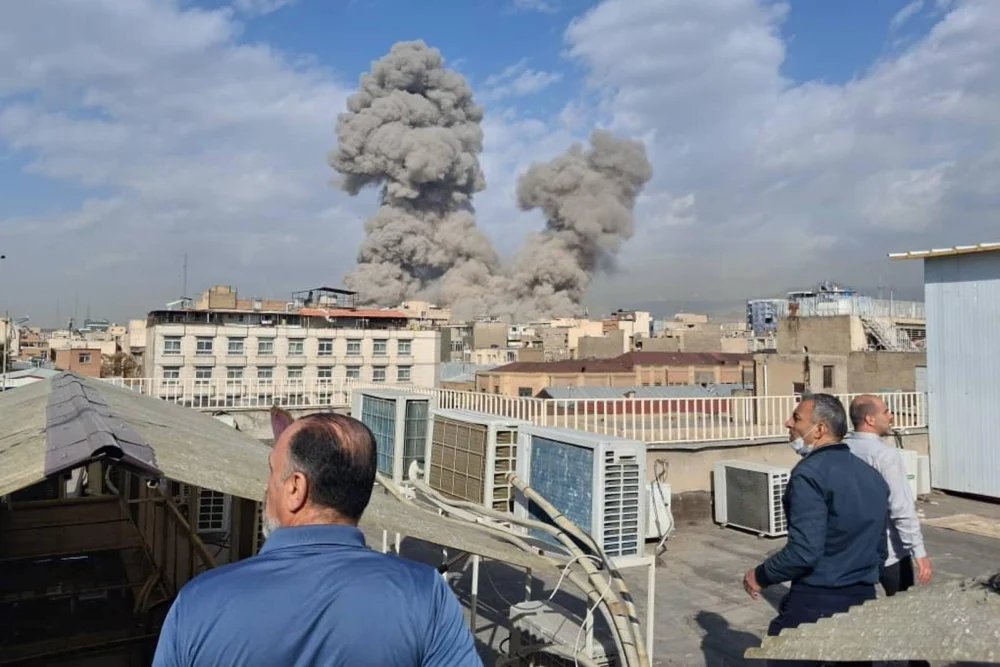
Middle East Engulfed in Escalating Conflict as Israel and US Launch Major Strikes Against Iran
The volatile geopolitical landscape of the Middle East was plunged into a new phase of intense military confrontation on Saturday as Israel initiated a pre-emptive strike against Iran, with the United States subsequently announcing that its own “major combat operations” were underway. This dramatic escalation significantly dims any lingering hopes for a diplomatic resolution to the protracted dispute over Iran’s nuclear program and ballistic missile capabilities.
U.S. President Donald Trump, in a stark address that underscored the gravity of the situation, confirmed the commencement of American military action. He cautioned the nation and the world that the ongoing operations could result in American casualties, a grim reality often associated with significant military engagements. The strikes, as articulated by President Trump, are primarily aimed at neutralizing Iran’s missile infrastructure and degrading its naval capabilities. This decisive action follows a prolonged period of increasingly urgent warnings from both the United States and Israel, who had repeatedly signaled their intention to act decisively should Iran continue its pursuit of advanced nuclear and ballistic missile technologies.
In a message disseminated via his Truth Social platform, President Trump articulated the rationale behind the U.S. intervention with unvarnished directness. “I do not make this statement lightly. The Iranian regime seeks to kill,” he declared, framing the operation as a necessary measure against a regime perceived as inherently hostile. He continued, acknowledging the potential human cost: “The lives of courageous American heroes may be lost and we may have casualties that often happens in war, but we’re doing this, not for now. We’re doing this for the future, and it is a noble mission.” The President extended a direct appeal to the members of Iran’s Islamic Revolutionary Guard Corps (IRGC), urging them to lay down their arms. He offered them a promise of immunity should they comply, contrasting this path with what he termed “certain death” for those who resist.
The precise scale and scope of the combined air and sea operations remained somewhat opaque in the immediate aftermath of the announcements. However, reports from Reuters indicated that Iran was preparing a forceful retaliatory response. Adding a layer of strategic concern, a source informed Reuters that Iran’s Supreme Leader, Ayatollah Ali Khamenei, was not present in Tehran, having reportedly been relocated to a secure, undisclosed location. This move suggests a heightened state of alert and a preparedness for significant repercussions.
This latest round of hostilities did not emerge from a vacuum. It follows a significant 12-day air war in June that saw direct engagement between Israel and Iran. That conflict, coupled with persistent U.S.-Israeli warnings, served as a clear precursor to the current military actions, indicating a sustained strategy to counter Iran’s perceived threat.
Israeli Defense Minister Israel Katz provided a direct statement from the Israeli perspective, asserting, “The State of Israel launched a pre-emptive attack against Iran to remove threats to the State of Israel.” This framing emphasizes a defensive posture, portraying the operation as a necessary step to safeguard Israeli security.
MONTHS OF CAREFUL COORDINATION WITH THE U.S., ISRAEL CONFIRMS
An Israeli defense official, speaking on condition of anonymity, revealed that the meticulous planning for this operation had been underway for several months, conducted in close coordination with Washington. The decision on the specific timing of the launch, the official added, was finalized weeks prior, underscoring the deliberative and strategic nature of the offensive.
In Tehran, explosions were reportedly heard on Saturday, according to Iranian media outlets. Simultaneously, air raid sirens wailed across Israel around 8:15 a.m. local time. The Israeli military characterized these alerts as proactive measures designed to prepare the public for the potential of incoming missile strikes, indicating a defensive readiness that mirrored the offensive actions.
In response to the heightened security situation, the Israeli military announced the closure of schools and most workplaces, with allowances made for essential services. Public airspace was also restricted, and Israel’s airspace was closed to civilian flights. The country’s airports authority issued a directive urging the public to refrain from traveling to any of its airports, signifying a comprehensive lockdown in anticipation of potential retaliatory attacks.
The international community has been closely observing renewed diplomatic efforts that began in February between the United States and Iran. These negotiations aimed to de-escalate tensions and find a path toward resolving the decades-long dispute through dialogue, thereby averting the specter of a military confrontation that could profoundly destabilize the entire region.
However, Israel has consistently maintained a firm stance, insisting that any agreement reached between the U.S. and Iran must extend beyond merely halting the enrichment process. Jerusalem has advocated for the complete dismantling of Iran’s nuclear infrastructure and has actively lobbied Washington to incorporate restrictions on Iran’s ballistic missile program into any diplomatic framework. This position reflects Israel’s deep-seated concerns about Iran’s long-range missile capabilities, which are seen as a direct threat to its security.
From the Iranian side, Tehran has stated its willingness to engage in discussions about curbs on its nuclear program, contingent upon the lifting of international sanctions. However, Iran has been unequivocal in its refusal to link the nuclear issue to its missile program, viewing the latter as a sovereign defense matter. Tehran has also reiterated its determination to defend itself against any external aggression.
Furthermore, Iran has issued stern warnings to neighboring countries that host U.S. military bases, signaling that it would retaliate against these American installations should Washington initiate strikes on Iranian territory. This posture underscores Iran’s readiness to escalate the conflict and involve regional players.
The current military actions bear a chilling resemblance to events in June, when the United States participated in an Israeli military campaign targeting Iranian nuclear installations. This marked one of the most direct American military engagements against the Islamic Republic to date. In that instance, Tehran retaliated by launching missiles toward the U.S. Al Udeid air base in Qatar, the largest U.S. air base in the Middle East, demonstrating its capacity for a significant response.
Western powers have consistently voiced concerns about Iran’s ballistic missile program, arguing that it poses a substantial threat to regional stability and could potentially be used to deliver nuclear weapons if Iran were to develop them. Tehran, however, has consistently denied any aspirations to acquire atomic bombs, maintaining that its nuclear program is solely for peaceful purposes.
The current escalation raises profound questions about the future of regional security, the efficacy of international diplomacy in containing proliferation threats, and the potential for a wider, more devastating conflict. As the situation unfolds, the world watches with bated breath, hoping for a swift de-escalation while bracing for the potential ramifications of this significant military engagement.
© Thomson Reuters 2026.