

Beijing Vows Unwavering Support for Taiwan Reunification, Stern Warning to Separatists
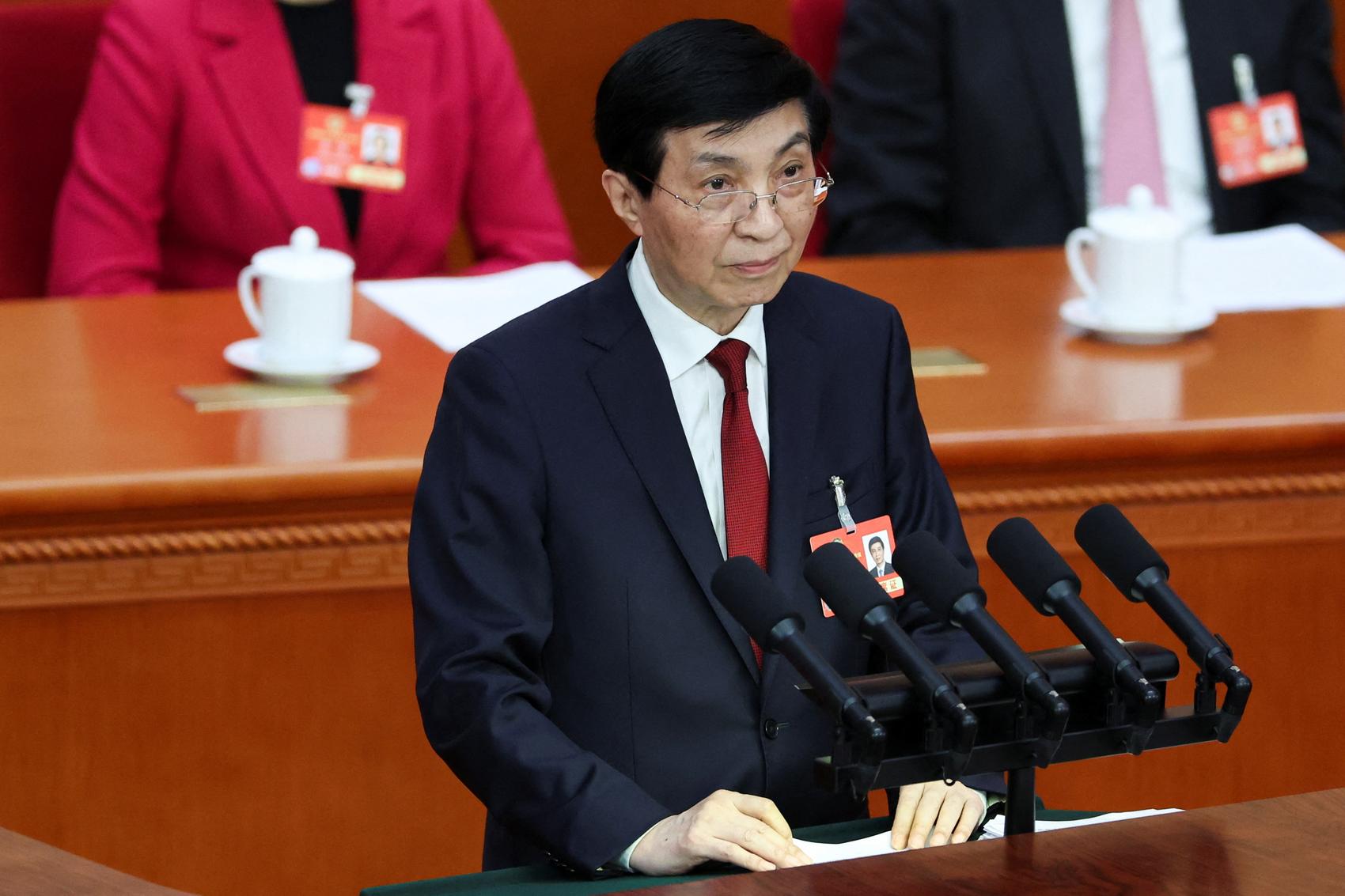
China’s top official overseeing its Taiwan policy has issued a strong declaration of unwavering support for “patriotic pro-reunification forces” on the island, coupled with a resolute commitment to “strike hard against separatists.” These pronouncements, published on Tuesday, signal Beijing’s continued escalation of military and political pressure on the self-governing democracy, which China considers a renegade province. The official, Wang Huning, a member of the Politburo Standing Committee and the fourth-highest-ranked leader in the Chinese Communist Party, emphasized the imperative to advance the “great cause of national reunification” during this year’s annual “Taiwan Work Conference.”
According to a report by the official state-run Xinhua news agency, Wang’s remarks underscored the necessity to “firmly support the patriotic pro-unification forces on the island, resolutely strike against ‘Taiwan independence’ separatist forces, oppose interference by external forces, and safeguard peace and stability in the Taiwan Strait.” While the official statement did not explicitly mention the use of force, Beijing has consistently maintained that it reserves the right to employ military means to achieve its objectives regarding Taiwan. This stance was further amplified by a comment from the Chinese Ministry of National Defense, which issued a sterner warning concerning potential Taiwanese military actions. Ministry spokesperson Jiang Bin declared on Tuesday in Beijing that “If the ‘Taiwan independence’ armed forces dare to provoke a conflict, they will inevitably be wiped out.” This rhetoric reflects a deepening resolve within Beijing to assert its sovereignty claims over Taiwan, a democratic island that has developed its own distinct political identity and governance system.
Beijing has long proposed a “one country, two systems” framework for Taiwan, a model it implemented in Hong Kong, offering a degree of autonomy under Chinese sovereignty. However, this proposal has found little traction among the Taiwanese populace or its major political parties. Taiwan’s government views Beijing’s governance in the former British colony as increasingly authoritarian, citing recent events as stark evidence. Taiwan’s President Lai Ching-te, in his remarks on Tuesday, pointed to the sentencing of Hong Kong tycoon Jimmy Lai to 20 years in prison the previous day. “Jimmy Lai’s sentencing exposes the Hong Kong national security law for what it is – a tool of political persecution under China’s ‘one country, two systems’ that tramples human rights & freedom of press,” Lai wrote on the social media platform X, formerly Twitter. This sentiment highlights a growing distrust in Taiwan towards the feasibility and desirability of the “one country, two systems” model, given the perceived erosion of freedoms and autonomy in Hong Kong.
There was no immediate official response from Taiwan’s government to Wang Huning’s latest comments. Taipei has consistently maintained that the future of the island can only be decided by its own people. Beijing, meanwhile, has repeatedly warned other nations, particularly the United States, against interfering in what it considers an internal affair. In a recent phone call with U.S. President Donald Trump, China’s President Xi Jinping reportedly described the Taiwan issue as the most critical element in China-U.S. relations, urging Washington to handle arms sales to Taiwan with extreme caution. China has refused to engage in dialogue with Taiwan’s current president, whom it labels a “separatist” and insists must first acknowledge Taiwan’s status as part of China. This diplomatic stalemate underscores the deep ideological and political chasm between Beijing and Taipei.
Wang Huning’s assertive statements come just a week after he met with a delegation from Taiwan’s largest opposition party, the Kuomintang (KMT). The KMT delegation was in Beijing for a meeting of party think-tanks, a visit that aimed to foster dialogue and explore areas of cooperation. Speaking to reporters in Taipei earlier on Tuesday, KMT Vice Chairman Hsiao Hsu-tsen, who led the delegation, stated that the discussions with Wang Huning did not delve into political matters. Instead, the focus was on practical issues such as tourism and artificial intelligence, suggesting a strategic approach by the KMT to engage with the mainland on non-contentious topics while maintaining their distinct political positions.
The KMT, historically the ruling party of China before its retreat to Taiwan in 1949, has a more pragmatic approach to relations with Beijing than the current ruling Democratic Progressive Party (DPP). While the KMT officially advocates for closer ties and eventual peaceful reunification, it also emphasizes the importance of maintaining Taiwan’s de facto autonomy and democratic system. The party’s engagement with Beijing, therefore, represents a delicate balancing act, seeking to preserve channels of communication without compromising core Taiwanese values or sovereignty. The visit also highlighted the internal political dynamics within Taiwan, where the KMT, despite being an opposition party, still wields significant influence and maintains its own distinct foreign policy approach towards the mainland.
The broader geopolitical implications of China’s assertive stance on Taiwan continue to be a focal point of international concern. The United States, in particular, has maintained a policy of “strategic ambiguity” regarding its defense commitments to Taiwan, while simultaneously providing the island with defensive weaponry. This policy aims to deter a potential Chinese invasion while avoiding explicit provocation. However, the escalating rhetoric and military activities from Beijing are testing the limits of this ambiguity, leading to increased anxieties among regional allies and international observers. The potential for miscalculation or accidental escalation in the Taiwan Strait remains a significant risk, with profound consequences for global security and economic stability. The international community largely adheres to a “one China” policy, acknowledging Beijing’s claim over Taiwan but also maintaining unofficial relations with Taipei and supporting its democratic system.
China’s economic leverage over Taiwan is also a significant factor in the cross-strait relations. Despite the political tensions, Taiwan remains a crucial economic partner for mainland China, particularly in the technology sector. Taiwanese companies are major investors in China, and the island is a vital link in global supply chains, especially for semiconductors. Beijing has, at times, used economic measures to exert pressure on Taiwan, such as imposing trade restrictions or encouraging Taiwanese businesses to shift their focus away from the island. However, the deep economic interdependence also creates a disincentive for a full-scale military conflict, as it would be immensely costly for both sides. The interplay between economic ties and political aspirations continues to shape the complex and evolving relationship between China and Taiwan.
The discourse surrounding “Taiwan independence” is highly charged. Beijing views any formal declaration of independence by Taiwan as a red line that would necessitate military intervention. Conversely, proponents of independence in Taiwan see it as the ultimate expression of self-determination and a rejection of authoritarian rule. The majority of the Taiwanese population, however, appears to prefer the status quo, enjoying the freedoms and democratic governance of their island while maintaining a degree of uncertainty about their long-term future. This nuanced position reflects a desire to avoid provoking Beijing while also resisting assimilation into a system that many perceive as oppressive. The ongoing debate within Taiwan about its identity and future trajectory remains a critical element in the broader cross-strait equation.
The role of external forces, particularly the United States and its allies, is a constant point of contention. Beijing views any support for Taiwan’s autonomy or defense capabilities as interference in its internal affairs and a challenge to its sovereignty. U.S. arms sales to Taiwan, joint military exercises in the region, and diplomatic engagements with Taiwanese officials are all closely monitored and frequently condemned by Beijing. The international community, however, is increasingly vocal in its support for maintaining peace and stability in the Taiwan Strait, recognizing the vital importance of freedom of navigation and the rule of law in the region. The ongoing strategic competition between the U.S. and China is played out in various arenas, with Taiwan serving as a particularly sensitive flashpoint.
The statements from Wang Huning and the Ministry of National Defense are indicative of a sustained and perhaps intensified effort by Beijing to shape the narrative and the reality on the ground. The emphasis on “patriotic pro-reunification forces” suggests a strategy of leveraging internal support within Taiwan, while the unwavering threat against “separatists” underscores the ultimate red line. The coming months and years will likely see a continuation of this high-stakes geopolitical drama, with the future of Taiwan remaining a central and unresolved issue in East Asian security and global affairs. The resilience of Taiwan’s democracy, its strategic economic importance, and the complex web of international relations will all play a crucial role in determining the island’s ultimate destiny.