



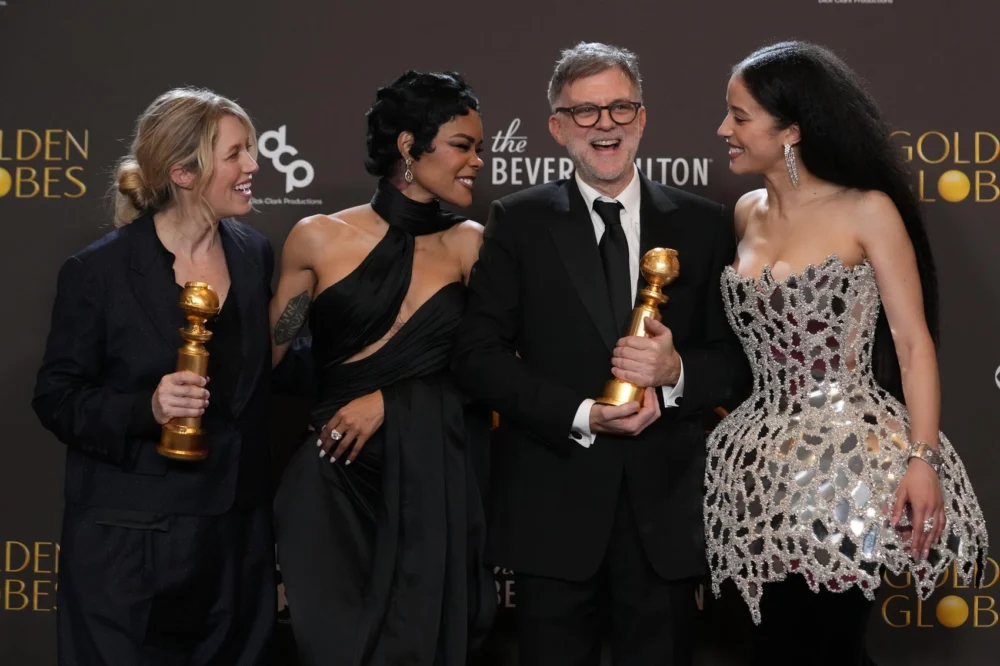
The 83rd Golden Globe Awards culminated in a night of unexpected victories and celebrated established favorites, with Paul Thomas Anderson’s sprawling historical epic "One Battle After Another" claiming the coveted Best Picture – Comedy award, while Chloë Zhao’s poignant Shakespearean drama "Hamnet" staged a surprising upset to win Best Picture – Drama. The ceremony, hosted by Nikki Glaser, also saw Anderson sweep major directing and screenplay honors, cementing his dominance in the comedy category.
Anderson’s "One Battle After Another" was a dominant force throughout the evening, earning not only Best Picture – Comedy but also a Supporting Actress win for Teyana Taylor and both Best Director and Best Screenplay for Anderson himself. This remarkable trifecta of wins for director, screenplay, and best picture (as a producer) marks a rare achievement in Golden Globe history, with only Oliver Stone, for his powerful Vietnam War drama "Born on the Fourth of July," having previously accomplished this feat. The film, lauded for its ambitious scope and ensemble cast, resonated with critics and audiences alike, solidifying its position as a major awards contender.
While many predicted a more predictable outcome, the night’s final award delivered a significant surprise. "Hamnet," a deeply moving and speculative exploration of William Shakespeare’s family life, based on Maggie O’Farrell’s bestselling novel, defied expectations by securing the Best Picture – Drama award. This victory came shortly after its lead actress, Jessie Buckley, had already triumphed in the Best Actress – Drama category for her transformative portrayal of Agnes Hathaway. The film’s quiet power and nuanced storytelling evidently struck a chord with the voting body, positioning it as a formidable contender in the upcoming Oscar race.
The evening proved to be a significant success for Warner Bros., the studio behind both "One Battle After Another" and the critically acclaimed drama "Sinners." This success arrives at a pivotal moment for the studio, as Warner Bros. Discovery is currently navigating a monumental $83 billion acquisition by Netflix, with a rival bid from Paramount Skydance also in play. In his acceptance speech for Best Director, Paul Thomas Anderson took a moment to acknowledge Warner Bros. co-chief Michael De Luca, highlighting his commitment to allowing filmmakers creative freedom. "He said he wanted to run a studio one day and let filmmakers make whatever they want," Anderson remarked. "That’s how you get ‘Sinners.’ That’s how you get a ‘Weapons.’ That’s how you get ‘One Battle After Another.’" His words underscored a sentiment of artistic integrity and the value of supporting bold directorial visions within the studio system, particularly in an era of consolidation and evolving media landscapes.
The convergence of cinematic talent was palpable as the final awards were presented. The stage brought together esteemed filmmakers such as Anderson, Zhao, and Ryan Coogler, whose film "Sinners" was also a significant contender, alongside Steven Spielberg, a producer on "Hamnet." Regardless of the specific wins, the evening offered a heartwarming display of camaraderie and a shared passion for storytelling. Zhao, reflecting on her journey, fondly recalled her early days at Sundance Labs alongside Coogler. "As students, let’s keep our hearts open and let’s keep seeing each other and allowing each other to be seen," she urged, a sentiment echoed by Coogler’s supportive presence in the front row. This moment of solidarity between artists at different stages of their careers underscored the collaborative spirit that drives the film industry.
"Sinners," despite not clinching the top drama prize, had a strong showing, securing wins for Best Score and a significant award for Cinematic and Box Office Achievement. This latter award, recognizing the film’s impressive financial success against a backdrop of more franchise-driven blockbusters like "Avatar: Fire and Ash," was particularly noteworthy. Coogler’s film, despite some early reports labeling its box office performance as a qualified success, ultimately achieved remarkable financial milestones, grossing $278 million domestically and $368 million worldwide, making it the highest-grossing original film in 15 years. Coogler, accepting the award, expressed his profound gratitude to the audience, stating, "I just want to thank the audience for showing up. It’s means the world." His words resonated with the power of audience connection and the enduring appeal of original storytelling.
The Golden Globes, having recently undergone a period of reform and rehabilitation following past controversies, presented a star-studded affair under the witty guidance of host Nikki Glaser. The ceremony also celebrated the vibrant world of animation with a win for the streaming sensation "KPop Demon Hunters" in the Best Animated Film and Best Song categories. Seth Rogen’s meta-commentary on the industry, "The Studio," garnered a well-deserved win, while an inaugural award for podcasting recognized Amy Poehler’s popular show, "Good Hang."
Many of the expected Oscar frontrunners also found their place on the Globes stage. Timothée Chalamet earned his first Golden Globe, for his role in "Marty Supreme," after four previous nominations. At just 30 years old, Chalamet is now widely seen as a strong contender for an Oscar, with industry peers like Leonardo DiCaprio and George Clooney rising to applaud his victory. In his acceptance speech, Chalamet reflected on the lessons of gratitude instilled by his father. "My dad instilled in me a spirit of gratitude growing up: Always be grateful for what you have," he shared. "It’s allowed me to leave this ceremony in the past empty handed, my head held high, grateful just to be here. I’d be lying if I didn’t say those moments didn’t make this moment that much sweeter." His humble words underscored the value of perseverance and appreciating every step of the journey.
Held at the renowned Beverly Hilton in Beverly Hills, California, the Golden Globes kicked off with a sharply observant and politically tinged opening monologue from host Nikki Glaser, who returned for her second consecutive year at the helm. Glaser, known for her incisive humor, immediately set a self-aware tone. "Yes, the Golden Globes, without a doubt the most important thing happening in the world right now," she quipped, acknowledging the ceremony’s place within a larger global context.
Her rapid-fire opening monologue didn’t shy away from celebrity-centric humor, playfully targeting familiar subjects like Leonardo DiCaprio’s dating habits and Kevin Hart’s stature. However, Glaser also skillfully wove in commentary on more topical issues. Addressing the ongoing discussions surrounding the potential sale of Warner Bros., she humorously opened the bidding for the studio at $5. She also made a pointed jab at the network airing the Globes, suggesting that the Justice Department deserved an award for "most editing" in reference to the Epstein files, while the "most editing" in news deserved to go to Bari Weiss’s new CBS News venture, a subtle dig at the Paramount Skydance-owned network.
The prevailing atmosphere leading into Sunday’s awards was a blend of political tension and industry-wide uncertainty. Hollywood was still reeling from a challenging box-office year and anxiously awaiting the resolution of the Warner Bros. sale. The tragic shooting of Renee Good in Minneapolis by a U.S. Immigration and Customs Enforcement officer also cast a somber shadow, with several attendees wearing "Be Good" pins as a symbol of solidarity and a call for thoughtful action.
It is important to note that the Golden Globes, now voted on by a body of approximately 400 individuals after being acquired by Eldridge Industries and Dick Clark Productions, have no direct affiliation with the Academy Awards, which are decided by over 10,500 industry professionals. However, a strong performance and a memorable speech at the Globes can significantly influence Oscar campaigns.
Among the other notable winners were Rose Byrne, who took home the award for Best Actress – Comedy or Musical for her role in "If I Had Legs I’d Kick You." Wagner Moura, the acclaimed Brazilian star of "The Secret Agent," received the award for Best Actor – Drama. Kleber Mendonça Filho’s period political thriller also secured the Best International Film award. Moura, accepting his award, delivered a powerful message about the transmission of values: "I think if trauma can be passed along generations, values can do," he stated. "So this to the ones who are sticking with their values in difficult moments." His words resonated deeply, emphasizing the importance of moral fortitude in challenging times.
The supporting actor race saw a well-deserved win for veteran actor Stellan Skarsgård, a frontrunner for his role in the Norwegian family drama "Sentimental Value." This marked a significant milestone for the 74-year-old actor, a respected figure in the industry who received a standing ovation. "I was not prepared for this because I, of course, thought I was too old," Skarsgård admitted, his humble surprise eliciting cheers from the audience.
In the television categories, the critically acclaimed series "The Pitt" was honored with the award for Best Drama Series. Noah Wyle also secured a win, notably surpassing his former "ER" co-star George Clooney on his way to the stage. Netflix’s limited series "Adolescence" proved to be a major success, garnering four awards, including Best Limited Series and acting accolades for Erin Doherty, Stephen Graham, and the remarkably talented 16-year-old Owen Cooper. Other television winners included Rhea Seehorn for "Pluribus" and Jean Smart for her role in the popular series "Hacks."
However, the most comically poignant award of the night undoubtedly went to "The Studio," which was crowned Best Comedy Series. Seth Rogen’s incisive Hollywood satire, which memorably featured an episode dissecting the very dramas surrounding a night at the Golden Globes, resonated deeply with its meta-commentary. A line from the show, "I remember when the red carpet of the Golden Globes actually stood for something," perfectly captured the show’s sharp observation of the industry. Rogen himself also triumphed, winning Best Actor – Comedy. "This is so weird," Rogen chuckled, accepting his award. "We just pretended to do this. And now it’s happening." His candid reaction perfectly encapsulated the surreal nature of awards season and the power of satire to reflect reality.