



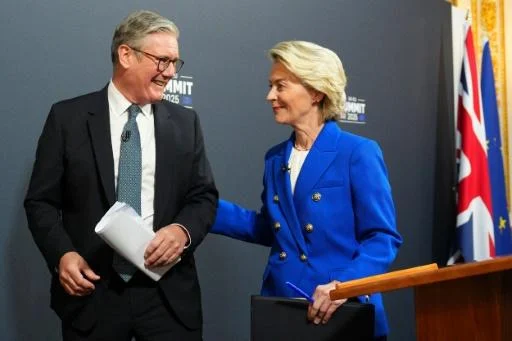
Years of acrimonious debate and political upheaval surrounding Britain’s departure from the European Union, often dubbed the “Brexit wars,” may be giving way to a new era of parliamentary contention. The Labour government, under Prime Minister Keir Starmer, is strategically positioning itself for fresh legislative skirmishes as it signals a clear intent to forge closer ties with the 27-member bloc.
Upon securing a decisive victory in the July 2024 general election, ousting the Conservative Party after a fourteen-year tenure, Starmer wasted no time in initiating a concerted effort to mend and rebuild the United Kingdom’s relationship with its European neighbours. This diplomatic reset is central to his administration’s agenda, aimed at revitalising a British economy that has, in recent years, been perceived as sluggish and lacking dynamism. The Prime Minister is betting that a strengthened bond with the EU can inject much-needed vitality into his premiership, which has, to date, struggled to gain widespread public favour.
In pursuit of this objective, Labour is actively preparing to introduce a significant piece of legislation. This bill is designed to establish a robust legal framework for the government’s much-advertised “reset” of relations with the European Union. While Labour commands a substantial majority in Parliament, this initiative is anticipated to face formidable opposition from the right-wing parties. Foremost among these are the Conservative Party, the very architects of Britain’s exit from the EU, and the hard-right Reform UK, a political force that has been steadily gaining traction in opinion polls and is currently led by the prominent Eurosceptic figure, Nigel Farage.
A senior UK government official, speaking to AFP on condition of anonymity, adopted a defiant stance, stating, “Bring it on.” This sentiment reflects an expectation of fierce pushback, particularly anticipated “Brexit betrayal” accusations from the Tories and strident opposition from Reform UK’s leader. Farage, a long-standing adversary of closer EU ties, is expected to be a vocal critic of any move perceived as capitulation to Brussels.
Beyond the external political challenges, the proposed legislation also carries the risk of exposing and exacerbating internal divisions within the Labour Party itself. Key among these is the potential debate over whether the party should reneve on a manifesto pledge not to seek re-entry into the EU’s customs union. This commitment, made during the election campaign, could prove to be a significant hurdle for the government’s ambitions.
The groundwork for this closer alignment has already been laid through a series of economic agreements brokered by Starmer with EU leaders in the preceding year. One notable pact focuses on boosting bilateral trade by streamlining regulatory burdens, particularly for food and plant exports. Furthermore, discussions have progressed towards a new electricity deal, intended to integrate the UK into the EU’s internal electricity market. The primary objective of this initiative is to drive down energy costs for consumers and businesses by leveraging shared infrastructure and market mechanisms.
Addressing the ‘Brexit Damage’
These recent agreements represent tangible steps towards aligning the UK with specific EU regulations and standards in key sectors. The forthcoming bill, though not yet published, is expected to formalise this approach by providing a clear “mechanism” for such alignment, according to the unnamed government official. “The bill will provide the powers to adopt the rules and set out the role parliament will play in that,” the official elaborated, underscoring the intention to empower the executive while maintaining parliamentary oversight.
The government’s timetable targets the introduction of this legislation for the spring or summer parliamentary sessions. This timing could be particularly resonant, potentially coinciding with the tenth anniversary of the Brexit referendum, which was held in June 2016. The aftermath of that historic vote was characterised by three years of deeply divisive parliamentary wrangling over the future shape of Britain’s relationship with the EU. This prolonged period of deadlock ultimately led to the resignation of then-Prime Minister Theresa May.
The political impasse was eventually broken by May’s successor, Boris Johnson, who secured a landslide general election victory in December 2019, enabling him to push through the UK’s formal withdrawal from the bloc. In the intervening years, a significant shift in public sentiment has occurred. Numerous opinion polls now consistently indicate that a majority of Britons regret the narrow vote to leave the EU and widely perceive the Brexit project as a failure. This evolving public mood is a factor that Starmer’s government hopes to leverage to its advantage.
One supportive Labour Member of Parliament, speaking anonymously, articulated this sentiment: “Labour members are almost wholly united in wanting to see some of the damage done by the Tory-Farage Brexit exposed and fixed.” The lawmaker continued, “Closer alignment helps our economic message, has the backing of members and most MPs, and will provide a boost to British business.” This perspective highlights the belief within parts of the Labour Party that a pragmatic approach to EU relations is not only economically beneficial but also aligns with the desires of the party faithful.
However, the path forward is not entirely smooth, and dissent exists within Labour’s own ranks. A contingent of thirteen Labour MPs recently sided with the Liberal Democrats, a pro-European centrist party, by voting in favour of a bill that advocated for the UK to initiate negotiations to rejoin the EU’s customs union. This move underscored the ongoing internal debate about the depth and nature of future UK-EU ties.
Adding further complexity to the leadership landscape, Health Secretary Wes Streeting, widely regarded as a potential successor to Keir Starmer, has publicly indicated his support for such a customs union agreement. This stance contrasts with Starmer’s stated position. The Prime Minister has firmly ruled out rejoining the customs union, instead expressing his preference for closer realignment with the EU’s single market, a policy that offers different economic benefits and trade-offs.
The internal divergence of views within Labour was further highlighted by another anonymous Labour MP who expressed a desire for a more ambitious approach. “I want us to do more,” this lawmaker stated, suggesting a belief that Starmer’s current strategy might not be bold enough in its pursuit of EU integration. Conversely, some of their parliamentary colleagues are urging caution, advocating for the government to steer clear of reopening the Brexit debate altogether.
MP Jonathan Hinder articulated this perspective to AFP: “We said we wouldn’t re-open the Brexit debate and now we are doing exactly that. We can create a fairer, socialist Britain while outside the EU and that is what we should be focused on doing.” This viewpoint champions an inward-looking approach, focusing on domestic policy objectives within the current post-Brexit framework.
In response to these developments, a spokesperson for the UK government issued a statement affirming the strategic importance of the proposed reset. “The reset is improving our diplomatic, economic and security cooperation and will be worth £9.0 billion ($12 billion) to the UK economy by 2040,” the spokesperson declared. “We will legislate to deliver on this and further details of the bill will be announced in due course.” This statement reiterates the government’s commitment to the initiative and its projected economic benefits.
Ian Bond, deputy director at the Centre for European Reform think tank, offered a nuanced perspective on the potential impact of the forthcoming legislation. He suggested that its significance as a “game changer” would ultimately hinge on the degree of autonomy the British government grants itself. “If it holds its nerve, it really doesn’t need to pay any attention to these noises,” Bond commented, referring to the anticipated political opposition. However, he also expressed concern that ministers might be overly apprehensive about potential criticism from parties like Reform UK.
“But he added he felt ministers were ‘all terrified that if they do anything too bold, Reform will criticize them for it’,” reflecting an awareness of the political tightrope the government is attempting to walk amidst a highly charged post-Brexit landscape.
© 2026 AFP