

In the rarefied, often absurd realm of contemporary art, a single red dot can signify triumph. It’s the universal symbol that a piece has found a buyer, marking an exhibition as a commercial success and a curator’s vision validated. Yet, in director Cathy Yan’s latest cinematic endeavor, “The Gallerist,” these crimson markers take on a far more sinister hue, pooling beneath a human corpse at Miami’s fledgling Polinski Mayer Gallery. What begins as a seemingly facile yet fun art-world satire quickly descends into a macabre chamber drama, questioning not just the value of art, but the ethical price of ambition in a world obsessed with superficiality.
Yan, known for her distinctive voice in films like “Dead Pigs” and the DC universe’s “Birds of Prey,” steers her audience into the glittering, cutthroat milieu of Art Basel week. Here, the joke, delivered with a brutal literalness, is that many wouldn’t recognize profound art if it were staring them down—or, more precisely, if it were to fatally stab them. This darkly humorous premise hinges on the unfortunate demise of Dalton Hardberry, an insufferable art influencer portrayed with a suitable blend of arrogance and vulnerability by Zach Galifianakis. Hardberry, a harbinger of the “hoi polloi,” arrives for an exclusive preview, only to become an unwitting, grotesque addition to the exhibition.
At the center of this unfolding chaos is Polina Polinski, the high-strung, titular gallerist, brought to life by Natalie Portman with an intensity reminiscent of her Oscar-winning turn in “Black Swan.” Polina is a woman teetering on the precipice of professional and personal reinvention. Her past success in art collecting, we learn, was largely underwritten by her now-ex-husband’s wealth. Divorced and determined to forge her own path, she has poured her settlement into transforming a dilapidated Jiffy Lube into an avant-garde showcase for uncompromising artists. This choice of venue itself is a poignant symbol of her ambition: taking something utilitarian and discarded, and attempting to elevate it into a sanctuary for high culture. It’s a metaphor for her own journey, seeking to transform her past into a foundation for a new, independent identity within an unforgiving industry.
Hardberry, a character who embodies the worst excesses of modern art critique and social media clout, sees right through Polina’s veneer. With a biting cynicism, he dismisses her as a “gold-digging dilettante,” suggesting her passion for art was merely a leisure pursuit tied to her marital status, and that she lacks the genuine acumen to sell art to discerning collectors. His words, though undeniably cruel and uncalled for, resonate with an underlying truth about the art market: it’s not just about aesthetic appreciation, but about connections, branding, and a certain performative confidence. Polina’s struggle for legitimacy in a world that often conflates wealth with taste is palpable. The narrative, however, offers a twist that sidesteps outright murder, presenting Dalton’s death as an “accident”—a slip on a patch of water from a broken AC unit, leading to his fatal impalement on an enormous, ten-foot emasculator sculpture. This oversized veterinary tool, blown up to grotesque, Jeff Koons-esque proportions, serves as a darkly ironic instrument of fate, symbolizing perhaps the castration of superficial judgment, or the emasculation of the male gaze in a female-driven narrative.
The decision to frame Dalton’s death as an accident, rather than a deliberate act, is a narrative choice that invites debate. While a premeditated murder might have offered a more straightforwardly satisfying starting point for a cynical chamber drama, the “accidental” nature of his demise amplifies the absurdity that follows. It forces Polina and her entourage into a desperate, improvised dance, highlighting their survival instincts rather than premeditated malice. This narrative pivot shifts the film’s focus from a whodunit to a farcical exploration of how far one might go to preserve a career and a dream, even when confronted with a literal dead body.
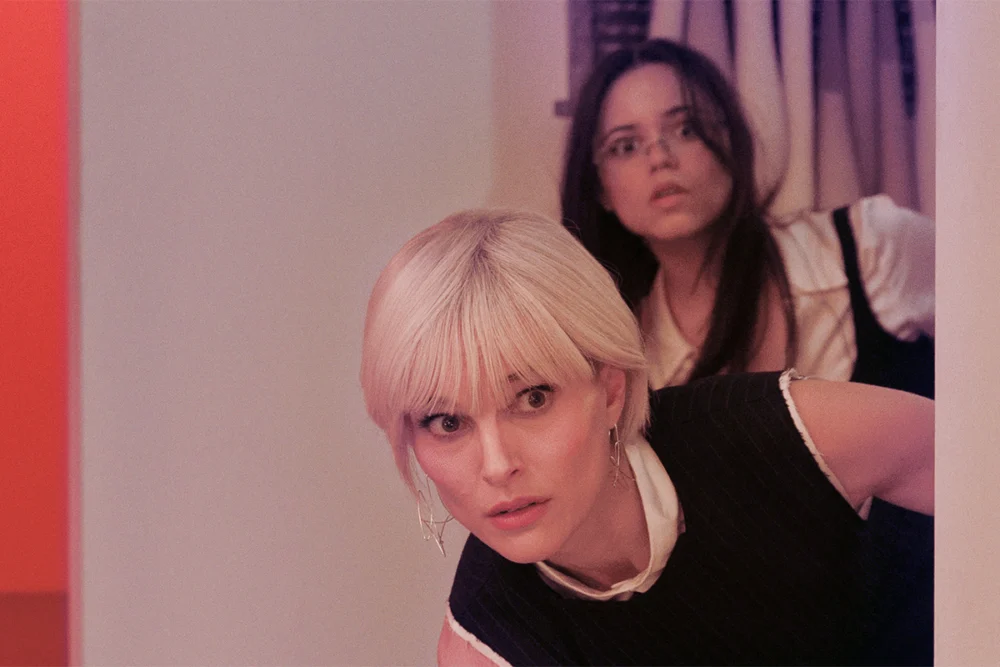
Polina’s initial reaction is pure panic. Her young, freaked-out assistant, Kiki (played by the ever-expressive Jenna Ortega), wants to call the police, a natural, ethical response. But Polina, with her career and financial future hanging precariously in the balance, instantly grasps the catastrophic implications. A crime scene in her nascent gallery during Art Basel week would not only signify the end of her professional aspirations but also confirm every cynical whisper about her lack of genuine artistic understanding. Instead, in a moment of desperate, audacious improvisation, she spins the horrific incident into a perverse publicity opportunity. This audacious move immediately places “The Gallerist” in conversation with other dark satires of the art world, such as Dan Gilroy’s “Velvet Buzzsaw,” and even evokes the sharp, morally ambiguous dialogue of a David Mamet play.
However, Yan and co-writer James Pedersen’s script introduces a significant challenge: the sudden disappearance of a social-media influencer with two million followers. In an age dominated by digital footprints and constant connectivity, the idea that Dalton Hardberry could vanish without immediate, widespread alarm stretches credulity. The film asks its audience to accept a certain level of narrative contrivance for the sake of its satirical thrust. If we are meant to admire Polina’s capacity to improvise—a trait often associated with intelligence and a strong survival instinct—then the collective obliviousness of everyone else in the film, particularly the art-going public, feels like a deliberate, perhaps too convenient, dumbing down. Polina’s belief that surrounding the crime scene with bright orange pylons will prevent anyone from examining the sculpture closely enough to realize it’s a real, bleeding body, becomes the central, absurd gamble of the film. It’s a testament to her desperation and the sheer audacity of her scheme, but also a point of contention for viewers expecting a more grounded realism within the satire.
The movie is liberally peppered with art-world in-jokes, appealing to those familiar with its eccentricities and pretenses. Yet, as the original review points out, it often breezes past its many plot holes, which can feel more conspicuous than the deliberate slashes in one of Lucio Fontana’s “Spatial Concept” canvases. The very existence of “The Gallerist” seems to draw inspiration from real-life art world spectacles, most notably Maurizio Cattelan’s infamous “Comedian”—a banana taped to a wall at Art Basel in 2019, which sold for $120,000. That piece, despite its apparent simplicity, served as a powerful, resonant symbol for the commodification and subjective valuation of art. In “The Gallerist,” however, the way people respond to a very real, very dead body as art struggles to achieve the same coherent point. The film attempts to set up a scenario where a group of independent-minded women navigate a crisis, transforming a fatal accident into an unlikely succès de scandale, but the logical leaps required to believe the public’s reaction sometimes undermine the satirical impact.
The ensemble cast further enriches this darkly comedic narrative. Beyond Polina and Kiki, who constantly retreat to the gallery’s opulent bathroom to refine their increasingly elaborate plans, we are introduced to Kiki’s aunt Marianne, played with captivating coolness by Catherine Zeta-Jones. Freshly out of prison, Marianne’s pragmatic, almost criminal, sensibilities provide a fascinating counterpoint to Polina’s frantic, on-the-edge meltdown. Zeta-Jones’s performance injects a much-needed groundedness and shrewdness into the proceedings, as Marianne, described as a “shark,” quickly recognizes the macabre commercial potential of the “ultrarealistic” piece, estimating a high-six-figure sales price. Her presence subtly highlights the different forms of “value” and “art” that exist in and outside the conventional art market.
Adding another layer to the complex dynamic is Stella Burgess, the artist behind the fateful emasculator sculpture, portrayed by Da’Vine Joy Randolph. Polina, against all odds, manages to convince Stella not to disown the work, despite its intention shifting completely with Dalton’s impalement. This negotiation is crucial, exploring the precarious relationship between an artist, their creation, and its public interpretation. Does the meaning of art belong solely to its creator, or does it evolve with audience reception, especially under such extreme circumstances? Stella’s decision, however reluctantly made, further complicates the ethical quagmire, turning her artistic integrity into another casualty of the market’s demands.
Polina’s repeated assertion that the corpse is made of PVC serves as a desperate attempt to deflect suspicion. Yet, the film’s central conceit gains its provocative edge precisely from the body being real. If it were merely a hyperrealistic sculpture, the ethical questions and the satirical bite would largely evaporate. “The Gallerist” attempts to pose ethically interesting questions about the boundaries of art and the commodification of tragedy. As Kiki, perhaps channeling her aunt’s newfound ruthlessness, initiates an auction for the “piece,” the ambiguity surrounding what the bidders truly see in it becomes a sharp critique of art’s subjective valuation. The film adeptly skewers the notion that any interpretation, however far-fetched, can be spun to legitimize a work, particularly when financial stakes are high. As the turmoil within the gallery intensifies, Yan’s camerawork becomes increasingly agitated, weaving through the space like a drunken hornet, passing through windows and walls, mirroring Polina’s escalating mental state and the chaotic energy of the unfolding farce.
The film’s satirical lens extends to its chosen setting. Miami, particularly during Art Basel, is often depicted as a nexus of wealth, superficiality, and a certain performative glamour. The original reviewer’s anecdote about the South Florida resident preferring Los Angeles for its perceived authenticity, despite L.A.’s own reputation for shallowness, succinctly captures the heightened artificiality Miami embodies. This perceived fakeness in Miami is cleverly underscored by the production’s decision to shoot nearly everything in Paris, passing it off as the sun-drenched Florida hot spot, and by Natalie Portman’s distinctive, Andy Warhol-esque wig, which further contributes to the film’s aesthetic of curated artificiality. It’s a place where appearances are paramount, making it the perfect stage for Polina’s grand deception.
After her ambitious but somewhat misbegotten DC movie “Birds of Prey,” Cathy Yan scales back to a more intimate, yet equally ambitious, satirical vision. She assembles a supporting cast that, while sometimes unconvincing in its roles, serves to populate this bizarre world. Daniel Brühl appears as a “nepo baby” with millions to waste on art he might never truly appreciate, embodying the entitled collector. Charli XCX makes an appearance as the only character willing to call out the emperor’s nakedness, representing a voice of unvarnished truth amidst the pretense. “The Gallerist” provocatively raises an uncomfortable question: What is the true purpose of art if it isn’t acquired, if it doesn’t circulate, if it doesn’t achieve some form of market validation? Not every artist creates hoping for immense wealth, but the film suggests that in the current art ecosystem, a work’s worth, both cultural and monetary, is inextricably linked to its transactional fate. Despite its imperfections, “The Gallerist” offers a biting, if uneven, commentary on the ethical compromises and absurdities inherent in the contemporary art world, forcing viewers to confront the thin line between artistic expression and commercial exploitation, and the often-deadly consequences of ambition.