




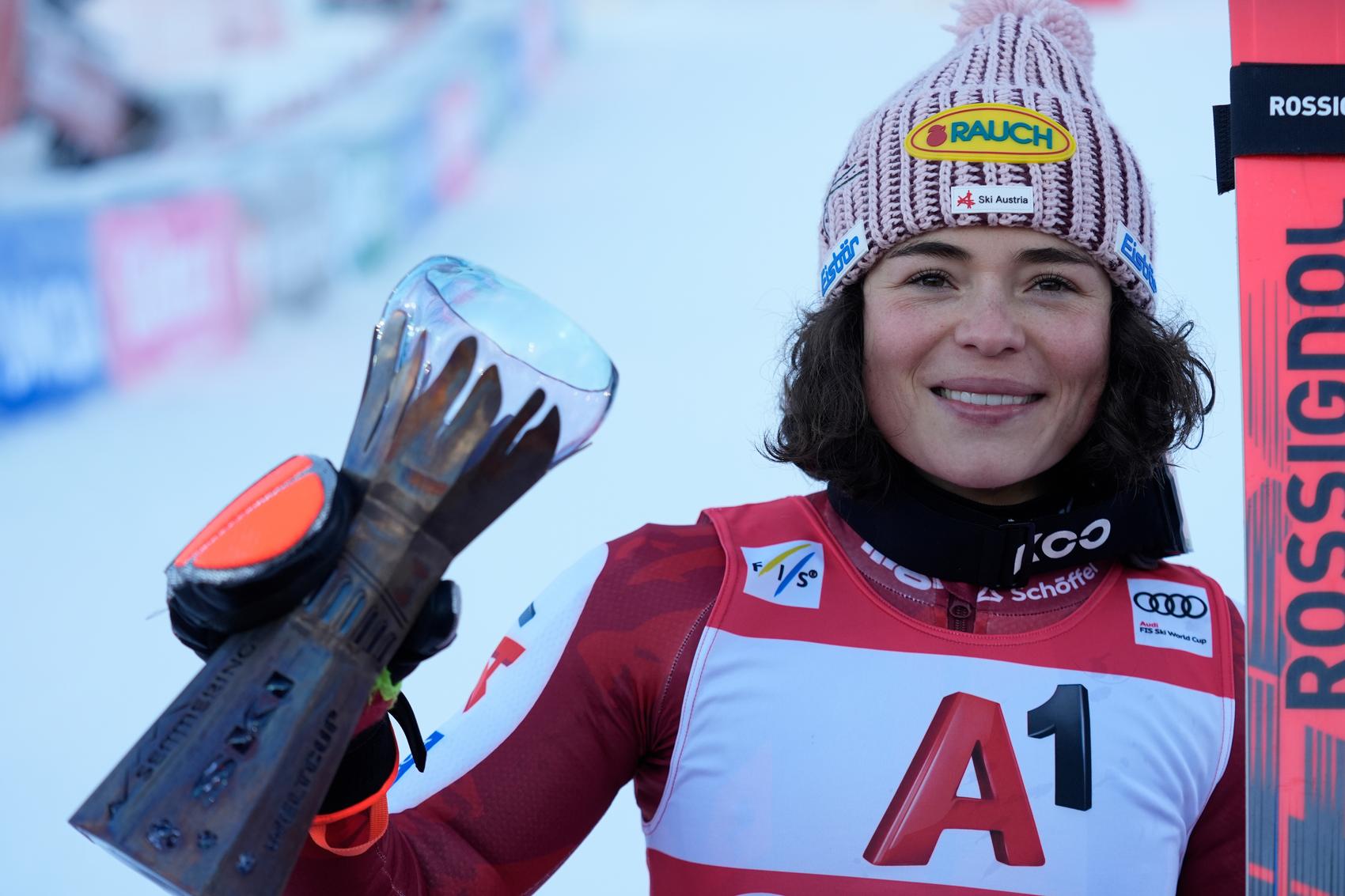
Austrian Star Scheib Dominates Home Slopes to Claim World Cup Giant Slalom Title and Olympic Momentum
In a performance that resonated with the passion of a home crowd and the anticipation of an Olympic year, Austrian skier Julia Scheib delivered a masterful giant slalom victory on Saturday, just weeks before the highly anticipated Milan Cortina Winter Olympics. The triumph, achieved on familiar slopes close to the nation’s capital, not only marked a significant personal achievement but also propelled her to the summit of the discipline’s standings, signaling her formidable form heading into the global competition.
Scheib’s commanding run saw her outpace a stellar field, with Switzerland’s Camille Rast securing second place, a mere 0.14 seconds behind, and Sweden’s Olympic champion Sara Hector trailing by 0.40 seconds to complete the podium. The performance was particularly noteworthy given the presence of Mikaela Shiffrin, the undisputed queen of women’s giant slalom, who finished sixth. Shiffrin, holder of a remarkable 22 GS victories, found herself unable to match Scheib’s pace on this occasion.
A visibly emotional Scheib described the overwhelming sensation of winning on home snow. “It’s crazy, I never thought it would be the win,” she confessed. “It was so tough, it was so bumpy, and I was so relieved when I came into the finish.” The Austrian had been trailing Hector by a razor-thin margin of two-hundredths of a second after the opening run, a testament to the incredibly tight competition. However, in the final run, Scheib exhibited remarkable composure, trailing then-leader Rast until the final split before unleashing a flawless finishing section.
“It’s amazing. I heard the crowd before I (skied) into the last section, I heard the crowd, and I thought I had to let the skis go,” Scheib recounted, attributing her final surge to the electrifying energy of her supporters. This victory was more than just a single race win; it represented a significant shift in the giant slalom landscape. With her main rival, Alice Robinson of New Zealand, skiing out in the first run, Scheib capitalized on the opportunity. Her win allowed her to overtake Robinson in the discipline standings, entering the Olympic year with a substantial 88-point lead. This dominance is underscored by her impressive record this season, having secured victory in three of the five giant slalom races contested thus far.
Robinson, a formidable contender throughout the season, had been setting a blistering pace in the opening run, clocking the fastest intermediate times. However, a momentary lapse in balance on a left turn led to her losing control and sliding off the course. “I got unlucky and off balance and I pressured in a bad spot and just went face flat,” Robinson explained, expressing her deep disappointment at leaving the competition without any points. The incident highlighted the unforgiving nature of the sport and the fine margins that often separate success from misfortune.
Mikaela Shiffrin’s sixth-place finish, while not a victory, provided valuable insights into her ongoing adaptation to giant slalom. Shiffrin, a multiple-time winner at Semmering, the venue for Saturday’s race, finished 1.45 seconds behind Scheib. While Shiffrin has been in exceptional form in slalom this season, boasting a perfect record of four wins from four races, her giant slalom performances have been a work in progress. This has been particularly true since her significant crash in Killington, Vermont, over a year ago, which resulted in a deep puncture wound and severe trauma to her oblique muscles. The psychological impact of such an injury can be profound, and Shiffrin has openly discussed the challenges of regaining confidence on the demanding GS courses.
“So far this season, the second run, that was maybe the biggest test for me. I was really quite scared, actually,” Shiffrin admitted, referring to the difficult conditions of skiing in the late afternoon shadows and the bumpy nature of the course. She elaborated on her approach to the second run, explaining her strategic shift. “I knew it would be bumpy from the first run and I didn’t really feel after the first run that I could tackle this again. So I changed the mentality on the second, just to try to be as smooth and like soft on the surface as possible. So it wasn’t going to be the most fast skiing, or like not the most powerful turns, but it felt much more manageable on the second run.” This tactical adjustment, while prioritizing safety and control, ultimately prevented her from challenging for the win.
The current streak of 10 giant slalom races without a podium finish marks the longest of Shiffrin’s illustrious career in the discipline, surpassing even the initial 15 GS races of her career in the 2010-11 season where she did not achieve a top-three result. This statistic underscores the competitive depth and evolving dynamics within women’s giant slalom. Adding to the challenging day for the U.S. team, Shiffrin’s teammates Nina O’Brien and Paula Moltzan both experienced concerning crashes. O’Brien slid off course in the first run, while Moltzan fell and hit her head in the second. Fortunately, both appeared to avoid serious injuries, a testament to the safety measures in place and perhaps a touch of good fortune.
The success of Julia Scheib and the Austrian women’s team marks a significant resurgence in giant slalom. Prior to Scheib’s breakthrough, the Austrian women’s team had not claimed a World Cup giant slalom victory for over nine years. Scheib broke this long drought in October at the season-opening race, also held in Austria. Her subsequent victory in Tremblant, Quebec, three weeks ago, followed by her triumphant performance on Saturday, solidifies her position as a leading contender for the Olympic giant slalom race on February 15th. However, Scheib’s ambitions extend beyond just giant slalom.
“I want to continue like this, but I want also to focus a little bit on super-G,” she revealed, indicating a desire to broaden her competitive scope and potentially challenge in multiple disciplines at the Olympics. This dual focus could present an exciting new dimension to her Olympic campaign.
Sara Hector, the reigning Olympic GS champion, was seeking her first World Cup victory in nearly a year. The Swedish skier, with seven career World Cup wins all in giant slalom, has not stood atop the podium since a race in Slovenia in early January. Reflecting on her performance, Hector acknowledged Scheib’s superior skiing. “Julia skied really well, I stepped on the brakes a little bit, you cannot do that,” she told Austrian television, offering a candid assessment of where the race was lost.
The focus now shifts to the slalom discipline, with a race scheduled on the same hill for Sunday. This presents an opportunity for specialists like Shiffrin to reassert their dominance and for other athletes to showcase their skills on a different discipline. The dramatic events of Saturday’s giant slalom have undoubtedly set the stage for an enthralling Olympic season, with Julia Scheib emerging as a powerful force and a compelling story of resilience and home-soil triumph.
© Copyright 2025 The Associated Press. All rights reserved. This material may not be published, broadcast, rewritten or redistributed without permission.