


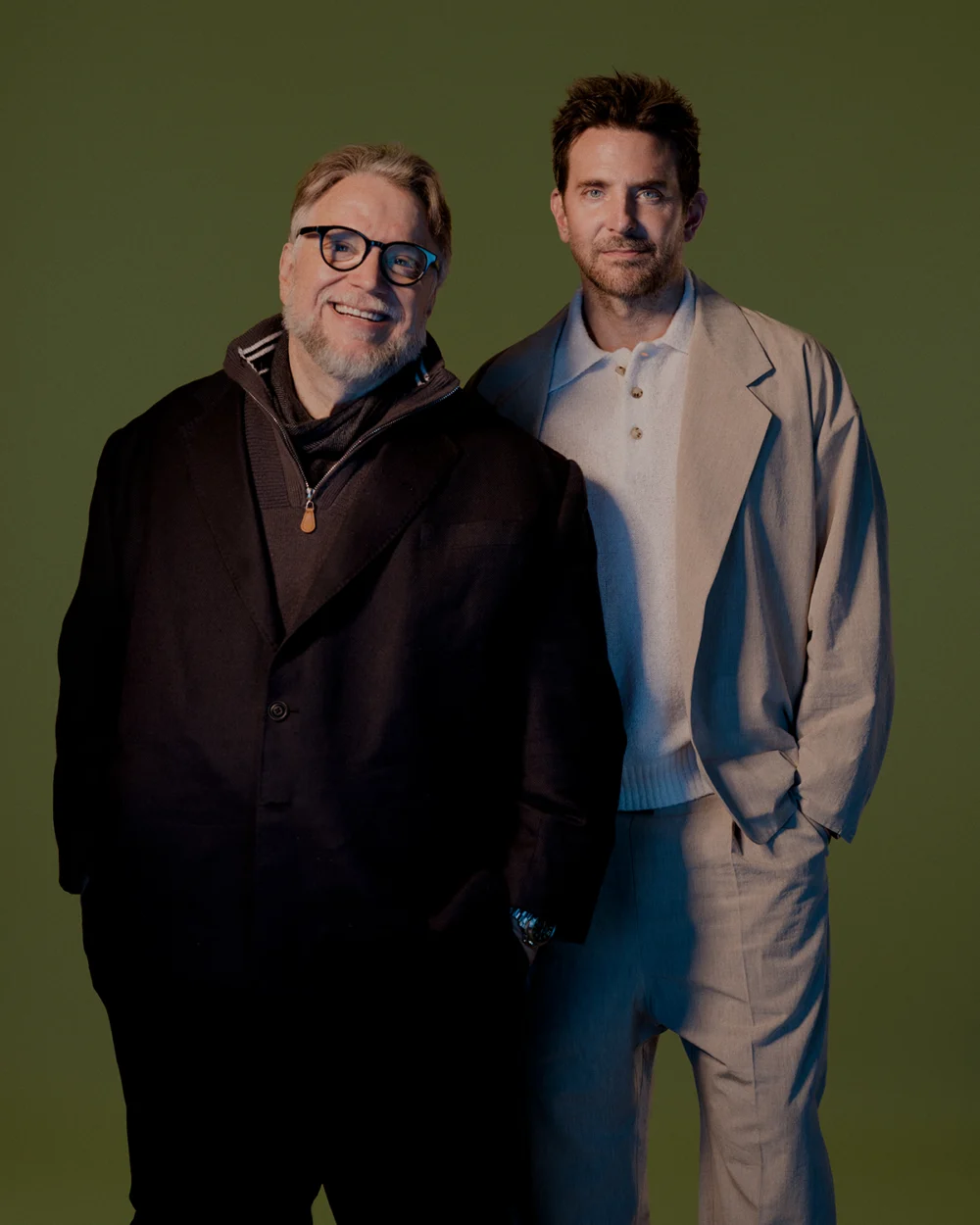
In a bustling midtown Manhattan studio, a rare convergence of creative minds unfolded as Oscar-winning filmmaker Guillermo del Toro, celebrated for his meticulously crafted narratives of the fantastical and the macabre, sat down with his friend and frequent collaborator, Bradley Cooper. Their conversation, a candid exploration of the directorial journey, quickly veered from the romanticized notions of artistic genius to the gritty, unglamorous reality of bringing stories to life on screen. Del Toro, despite a career brimming with visually stunning and deeply resonant works, staunchly rejects the label of "visionary," famously quipping to Cooper, "It’s not like you’re in a recliner with somebody feeding you grapes, going, ‘I see a castle.’" This humorous yet pointed remark encapsulates the core of their discussion: filmmaking, at its heart, is a testament to relentless effort, pragmatic decision-making, and an unwavering commitment to the craft, often steeped in profound personal experience.
Del Toro’s aversion to the "visionary" moniker stems from a deep respect for the tangible, often arduous process that underpins cinematic creation. For him, the magic of cinema is not born from ethereal inspiration alone but from the disciplined orchestration of countless practical elements. It’s the exhaustive hours spent in pre-production, sketching every frame, meticulously designing creatures, and collaborating with artisans to construct immersive worlds. It’s the on-set agility required to pivot when budgets tighten or time dwindles, demanding swift, informed choices that can make or break a scene. This perspective resonates with many creative professionals, especially women, who often find their intellectual labor and meticulous execution overshadowed by reductive labels of "talent" or "intuition." Del Toro champions the visible and invisible labor that transforms an idea into a palpable experience.
This philosophy is acutely evident in del Toro’s latest endeavor, a sumptuously produced adaptation of Mary Shelley’s timeless gothic novel, "Frankenstein." A project he has harbored a deep fascination for since childhood, "Frankenstein" remained a decades-long struggle to materialize until Netflix greenlit the ambitious $130 million horror film. True to his signature style, del Toro’s "Frankenstein" reimagines the classic tale, presenting a creature (Jacob Elordi) whose plight evokes more sympathy than his tormented creator (Oscar Isaac). This inversion of traditional roles is not merely a narrative choice but a deeply personal reflection for del Toro, a vessel for his own "turmoil and pain." The film, like much of his oeuvre, transcends simple genre classification, using the monstrous as a mirror to humanity’s deepest fears and flaws.
Bradley Cooper, himself a formidable presence both in front of and behind the camera, echoes del Toro’s sentiment of deeply personal filmmaking. Having starred in del Toro’s critically acclaimed 2021 neo-noir thriller, "Nightmare Alley," Cooper understands the emotional investment required. His latest directorial effort, "Is This Thing On?", is another deeply autobiographical project. It chronicles the journey of a middle-aged man, played by Will Arnett, who discovers a burgeoning passion for stand-up comedy as his marriage crumbles. This narrative choice provided Cooper with a unique opportunity to peel back the layers of his close friend, Arnett, known predominantly for his broadly comedic turns in beloved series like "Arrested Development" and animated features such as "The Lego Movie," revealing a more profound and sensitive side. The collaboration underscores the power of trust and intimacy in drawing out authentic performances.
The conversation naturally pivoted to the foundational element of casting, a subject both directors hold in high regard. Cooper profoundly quoted legendary actor-director Warren Beatty: "Casting is plot." Del Toro wholeheartedly agreed, elaborating on a recent discussion with Al Pacino about the transformative power of casting in theatrical productions. "If you do Shakespeare and all of a sudden you cast a Hamlet in his 50s," del Toro mused, "that changes everything." This insight speaks to the profound ripple effect a casting decision has on the entire narrative fabric. An actor doesn’t merely embody a role; they imbue it with their own history, gravitas, and interpretative lens, subtly shifting the story’s trajectory and audience perception.
Cooper, recognizing del Toro’s lifelong obsession with "Frankenstein," pressed him on how this "casting is plot" philosophy applied to his choice of Oscar Isaac as Victor Frankenstein. Del Toro explained his intentional departure from Shelley’s depiction of Victor as a young, brilliant student. Instead, he envisioned a man in his 30s "stuck in their teens," emotionally stunted by the childhood loss of his mother, having intellectually and socially matured but halted emotionally. Isaac’s unique qualities were central to this vision. "I wanted Oscar to not belong completely to the family of his father; I wanted him to be frowned upon because his skin was darker, his hair was unruly, and he had this fiery temperament," del Toro revealed. "I wrote it for him." This illustrates a director’s profound understanding of an actor’s essence and how it can deepen and subvert character archetypes.

Similarly, Cooper confessed to rewriting "Is This Thing On?" specifically for Will Arnett and Laura Dern, tailoring the roles to "where they are in their lives." This bespoke approach to character development, rooted in real-life observation and personal connection, allows for a raw authenticity that resonates deeply with audiences. The shared methodology led del Toro to observe, "Both movies are strangely autobiographical." Cooper’s swift, profound response — "Don’t you think if we’re doing our jobs properly, everything’s autobiographical?" — encapsulates the vulnerability inherent in true artistic expression. For these filmmakers, the line between personal experience and fictional narrative often blurs, allowing their work to become a mirror to their souls.
Del Toro, known for his empathetic portrayal of "monsters," confessed an evolution in his relationship with "Frankenstein." "People say, ‘Oh, you identify with the creature.’ In the past, yes. Now I identify with the creator," he shared. "I’m the antagonist of my own story, as well as the protagonist." This poignant shift reflects a journey of self-awareness, acknowledging the complexities of creation, responsibility, and the often-unintended consequences of one’s actions. Cooper, intimately familiar with del Toro, affirmed this: "I know you, so I identify you throughout the film." This personal connection between director and story, often unseen by the wider public, is the beating heart of their cinematic endeavors.
The conversation then delved into the practicalities of filmmaking. Cooper revealed he "wound up operating the camera for the lion’s share of filming" on "Is This Thing On?," a decision that fostered a unique, intimate environment with his actors. "I was able to keep the flow going," he noted, explaining how he would "shout lines or ask them to explore something" from behind the lens. This hands-on approach, reminiscent of the dynamic sets of directors like David O. Russell, from whom Cooper explicitly learned during films like "Silver Linings Playbook" and "American Hustle," expanded his horizons on what a "creative environment on a set" could truly be. It emphasizes a director’s need to be both technically proficient and emotionally attuned to their cast.
Del Toro reiterated his belief that the "visionary" aspect is inseparable from the tangible, physical act of filmmaking. "When people talk about filmmaking visionaries, I go, ‘Well, it’s hard work and it’s hardware.’ You have to build it; you have to film it with a certain lens. You have to decide between a Steadicam or a handheld. The decision is precision." This detailed perspective underscores that every creative choice, no matter how minute, is a deliberate act, contributing to the overall narrative and emotional impact. It’s a call to appreciate the meticulous engineering behind the art.
Both directors spoke to the structural risks they embrace, trusting their audience to engage with unconventional storytelling. Cooper elaborated on a bold choice in "Is This Thing On?", where "you don’t see a full shot of our main character’s face until about 20 minutes into the movie. It’s all profiles or three-quarter shots until he gets up on that stage, finally turns and says, ‘I’m getting a divorce.’" Despite studio trepidation, Cooper insisted, confident that the emotional payoff would be profound. "It will work because hopefully the audience won’t know it cerebrally, but they’ll feel like all of a sudden there he is." This deliberate withholding of information builds anticipation and deepens the emotional revelation.
Del Toro, in turn, described a pivotal scene in "Frankenstein" where the monster transitions from hiding to entering the blind man’s house. "The moment where he crosses from his hiding place into the house, the camera crosses with him through the set. All of a sudden, he’s in a completely different environment. It’s the widest shot of the scene, so that when we enter the house, it’s magical." He likened this experience to receiving his Oscar for "The Shape of Water," a moment of surreal wonder where one suddenly finds themselves in a long-held dream. This meticulous choreography of camera and set design is designed to evoke a visceral, emotional response, drawing the audience into the monster’s perception of a newfound sanctuary. The commitment to this immersive experience extended to the very fabric of the production: "Everything we did is 99% anchored in practical elements. We wanted to build giant sets. We wanted to build a massive ship on real motors." This dedication to practical effects speaks to a belief in the tangible, in creating a world that truly exists for the actors and, by extension, the audience.
The conversation highlighted the crucial ability of filmmakers to adapt to unforeseen circumstances, turning potential setbacks into creative opportunities. Del Toro recounted a specific incident involving Jacob Elordi’s contact lenses for the monster role. He had ordered oversized irises to give Elordi an "animalistic" look, but the scleral lenses proved troublesome. When one lens hurt, Elordi suggested digital alteration. Del Toro, however, seized the "accident." "No, let’s keep two different sizes of eyes, and the bigger eye is going to reflect back the light, and I’m going to use it to show when he’s angry." Cooper lauded this ingenuity, calling it an "incredible story weapon." This anecdote perfectly illustrates the resilience and innovative thinking demanded in filmmaking, transforming a limitation into a powerful narrative device.

The discussion broadened to the delicate balance between control and freedom on a film set. Del Toro referenced James Cameron’s "Avatar" movies, noting that "the more control he has over the world, the more he can be loose with the actors." Cooper agreed, adding, "the more structured I am, the freer the actors feel." This paradox reveals a fundamental truth about creative environments: a strong, clear framework, meticulously established by the director, often provides the psychological safety and creative latitude for actors to truly explore and improvise.
When asked how he chooses his directorial projects, Cooper offered a rather mystical answer: "It sounds hokey, but they choose me." He described the immense "work and energy" required, necessitating a project that feels "slightly otherworldly to harness what it takes to see it through." He then outlined his concept of a "nuclear weapon" for each film. For "A Star Is Born," it was the unparalleled emotional vulnerability of "two people singing" and the powerhouse talent of Lady Gaga. For "Maestro," it was his childhood obsession with conducting, coupled with the profound discovery of Leonard Bernstein. For "Is This Thing On?", it was Will Arnett himself. Cooper saw in Arnett, a man of imposing physical presence and distinctive voice, the potential to "open up" and explore new emotional depths, knowing "where he is right now in his life." He acknowledged that pushing Arnett to these vulnerable places was a daily "struggle," demanding immense trust.
Del Toro’s response offered a stark, pragmatic contrast to Cooper’s sense of projects "choosing" him. "People say, ‘Why did you choose this movie?’ I say, ‘Listen, I’ve written 42 screenplays; I’ve made 13 movies.’ It’s not like I said, ‘Oh, no, I’ll do that one now.’ It’s which project can I get produced." This candid admission highlights the often-overlooked economic realities that shape a director’s output, particularly for independent and genre filmmakers. Even for acclaimed artists, the path to bringing a vision to screen is often paved with strategic choices and compromises dictated by opportunity.
Significantly, both directors acknowledged that their collaboration on "Nightmare Alley" served as a crucial stepping stone for their current passion projects. Del Toro explained, "But because we made it, I got to make ‘Frankenstein’ and you made ‘Maestro.’" This highlights the intricate web of creative relationships and the strategic importance of certain projects in enabling others. Their shared experience on "Nightmare Alley" also informed their approach to working with actors on their latest films. Del Toro recounted telling Jacob Elordi and Oscar Isaac, "Let us not be the actor and the director; let us be flawed human beings and confess to each other our shortcomings and come to these characters through that pain." This philosophy of shared vulnerability allows for a deeper, more authentic exploration of character, stripping away the performative layers to reveal the raw humanity beneath.
Del Toro concluded with a poignant reflection on the evolving nature of his art, linking his current "Frankenstein" adaptation to his present stage of life. If he had tackled the story two decades prior, he mused, "it would have been about my father and me as a child. Now it’s too late for that. It needed to be about me as a father and my fear of repeating mistakes through generations with my children." This deeply personal revelation underscores the organic, ever-changing relationship between artist and artwork. For del Toro and Cooper, filmmaking is not merely about crafting compelling narratives; it is a profound act of self-discovery, a testament to the relentless pursuit of truth through the lens of their own evolving humanity. Their shared dedication to this intricate, demanding, and ultimately deeply personal craft is what truly sets them apart, far beyond any singular "visionary" label.