

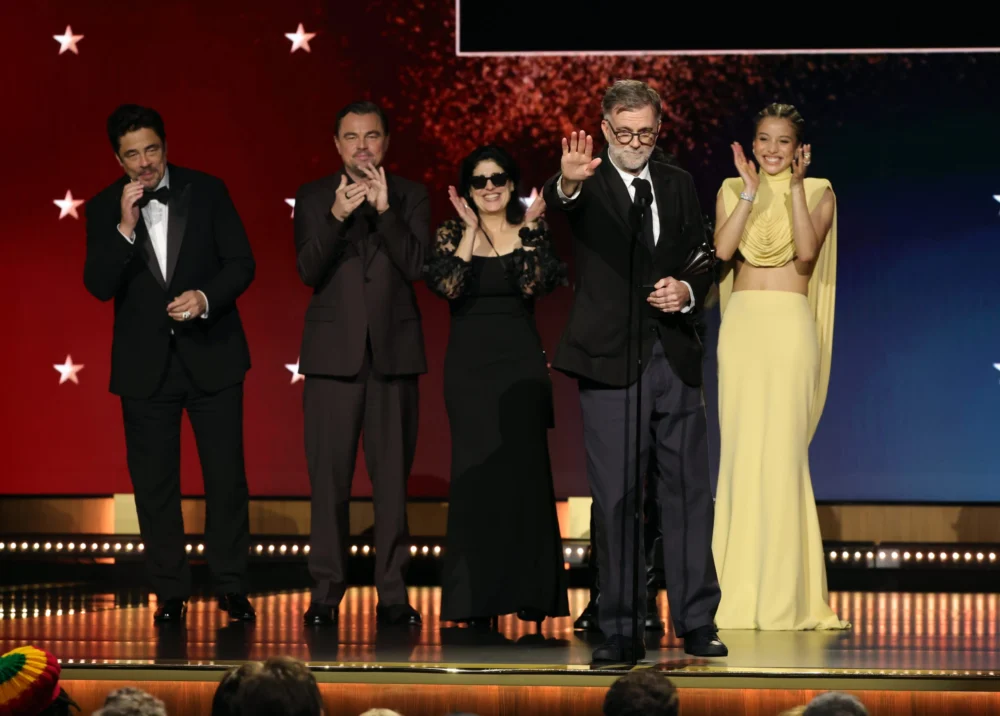
The glittering stage of the 31st Critics Choice Awards delivered more than just trophies; it provided a crucial, albeit complex, roadmap for the unfolding Oscar race. With the Golden Globes on the horizon and Academy Award nomination voting set to commence, this star-studded ceremony served as one of the final significant data points before ballots are cast, offering a tantalizing glimpse into both established favorites and surprising challengers.
Paul Thomas Anderson’s profound epic, “One Battle After Another,” emerged as the night’s undeniable juggernaut, sweeping Best Picture, Best Director for Anderson himself, and Best Adapted Screenplay. This commanding trifecta isn’t just a collection of accolades; it’s a powerful declaration to the industry: this is the film to beat. Historically, such a combination is often considered “Oscar catnip,” signaling a master filmmaker’s singular vision coupled with broad appeal that resonates across various Academy branches. In an era dominated by preferential ballot voting, where a film’s ability to survive multiple rounds of redistribution is paramount, “One Battle After Another” now stands as the formidable title most capable of enduring and ultimately conquering the race.
The Critics Choice Association, comprising over 600 film and television critics across the U.S. and Canada, represents a distinct voting body from the Academy of Motion Picture Arts and Sciences. This distinction forms the perennial asterisk attached to any CCA sweep: critics do not, in fact, vote for the Oscars. This fundamental rule has long been the North Star for awards prognosticators. Yet, when a film manages to captivate critics while simultaneously delivering the kind of meticulously crafted, craft-forward storytelling that profoundly appeals to Academy voters across diverse demographics, it becomes exceedingly difficult to dislodge from its frontrunner position. Expect “One Battle After Another” to harness this momentum, building significant traction as Oscar nominations draw near, particularly within the crafts categories. Its impact could also extend to acting contenders, with names like Chase Infiniti and Regina Hall potentially solidifying their positions in a fiercely competitive landscape.
A central question now looms over Anderson’s acclaimed work: Can “One Battle After Another” complete its expected trifecta of Picture, Director, and Screenplay without also securing wins in an acting or a major craft category on Oscar night? Historically, this path to Best Picture glory is remarkably rare. The annals of Oscar history reveal only a handful of films that have achieved Best Picture without at least one additional win in an acting or craft discipline, such as “The Greatest Show on Earth” (1952) and “Spotlight” (2015). Both were powerful, timely films that resonated deeply, yet their minimalist Oscar night tallies remain outliers. With Variety projecting “One Battle After Another” to achieve one of the highest nomination totals in Oscar history, a scenario where it converts so lightly on the grandest stage would feel counterintuitive for a film that currently reads as almost inevitable. A more plausible outcome might mirror Guillermo del Toro’s “The Shape of Water” (2017), which skillfully paired its Best Picture and Best Director wins with selective, yet impactful, below-the-line support in categories like Production Design and Original Score.
Despite the emphatic statement from “One Battle After Another,” the race is far from settled. Warner Bros. impressively led all studios overall, largely propelled by the electrifying “Sinners,” which tied for the most film wins with four. Ryan Coogler’s visionary original screenplay earned him a well-deserved trophy, while Miles Caton received Best Young Actor, and the film garnered accolades for Best Casting and Best Ensemble. Ludwig Göransson’s evocative score also claimed a prize. This comprehensive package of wins suggests something far more profound than mere passion; it hints at the emergence of a powerful, cross-industry coalition. If “Sinners” can successfully carry this potent momentum through the upcoming Golden Globes and translate it into robust support from key guilds such as the Screen Actors Guild (SAG), the Writers Guild of America (WGA), and other major industry bodies, it possesses the distinct potential to emerge as the season’s late-breaking, formidable spoiler.
Academy voters have repeatedly demonstrated a willingness to champion bold originality, particularly when it is meticulously paired with undeniable technical achievement. “Sinners” is increasingly embodying this coveted formula. Ryan Coogler, known for his ability to craft narratives that are both socially resonant and visually innovative, has clearly struck a chord. The win for Original Screenplay is particularly noteworthy and carries significant weight. This is a category where the Academy frequently diverges from the preferences of critics, often favoring richly dialogue-driven work and intricate character development over purely structural innovation or avant-garde concepts. Coogler’s triumph here indicates that “Sinners” has broken through in ways that could directly translate onto Oscar ballots, especially within the powerful writers’ branch, which consistently punches above its weight in influencing the Best Picture race. Their collective endorsement of Coogler’s script could be a pivotal factor in mobilizing broader support for the film across the Academy.


Getty Images for Critics Choice
Netflix’s ambitious gothic epic, “Frankenstein,” also made a significant impact, collecting four prizes. Among its wins, the most talked-about was Jacob Elordi’s surprising triumph for Best Supporting Actor for his haunting portrayal of the Creature in Guillermo del Toro’s latest masterpiece. Until this point, Elordi had only secured two relatively niche critics’ prizes from the New York Film Critics Online and the Oklahoma Film Critics Circle, positioning him largely as a fringe contender behind more established names like Benicio Del Toro, Sean Penn, Stellan Skarsgård, and Paul Mescal. His Critics Choice win immediately triggered two pressing questions within the awards circuit: Did Elordi just unequivocally solidify a coveted Oscar nomination slot, or did we witness a Critics Choice iteration of the infamous “Aaron Taylor-Johnson effect”? This phenomenon refers to Taylor-Johnson’s unexpected Golden Globe win for “Nocturnal Animals” which, despite its prestige, ultimately failed to translate into an Oscar nomination, leaving prognosticators scratching their heads.
However, a crucial distinction provides Jacob Elordi with a far more favorable outlook. “Frankenstein” is significantly more embedded in the broader Best Picture conversation than “Nocturnal Animals” ever was, giving Elordi’s performance a stronger narrative tailwind. More compellingly, a powerful historical precedent stands in his favor: no Critics Choice winner for Best Supporting Actor has ever gone on to miss an Oscar nomination. This statistic alone provides a formidable shield against the “Aaron Taylor-Johnson effect.” On this basis, Elordi now appears safely in the Oscar lineup, at least pending the forthcoming SAG nominations next week, which will offer further clarity. Whether he can convert this nomination into a serious win threat remains a separate, more complex discussion—one that will hinge on his ability to maintain momentum and garner additional recognition at the Golden Globes and BAFTA Awards. Should that happen, the entire supporting actor race will undoubtedly recalibrate with lightning speed, turning a dark horse into a formidable challenger.
The acting races elsewhere continue to demonstrate a compelling fluidity, promising an exciting and unpredictable lead-up to the nominations. Jessie Buckley’s poignant win for portraying Agnes Shakespeare in Chloé Zhao’s deeply felt grief-soaked drama, “Hamnet,” resonated deeply with voters and audiences alike. Her emotionally charged acceptance speech was undoubtedly one of the night’s most memorable moments, offering Academy members a clear, focused, and profoundly moving way to reward a film that, despite its critical acclaim, may ultimately come up short in the fiercely competitive Best Picture category. Given that Buckley’s was the sole win for “Hamnet,” her performance stands out as the film’s undeniable emotional core. Her two closest competitors, Renate Reinsve and Rose Byrne, now face the challenging task of playing significant catch-up in the coming weeks if they hope to overtake Buckley’s newly established frontrunner status.
In the Best Actor category, Timothée Chalamet’s charismatic win for “Marty Supreme” further strengthens his already formidable frontrunner status heading into the Golden Globes. The Globes’ genre-friendly voting body could very well amplify his lead, solidifying his position as the one to beat. However, as is often the case in Oscar prognostication, it is never quite that simple. At 30 years old, Chalamet would become only the second-youngest Best Actor winner in Oscar history, and he is now the youngest ever to win the Critics Choice Award in this category. The Academy, known for its sometimes-conservative tendencies, has a track record of making deserving actors wait for their ultimate prize; one needs only recall Leonardo DiCaprio’s protracted journey, waiting until the age of 41 before finally being awarded for his arduous performance in “The Revenant” (2015). This particular race has been tightly contested all season, with Chalamet frequently trading critics’ wins with Michael B. Jordan for “Sinners,” while the consistently excellent Ethan Hawke remains a serious factor for “Blue Moon,” and the perennial favorite Leonardo DiCaprio anchors the Best Picture frontrunner. Critics Choice history also offers several cautionary tales: past winners like Chadwick Boseman (“Ma Rainey’s Black Bottom”), Christian Bale (“Vice”), and Michael Keaton (“Birdman”) all entered Oscar night as perceived “no-brainers” only to ultimately lose their respective categories, serving as stark reminders that critic awards do not always directly translate into Academy gold.
Amy Madigan’s supporting actress win for “Weapons” was widely anticipated by many pundits, cementing her strong position. Yet, questions persist regarding the Academy’s willingness to reward a genre performance—especially one as undeniably “cool” and subversive as Madigan’s—and particularly if she emerges as the film’s sole Oscar nominee. If “Weapons” fails to land any additional nominations in key categories such as Best Casting or Original Screenplay, history can be unforgiving to lone performers, making a win incredibly challenging. Penélope Cruz’s victory for “Vicky Cristina Barcelona” (2008) stands as the most recent example of a sole nominee winning in the supporting actress category, but even that required a rare category switcheroo by Kate Winslet, who moved from supporting to lead for “The Reader” after sweeping all the precursors. Before that, one must look all the way back to Marisa Tomei in “My Cousin Vinny” (1992), who was a genuine surprise nominee on the day and an even more shocking winner on Oscar night. These instances are unequivocally the exceptions, not the norms, highlighting the uphill battle Madigan might face without broader film recognition.
By all these nuanced measurements, there remains ample room for another contender, or perhaps even two, to emerge and significantly disrupt the current awards landscape. With Oscar nomination voting opening its digital doors on Monday morning, the next week may prove to be more critically important than any ceremony that has come before, as narratives solidify, momentum shifts, and the true shape of the Academy Awards race begins to crystallize.