

In the pulsing, unforgiving labyrinth of New York City, Clay, the central figure in Andre Gaines’ ambitious adaptation, The Dutchman, finds himself ensnared in a nightmarish odyssey. It is a journey fraught with peril, a psychological crucible that threatens to irrevocate his life or reshape it in profoundly material ways. Early in this harrowing narrative, an enigmatic figure offers a prescient piece of counsel: "heed the warnings of those before you, so your fate can be different." This admonition serves as the film’s clarion call, signaling its intent to offer a refreshed, contemporary interpretation of Amiri Baraka’s incendiary 1964 play, Dutchman. A seminal work that ripped open the raw wounds of race and Black identity in America, Baraka’s original text dared to confront uncomfortable truths. Gaines’ film, by adding modern allusions and situating the drama in the present day, endeavors to bridge the gap between that historic moment and our current societal landscape. Yet, its engagement with the play’s profound themes often feels murky, a narrative tethered by a reverence that prevents it from fully embracing its own innovative spirit.
Amiri Baraka’s Dutchman burst onto the American theatrical scene at the height of the Civil Rights movement, a provocative and audacious work that challenged audiences to confront the insidious nature of racial prejudice and the psychological toll of assimilation. Set entirely within the claustrophobic confines of a subway car, the play stripped bare the dynamics between a seemingly assimilated Black man, Clay, and a seductive, dangerous white woman, Lula. Their encounter rapidly escalates from flirtation to a brutal, symbolic battleground, culminating in a shocking act of violence. Baraka’s genius lay in his allegorical framework, where Clay represented the intellectual, middle-class Black man attempting to navigate and appease a white-dominated society, and Lula embodied the destructive, manipulative force of white supremacy, capable of both enticement and annihilation. The play was a visceral scream, a warning about the fragility of Black life and identity in a racially charged America, and its impact was immediate and profound, solidifying Baraka’s place as a radical voice in American literature and theatre.
Gaines and co-writer Qasim Basir embark on their adaptation by immediately diverging from Baraka’s tightly wound original. The film opens not on a subway, but in the intimate, often uncomfortable setting of a marriage therapy session. Here, we meet Clay (portrayed with compelling depth by André Holland), a successful Black businessman, grappling with the aftermath of his wife Kaya’s (Zazie Beetz) infidelity. The scene pulsates with palpable tension, yet beneath the surface, a commitment and love between the spouses are evident. Clay struggles to articulate his pain, appearing defensive and emotionally guarded, while the therapist (the versatile Stephen McKinley Henderson) gently urges him to truly listen to Kaya. This opening not only grounds Clay in a relatable, contemporary domestic reality but also immediately complicates his character, moving him beyond a mere allegorical figure. By introducing Kaya and their marital struggles, the film posits a modern Black man whose identity is not solely defined by external racial pressures but also by the intricate dynamics of partnership, trust, and emotional vulnerability. For a women-focused audience, this addition offers a crucial lens, exploring how societal pressures and personal struggles intersect within the fabric of intimate relationships, and how men, too, navigate emotional landscapes often obscured by traditional expectations of masculinity. It hints at a deeper exploration of how Black men, even those who achieve professional success, contend with their internal worlds and the complexities of human connection.
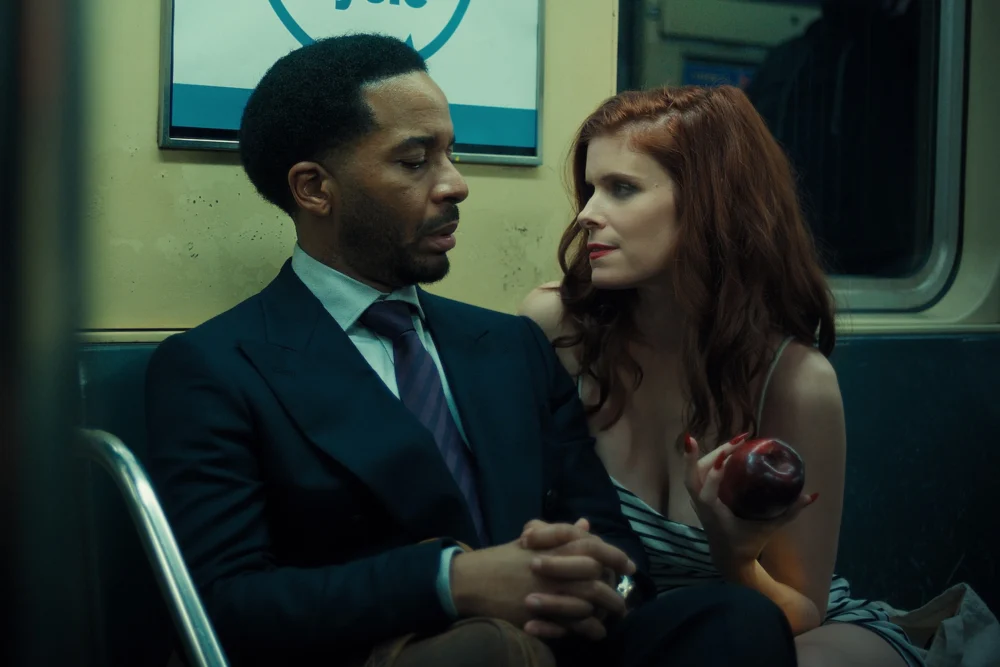
The narrative then propels Clay into the fateful encounter that defines Dutchman. En route to a Harlem fundraiser for a friend running for office (Aldis Hodge), Clay’s path intersects with Lula (Kate Mara) on the subway. From the moment her eyes fixate on him, Lula’s intentions are clear, if unsettlingly mercurial. She becomes an embodiment of chaotic energy, determined to provoke, seduce, taunt, and repel Clay in rapid succession. One moment, her invitation to her bed is laced with raw, dangerous allure; the next, she threatens to accuse him of "rape," weaponizing the very power dynamics she seemingly seeks to dismantle. Her insistence on accompanying him to the fundraiser, where she appears intent on sowing discord and disrupting his relationships with his wife, friends, and community, further underscores her disruptive influence. What truly drives Lula’s obsessive fixation on Clay remains an enigma, a deliberate narrative choice that, while perhaps mirroring the allegorical ambiguity of the original play, ultimately hinders the film’s ability to fully flesh out its contemporary themes.
In Baraka’s original work, the allegorical weight carried by Clay and Lula was a cornerstone of its power. Clay, the assimilated Black intellectual, and Lula, the personification of white predatory power, functioned as stark symbols. The play’s audacity lay in its refusal to offer easy answers, instead forcing audiences to confront the raw, uncomfortable truths about racial violence, both physical and psychological. Gaines and Basir’s adaptation attempts to open up this allegorical framework for a 2026 audience, and in doing so, they succeed in adding layers of dimension to Clay. Holland’s portrayal imbues Clay with a rich interiority, making him a flesh-and-blood character wrestling with complex emotions and societal expectations. However, Lula, in this modern retelling, remains largely static. She functions primarily as a mechanism for confrontation, a catalyst for Clay’s internal and external conflicts, rather than a fully realized individual. This imbalance—one central character rendered with intricate detail while the other never quite transcends her symbolic function—creates a narrative friction that detracts from the film’s central thrust. While the original play could sustain Lula’s enigmatic nature due to its heightened, allegorical style, a film aiming for contemporary relevance and emotional depth might have benefited from exploring the roots of her destructive behavior, even if only to reveal the deeper societal sickness she represents. Her lack of explained motivation, while perhaps intended to maintain her allegorical force, leaves a void that impacts the audience’s ability to engage with the film’s broader commentary on systemic issues.
Gaines’ adaptation also expands the physical confines of the drama. While the subway train remains a pivotal setting, serving as a powerful visual link to the original play’s iconic imagery, Gaines strategically moves Clay and Lula through a broader social landscape. Their encounters are not confined to a single, claustrophobic space but unfold across various New York City locales: the intimacy of Lula’s apartment, the bustling energy of a large party, and the anonymous streets of the city. This expansion reinforces the notion that their encounter is not an isolated incident but rather a microcosm of the pervasive racial tensions and systemic violence embedded within the very fabric of urban life. This shift allows for a more dynamic visual narrative, enabling Holland and Mara to play off each other in varied environments, potentially amplifying the tension and psychological stakes. For the audience, this broader canvas visually underscores the film’s argument that the struggle for Black identity is not confined to specific moments or places but is a continuous negotiation within a larger, often hostile, societal environment.
Perhaps one of the most intriguing, and at times perplexing, choices made by Gaines and Basir is the film’s overt meta-narrative. Dutchman is referenced multiple times within the script itself, blurring the lines between the story being told and the story that inspired it. Clay is literally handed a printed version of Baraka’s play by his therapist early on, an almost didactic inclusion that immediately signals the film’s self-awareness. Later, he observes a miniature theater where his "character" appears as a small, manipulable toy, a chilling visual metaphor for the predetermined nature of his journey. He even catches a glimpse of a TV production of the play flickering on a display window as he walks through the city with Lula. Further cementing this meta-commentary is the recurring presence of Stephen McKinley Henderson’s character, who assumes various roles throughout the film. Often appearing as a spectral figure, he comments directly on the proceedings, frequently quoting Baraka’s play and other seminal texts on American Black identity. His character is even referred to as "Amiri," an unmistakable nod to the playwright himself. This deliberate incorporation of the source material creates a profound sense of déjà vu, suggesting that Clay’s hellish night is not merely a singular event but a cyclical "rite of passage" that every Black man in America must, in some form, confront. It’s a bold artistic choice that positions the film less as a direct adaptation and more as a meditation on the enduring relevance of Baraka’s work, questioning whether true escape from these historical patterns is ever possible.
Gaines and Basir’s adaptation adheres faithfully to the intellectual origins of Baraka’s play, meticulously preserving its thematic core. The film deftly navigates the complex interplay of assimilation, rage, and the psychological burden of racial identity. However, despite its intellectual rigor, the adaptation struggles to translate these weighty themes into a deeply emotional experience. The narrative maintains its philosophical underpinnings without fully modernizing the emotional resonance that might allow a contemporary audience to connect on a visceral level. Perhaps this is, in itself, the film’s subtle point: the struggles faced by African American men concerning their identities and the pervasive gaze of white society remain agonizingly constant, requiring a continuous conversation across generations. If the film’s primary objective is to reignite and sustain this vital dialogue for a new era, then it undeniably succeeds in its intellectual ambition.
The undeniable anchor of The Dutchman is André Holland’s commanding performance as Clay. He injects vivid shading into a role that, in its original form, served as a potent symbol of race and nationality. Holland’s Clay is immediately believable as a man deeply in love yet simultaneously wounded by betrayal. He portrays a man grappling with desires he may prefer to suppress, an ambitious individual who rightfully believes he has earned his success. These are all nuances hinted at in Baraka’s text, but Holland brings them to vibrant, agonizing life, matching intense vulnerability with simmering intensity. In his climactic monologue, Holland masterfully layers notes of sarcasm over the righteous anger his character feels, delivering an explosive finale that the film has painstakingly built towards, even if the preceding emotional journey sometimes feels less than fully earned. His performance alone is a compelling reason to engage with this adaptation, offering a nuanced portrait of modern Black masculinity under du siege.
Ultimately, The Dutchman exists in a tense, often precarious, space between profound reverence and daring reinvention. It is an adaptation so acutely aware of the formidable power and enduring legacy of Baraka’s text that it never quite trusts its own instincts for departure. The result is a film that, while undeniably thought-provoking, often falls short of eliciting the deep emotional response that might have fully driven home its contemporary relevance. It invites rigorous discussion and intellectual engagement but sometimes denies audiences the raw, visceral connection that transforms a powerful message into an unforgettable experience. In its attempt to honor a sacred text, The Dutchman illuminates the challenges of updating a classic for a new generation, leaving us to ponder whether some warnings, regardless of how often they are heeded, are destined to be replayed.