The pop music landscape is currently experiencing a fascinating shift, a moment when the industry’s reigning male superstars are making their presence felt with undeniable force. It appears the boys are back in town, and in a striking display of synchronicity, two of the genre’s most prominent figures, Bruno Mars and Harry Styles, are releasing their highly anticipated albums on consecutive weekends. This back-to-back rollout feels less like a coincidence and more like a deliberate, perhaps even collaborative, effort to reassert male dominance, or at least parity, in a pop arena that has, for several years, been vibrantly commanded by its "girl bosses." As these two alpha artists step into the spotlight, the intrigue lies in the stylistic arsenals they’ve chosen to deploy in their quest to redefine their influence. While Styles’ intriguingly titled "Kiss All the Time. Disco, Occasionally," is set to drop next week, leaving fans to ponder the literal or figurative interpretation of its "D-word," Mars has already unveiled his latest offering, providing a rich tapestry for immediate exploration.
Mars’ new album, "The Romantic," marks a significant milestone, being his first solo endeavor in a full decade. The title itself, "The Romantic," immediately sets a tone, promising an intimate journey into matters of the heart. However, the musical execution of this promise takes an unexpected, yet deeply deliberate, turn. It’s as if the very concept of disco never entered Mars’ sonic universe; instead, he has meticulously engineered a time machine, transporting listeners directly back to the mid-1970s, precisely the era just before the pervasive rhythms of dance music seized control. The album, therefore, is an immersive masterclass in retro-soul balladry, heavy on emotion and drenched in a sound that feels both familiar and exquisitely crafted.
From the very first notes, "The Romantic" establishes its leisurely, deliberate pace. The album opens with a track that surprisingly slow-simmers, setting the stage for an experience dedicated not to frenetic movement, but to profound connection. Even the album’s closing track, "Dance With Me," is not an invitation to an energetic club beat, but rather a tender plea for a slow dance, underscoring the consistent thematic and sonic thread throughout the nine-song collection. When the tempo does occasionally quicken, it never veers into contemporary pop or hip-hop territory, instead elevating to the smooth, sophisticated groove reminiscent of The O’Jays, a far cry from the modern pulse of artists like J. Cole. There isn’t a single moment on "The Romantic" that sounds as though it was minted any more recently than 1976. This commitment to an unwavering aesthetic is further cemented by the album’s first single, "I Just Might," a bona fide banger that instantly evokes comparisons to Leo Sayer’s 1976 hit, "You Make Me Feel Like Dancing." In essence, with "The Romantic," Bruno Mars fully embraces the moniker of the "Bicentennial Man," meticulously embodying an era half a century past.
For many listeners navigating the complexities and anxieties of 2026, a meticulously crafted journey back 50 years into the past might be precisely the welcome escape they crave. This retro immersion offers a comforting balm, a sonic sanctuary from the relentless pace of modern life. Yet, as compelling as this nostalgic ride might be, it raises a crucial question: will "The Romantic" resonate as anything more than a beautifully rendered "mood piece," akin to a sonic mood ring? The most accurate predictor for a listener’s engagement with this album will likely be their affinity for "An Evening With Silk Sonic," the similarly throwback album Mars co-created with Anderson .Paak four and a half years prior. That project, a loving homage to 70s soul, proved incredibly successful, demonstrating Mars’ deep understanding and reverence for the era.
Anderson .Paak may have moved on to other ventures, but Mars, it appears, remains thoroughly, almost religiously, committed to this particular artistic "bit." This dedication requires a certain audacity, especially considering "The Romantic" is his first solo offering after a decade-long hiatus, following his Grammy-winning Album of the Year, "24k Magic." To return with a body of work so entirely beholden to styles that predated his birth could be seen as a bold risk. However, it’s also a less nervy proposition when viewed as a strategic adherence to a formula that previously delivered an album-sized smash. In many respects, "The Romantic" functions as "Silk Sonic II," a continuation of a highly successful artistic venture, albeit now solely under Mars’ direction.
As an admitted nostalgist who often considers the 1970s a golden era for nearly everything (save for gas lines), I find myself squarely within the target demographic for "The Romantic." Yet, paradoxically, I also fall outside it. While I appreciate homages to past eras, my preference leans towards those that aren’t entirely "hermetically sealed," those that offer subtle nods to subsequent musical evolutions, or even attempt to nudge the vintage sound slightly into the future. Despite this, I believe "The Romantic" actually surpasses "An Evening With Silk Sonic" in several quantifiable ways. Its bold emphasis on ballads, for instance, provides a magnificent canvas for Mars to truly test the formidable range and expressiveness of his vocals, a challenge he meets with impressive skill. The album also showcases an even craftier execution in how Mars, his immensely talented co-producer D-Mile, and his band, The Hooligans, have meticulously replicated the exact feel of a truly great era in record-making. However, the album faces the inherent disadvantage of being the second iteration of this particular stylistic approach. While "The Romantic" is undeniably excellent as a stunt, even if subtly refined, it remains the second time the same stunt has been performed. One can admire the unparalleled ability to reverse-engineer the cool sounds of his forefathers, but admiration for technical prowess doesn’t always translate into genuine emotional resonance.
This sentiment becomes particularly pronounced once the initial awe for the encyclopedic knowledge of ’70s musical flourishes subsides. What becomes apparent is a relative scarcity of truly standout songs. While nearly every track could be a viable candidate for a follow-up single to "I Just Might," nothing unequivocally jumps out as the definitive pick. The album does offer a decent amount of sub-genre variation from song to song, exploring different facets of retro-soul. Yet, emotionally, the collection largely maintains a flat-line trajectory, often accompanied by some of the most perfunctory lyrics one might encounter this year. There’s a persistent absence of any remote possibility that Mars is sharing insights into his personal life; instead, the listener is presented with a string of fill-in-the-blank clichés: "The fire don’t burn like it used to, girl"; "Let’s go to the moon a little later / Hope your wings get to fly"; "Turns out you don’t need a rocket ship, no / To find your own shooting star." In an age of hyper-autobiographical pop, where artists bare their souls, "The Romantic" feels strangely and entirely impersonal. Unless, of course, one considers extreme pastiche a personality in itself. It’s akin to attending a fun, elaborate costume party where you never quite discover the true identities of those behind the masks – though, to be fair, a Curtis Mayfield mask is a rather spectacular disguise to wear.
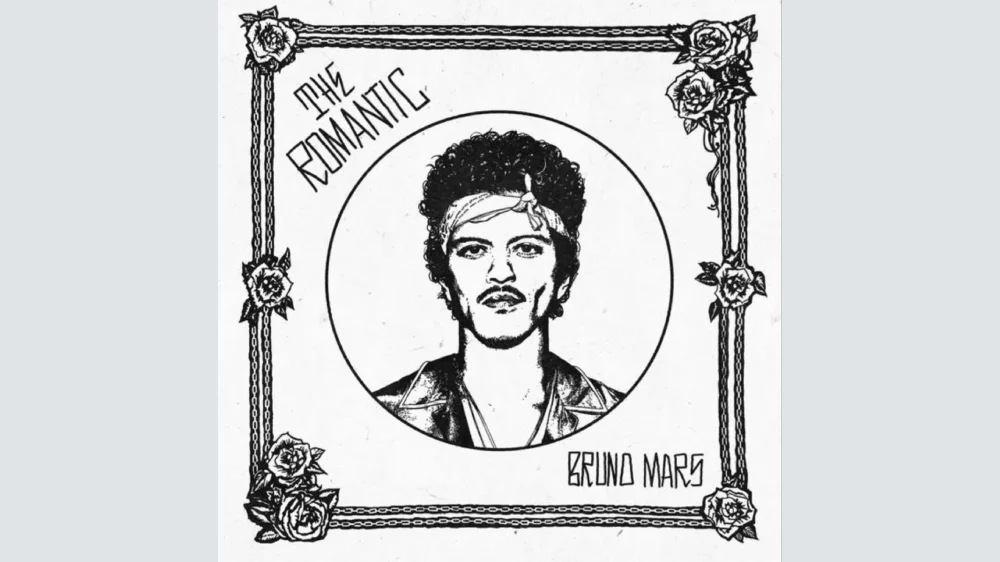
One intriguing element that adds a layer of unexpected depth to "The Romantic" is a subtle Latin current that ebbs and flows through several pieces of the record. This influence is subtly hinted at from the very outset, with the album cover itself featuring hand-written lettering designed to evoke a golden age of Chicano rock for those familiar with the aesthetic. The album’s initial tracks even seem to suggest a potential conceptual arc in this direction. "Risk It All," the album’s aforementioned kick-off, feels like a genuine risk not just for its slow, pleading acoustic guitar plucking and some of Mars’ most supple vocals, but also for its distinctive instrumentation. While horns are prevalent throughout the record, in this particular number, they are played as distinct mariachi horns, lending a unique cultural flavor. (It’s worth noting, however, that even here, the lyrics are arguably some of the album’s most vapid – "I would swim across the sea just to show you / Sacrifice my life just to hold you," and so forth – but their simplicity doesn’t detract from the musical texture.) Mars further elevates the Latin quotient with the tenser rhythms, intricate strings, and congas of the second track, "Cha Cha Cha," its title a clear giveaway to its stylistic leanings. (On a non-Latin, yet equally interesting note, this track also cleverly interpolates Juvenile’s 2004 hit "Slow Motion," creating a surprisingly effective combination.) However, these vibrant Latin flavors turn out not to be a consistent presence throughout the remainder of the album. They do make a welcome return in one of the most up-tempo tracks, "Something Serious," a fairly direct homage to Santana’s iconic "Oye Como Va." While undeniably fun, the track eventually leads one to ponder how its chorus, while enjoyable, isn’t particularly special, inevitably prompting the desire to simply listen to the original "Oye Como Va."
Following the Latin-infused opening, the album shifts gears. After the third number, "I Just Might," snaps listeners to attention with its undeniable "booty-shake-or-go-home" machismo, the fourth track, "God Was Showing Off," marks the point where "The Romantic" truly settles into the groove where Mars appears most comfortable these days: a sophisticated blend bridging the gap between classic Motown and the lush, orchestral sounds of Philly soul. Tracks like "Why You Wanna Fight?" even venture into what almost sounds like a playful parody of these genres, featuring a backing chorus that repeatedly and dramatically coos "why-you-wanna-fight" as a single, elongated word, artfully interspersed between the singer’s more drawn-out phrases. Later, "On My Soul" and "Nothing Left" introduce some welcome electric guitar licks, adding another layer to the album’s meticulously crafted sound. For the most part, the subsequent tracks will transport listeners to a sonic landscape reminiscent of vintage Top 40 and Adult Contemporary (AC) soul – the kind of music that evokes images of summer, sunshine, and effortlessly "EZ listening."
Overall, "The Romantic" emerges as an album seemingly designed to function as exquisite background music. This is by no means an insult; there is a profound art to creating music that can be seamlessly integrated into virtually any social gathering, appealing to the refined tastes of grandmothers as readily as it captivates younger audiences, and serving that function reliably for years. However, if one approaches "The Romantic" with the intention of foregrounding it, of giving it one’s undivided attention, its shelf life may prove more limited. As a meticulously tailored leisure suit of a record, it doesn’t quite possess the gravitas or innovative thrust to be considered album-of-the-year material, unlike his previous "24K Magic." To be fair, "The Romantic" isn’t explicitly aiming to be that kind of tour de force. Yet, one might argue it also wasn’t intended to be quite this in-one-ear-and-out-the-other. The paradox lies in the sheer impressiveness and bountiful quality of Mars’ vocals throughout the album, which nonetheless leave the listener with a curious impression that the songs themselves lack any tangible sense of lived experience.
This truly is a "romantic" album in its aesthetic and thematic aspirations, yet what feels conspicuously absent is the genuine sensation that the material holds any tangible connection to actual, messy, heartfelt love. Unless, of course, a deep and abiding love for the timeless grooves of Kool & the Gang, The O’Jays, and the entire pantheon of 70s soul legends is precisely the kind of romance Mars intends to celebrate. His commitment to this era is unwavering, creating a meticulously detailed sonic world.
As Mars immerses himself in the pre-disco era, next week will see Harry Styles offer a contrasting, yet equally retro-leaning, perspective with his "Kiss All the Time. Disco, Occasionally." The impending release of Styles’ album, with its explicit mention of "Disco," creates an intriguing counterpoint to Mars’ deliberate avoidance of the genre. It leaves listeners eager to discover whether Styles will engage with the "D-word" literally, embracing the shimmering, upbeat sounds of the late 70s and early 80s, or if his reference will be a more figurative, nuanced exploration. This dual release highlights the diverse ways male pop powerhouses are choosing to interpret and reintroduce vintage sounds, shaping the contemporary pop narrative with their unique, yet equally compelling, artistic visions.