


TV Station Group Consolidation Leaves Markets With Less Local News, According to New Study That DirecTV Has Filed With the FCC
As the Federal Communications Commission (FCC) deliberates on potentially loosening longstanding restrictions on media ownership, a new, critical report commissioned by DirecTV has cast a stark light on the profound dangers of unchecked broadcast consolidation. The findings reveal a disturbing trend: in markets where major broadcasters operate multiple “Big Four” network affiliates under a single management umbrella, local newsrooms are being systematically dismantled, leading to a precipitous decline in journalistic output, quality, and the diversity of voices available to communities. This revelation emerges at a pivotal moment, with industry giants like Nexstar actively pursuing mega-mergers, most notably its proposed acquisition of Tegna, that could further exacerbate this troubling landscape.
The implications of the DirecTV study are far-reaching, directly challenging the arguments put forth by broadcast groups who contend that consolidation fosters efficiency and strengthens local news operations. Instead, the report unequivocally demonstrates that the opposite is true. According to DirecTV attorneys Michael Nilsson and Annick M. Banoun, whose findings were submitted to the FCC today, “Recent history shows that when broadcasters acquire a second, third, or fourth station in a local market, they consolidate news operations, leaving one newsroom where there had been two, three, or four, thus decreasing the quality of local news.” This isn’t merely theoretical; the attorneys emphasize that this consolidation is a documented pattern, citing Nexstar’s own operational history with its existing multi-station holdings as concrete evidence of this trend. “This is not a speculative claim,” they assert. “In fact, in the context of the proposed Nexstar-Tegna transaction, we’ve filed evidence demonstrating that Nexstar, for example, has done this with every duopoly or triopoly it possesses.”
The DirecTV analysis meticulously mapped every Nielsen Designated Market Area (DMA) where affiliates of the “Big Four” networks (ABC, CBS, NBC, and Fox) are managed by the same corporate entity. Crucially, this study excluded stations directly owned and operated by the networks themselves (O&Os), focusing solely on the broader landscape of independent station groups. The results painted a concerning picture of market concentration: 98 markets exhibited a duopoly (two Big Four affiliates under one management), 15 markets featured a triopoly (three affiliates), and three markets were found to have a quadropoly (four affiliates).
What makes these numbers particularly alarming is that DirecTV’s methodology was notably conservative. The report deliberately omitted combinations involving non-Big Four affiliates, such as The CW or My Network TV – despite a significant number of Nexstar stations being affiliated with The CW, a network the company itself owns. Furthermore, the study did not account for “sidecar operations,” where major broadcasters like Nexstar exert operational control over stations legally owned by other, often smaller, entities through shared services agreements or local marketing agreements. Had these additional forms of control been factored in, the true extent of newsroom consolidation and the resulting decrease in local news diversity would likely be even more pronounced and alarming, painting an even grimmer picture for independent journalism.
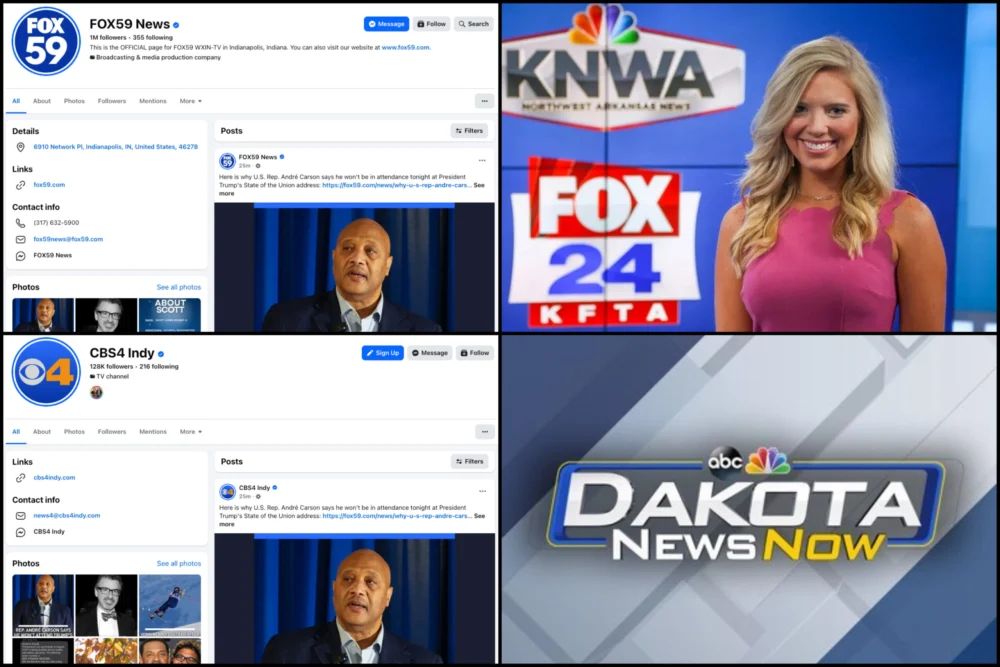
The operational realities of these co-managed stations, as detailed by the DirecTV report, vividly illustrate the mechanism of consolidation. Far from fostering distinct, competitive news operations, these arrangements invariably lead to shared resources and homogenized content. Stations under the same management typically consolidate their online news presence into a single website, funneling all digital traffic and editorial control through one portal. A single news director is often tasked with overseeing the newsgathering efforts for all co-owned stations, effectively eliminating distinct editorial leadership. Moreover, journalists and anchors are frequently shared across these stations, meaning the same faces and voices deliver what is presented as “local news” across multiple channels, often with identical scripts and reporting.
“By our calculations, in the vast majority of markets in which any broadcaster holds a duopoly, triopoly, or quadropoly today, they have consolidated news operations,” the DirecTV filing stated emphatically. “In the majority of duopolies, triopolies, and quadropolies, the co-owned stations offered essentially the same local news.” This finding underscores a critical concern: when multiple broadcast licenses are held by a single entity, the public is often left with the illusion of choice, while in reality, they are consuming a singular news product, stripped of diverse perspectives and independent editorial lines that would naturally arise from genuine competition.
To quantify this widespread consolidation, DirecTV embarked on a comprehensive analysis. After identifying Big Four affiliate duopolies, triopolies, and quadropolies across numerous station groups – including industry behemoths like Nexstar, Sinclair, Scripps, Hearst, Lilly, Gray, and Tegna – researchers meticulously examined station websites. The criteria for assessing consolidation included checking whether more than one station was referenced on a single news site, identifying instances of shared news directors, and verifying the presence of shared news talent. The results were stark: among all broadcast duopolies and more extensive combinations, a staggering 90.5% of news sites were found to be shared. The consolidation of leadership was even more pronounced, with 98.2% of news directors being shared across co-owned stations. Similarly, the talent pool was heavily integrated, as 97.3% of news talent was shared, often appearing on multiple channels under the same corporate umbrella.
These statistics paint a clear picture of an industry moving towards a model where efficiency is prioritized over diversity and depth in local reporting. The historical rationale behind strict media ownership rules, particularly at the local level, has always been to ensure a marketplace of ideas, foster competition, and prevent a single entity from dominating the flow of information vital to an informed citizenry. When fewer distinct newsrooms exist, the range of stories covered narrows, investigative journalism often suffers due to stretched resources, and the unique perspectives of different communities within a market may be overlooked or homogenized. This consolidation can lead to a “one-size-fits-all” approach to local news, where critical local issues might be ignored in favor of more broadly appealing, less resource-intensive content.
The ramifications extend beyond mere news content. A robust, independent local press is a cornerstone of democratic society, holding local officials accountable, informing public discourse, and providing essential information that directly impacts citizens’ daily lives, from school board meetings to public safety alerts. When news operations are consolidated, the depth of scrutiny applied to local governance and community issues inevitably diminishes. This erosion of local journalistic capacity can leave communities less informed, less engaged, and more vulnerable to misinformation or unchallenged narratives. For women, in particular, who often lead community initiatives and rely on local news for information impacting their families and neighborhoods, the loss of diverse and in-depth reporting can mean vital stories go untold or are presented through a narrow lens.
The DirecTV report serves as a potent counter-argument to the broadcast industry’s lobbying efforts for deregulation. Broadcasters often argue that lifting ownership caps is necessary to compete in a fragmented digital media landscape, where audiences have endless choices online. They contend that scale allows for greater investment in news. However, DirecTV’s evidence suggests that, in practice, increased scale has led not to enhanced investment in diverse local news products, but rather to cost-cutting through consolidation, often at the expense of journalistic integrity and community service.
The Nexstar-Tegna transaction, a significant proposed merger that would create an even larger broadcast entity, epitomizes the very trend DirecTV’s report warns against. If approved, it could further accelerate the pattern of newsroom consolidation across an expanded geographic footprint, impacting countless more communities. Nexstar, already the largest owner of local television stations in the U.S., has a documented history, as highlighted by DirecTV, of integrating news operations when it acquires multiple stations in a single market. Approving such a merger without robust safeguards, critics argue, would be an endorsement of a model that demonstrably undermines local journalism.
In light of these compelling findings, DirecTV’s attorneys Nilsson and Banoun issued a clear and urgent plea to the FCC. “The evidence conclusively demonstrates that broadcaster consolidation reduces competition, output, and quality in local news,” they wrote. “Accordingly, we urge the Commission to reject broadcasters’ proposals that would create more duopolies, triopolies, and quadropolies and decrease local news content.” The report is a powerful reminder that while the media landscape constantly evolves, the fundamental principles of diverse ownership and robust, independent local journalism remain paramount for an informed public and a healthy democracy. The FCC’s decision on ownership caps will not just shape the future of broadcasting; it will profoundly impact the quality of information available to millions of Americans, with lasting consequences for civic engagement and community well-being.