The Weight of the Spotlight: How a National Crisis Exposed Pima County’s Sheriff Chris Nanos
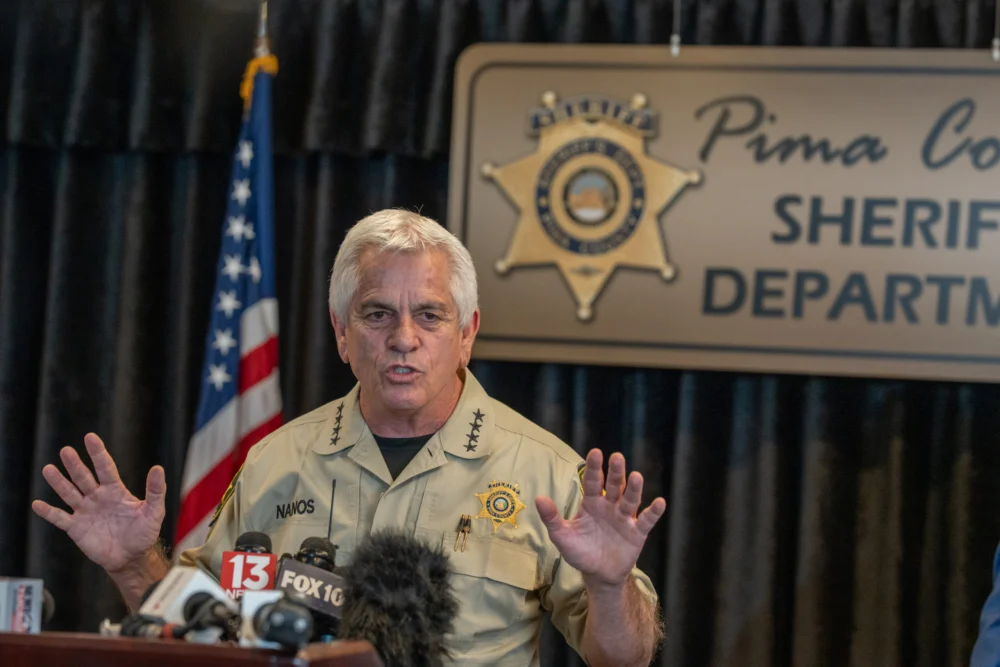
Savannah Guthrie’s Mom Is Still Missing — Why the Sheriff in the Case Has Become the Internet’s Punching Bag
National tragedies and high-profile criminal investigations possess a unique power to transform obscure local figures into subjects of intense public scrutiny. For some, this sudden glare proves to be their moment, an opportunity to demonstrate leadership, empathy, and competence. For others, however, the unforgiving spotlight reveals fundamental inadequacies, exposing a lack of preparedness for the immense pressure that accompanies a case of national significance. Such has been the challenging trajectory for Pima County Sheriff Chris Nanos, whose handling of the deeply unsettling Nancy Guthrie kidnapping case has cast a long shadow over his leadership and the broader law enforcement response.
The disappearance of Nancy Guthrie, mother to beloved NBC “Today” show anchor Savannah Guthrie, sent shockwaves across the nation, transforming a local crime into a story followed by millions. The sheer prominence of the Guthrie name amplified every detail, every development, and every public statement made by the authorities tasked with finding her. In this charged atmosphere, Sheriff Nanos, the lead figure overseeing the local law enforcement effort, has found himself consistently at odds with the demands of effective crisis communication, often employing words and a tone that have done little to reassure a anxious public or the grieving family.
From the outset, the situation was fraught. The apparent kidnapping of Nancy Guthrie presented an immediate and complex challenge, demanding not only meticulous investigative work but also a delicate balance of transparency, professionalism, and compassion in public discourse. Yet, as the weeks turned into months, Nanos’s public pronouncements have frequently veered into territory that has raised more questions than answers, suggesting an official struggling to navigate the complexities of a national media firestorm while simultaneously leading a challenging criminal probe.
One of the most notable instances of Nanos’s communication missteps came during a recent interview with The New York Times. Reflecting on the ongoing investigation—an investigation already marred by the brief, wrongful detention of an apparently unrelated delivery driver—Nanos described the process as “exhausting, these ups and downs.” While the personal toll on any investigator in a high-stakes case is undeniable, such an admission, particularly from the lead official, can be perceived as self-serving and detract from the perception of unwavering determination. More troubling, however, was his subsequent assertion that Nancy Guthrie would “inevitably be found,” but added a caveat that chilled many: “maybe it’s weeks or months or years from now” when that discovery would happen. For a family desperate for immediate answers and a public yearning for a swift resolution, such a statement, delivered by the head of the investigation, was less a reassurance and more a public acknowledgment of the profound uncertainty and lack of immediate progress. It conveyed a sense of resignation that undermined confidence in the investigative team’s capabilities.
The implications of such a candid, perhaps overly honest, assessment are significant. In high-profile missing person cases, law enforcement typically strives to project an image of relentless pursuit and a belief in imminent breakthroughs, even when facing formidable obstacles. Nanos’s remarks, however, inadvertently telegraphed the profound extent of the Pima County Sheriff’s Department’s bewilderment weeks into the case. A sheriff genuinely confident in a clear path forward would rarely offer such a broad, potentially disheartening timeline. This public admission of a protracted and uncertain future for the investigation left many wondering if the department was truly equipped to handle the unique demands of this baffling case.
Beyond the perceived lack of strategic communication, Nanos has also exhibited a tendency to personalize criticism and center his own feelings, rather than maintaining a focus on the victims and the investigation itself. While the emotional strain on public servants is real, the public expects its leaders to project strength and empathy for those most affected. In responding to legitimate concerns about the case’s progress, Nanos has often pivoted to defending himself. One can sympathize with the exhaustion of leading such an arduous search, but a more seasoned public servant might first acknowledge the immeasurable anguish of the Guthrie family, whose exhaustion surely dwarfs his own.
This “me-first” approach reached a peak in a bewildering outburst last week, when Nanos directly confronted his critics. In a moment captured by the Tucson Sentinel, he declared, “Now, you want to get picky that the sheriff speaks funny or talks off the cuff, or you can call him a buffoon or Barney Fife or whatever you want to call him. The haters are going to hate, but my local media, you included, know me. You know what I’m about, and you know I’ve always been a pretty much open book. You ask me a question, I’m going to answer it. That’s just the way it is.”
This extraordinary statement, delivered during a period of intense public anxiety over Nancy Guthrie’s fate, was met with widespread dismay. Public officials, especially those in law enforcement, are expected to maintain a professional demeanor, particularly when addressing matters of life and death. To dismiss critics as “haters” and to frame their concerns as mere “pickiness” about his communication style is a profound misjudgment. It suggests a leader more concerned with personal vindication than with the imperative of reassuring a worried community and demonstrating unwavering focus on the case. While Nanos may indeed be an “open book” to his local media, the national spotlight demands a more refined, circumspect approach, where personal feelings are secondary to the solemn duties of the office.
The inability of local law enforcement to make substantial headway in the Nancy Guthrie case has become increasingly apparent as the investigation has dragged on. Yet, the criticism directed at Sheriff Nanos is not merely about the lack of progress; it is fundamentally about his leadership and communication in a crisis. When Nanos hears legitimate inquiries about investigative strategies as accusations of being a “buffoon,” it reveals a defensive posture ill-suited for the transparency and accountability required of public office. This tendency to personalize criticism is not new for the Sheriff. Early in the investigation, he had already told reporters, “I’m not used to everyone hanging onto my every word and then holding me accountable for what I say.”
This statement, while perhaps an honest reflection of his prior experience in a less scrutinized role, underscores a critical failure to adapt. While it is fair to acknowledge that Nanos may never have anticipated being under such a powerful national microscope, a core responsibility of any public official is to understand and adapt to the expectations of their office, especially in moments of crisis. Among Nanos’s many duties is the vital task of preserving public trust—the trust that this grave crime is being investigated with the utmost competence, thoroughness, and sensitivity. Instead, his public appearances have often alternated between inadvertently revealing sensitive information and attempting to defensively clean up previous comments, frequently making the situation worse.
One such inadvertently revealing moment occurred when Nanos disclosed that Savannah Guthrie’s public plea for help in solving the case generated “4,500 more leads.” While this might seem like a positive indication of public engagement, in the context of a baffling investigation with no clear direction, such a massive influx of unverified information can signal a scattered and overwhelmed investigative team. It suggests an investigation struggling to sift through a deluge of data without a focused strategy, rather than a precision-guided operation. The question then becomes unavoidable: why is a sheriff grappling with a challenging, high-stakes case spending valuable time addressing “the haters” instead of directing all available resources and energy towards finding Nancy Guthrie?
The Nancy Guthrie case has been a painful media spectacle for numerous reasons, not least among them the unavoidable reality of Savannah Guthrie’s particular brand of celebrity. A figure whose public persona has long been defined by a sunny, amiable approach to morning conversation, coupled with a deep devoutness that often manifests as unwavering optimism, has been pushed to the absolute brink. To witness her, a familiar face of composure and cheer, reduced to pleading via Instagram video for her mother’s safe return, has been profoundly affecting for millions.
Savannah Guthrie’s videos, raw and agonizingly personal, are difficult to watch precisely because they show a figure known for her strength at the absolute end of her rope. Yet, even in her deepest anguish, Savannah has consistently decentered herself. Her pleas are not about her fame, her notoriety, or the years she has spent in the national spotlight. They are unequivocally about her mother—a testament to profound filial love and desperation. Her public comportment, marked by vulnerability and an unwavering focus on the victim, offers a poignant contrast to the “me-first” approach adopted by Sheriff Nanos. While it may not directly alter the course of the investigation, Savannah Guthrie’s demonstration of grace, empathy, and humility in the face of unimaginable suffering serves as a powerful reminder of the human cost of this crisis—a reminder that a similar approach from the sheriff overseeing the case would not only be a welcome change but a necessary one in an increasingly blunt and self-absorbed public sphere.