



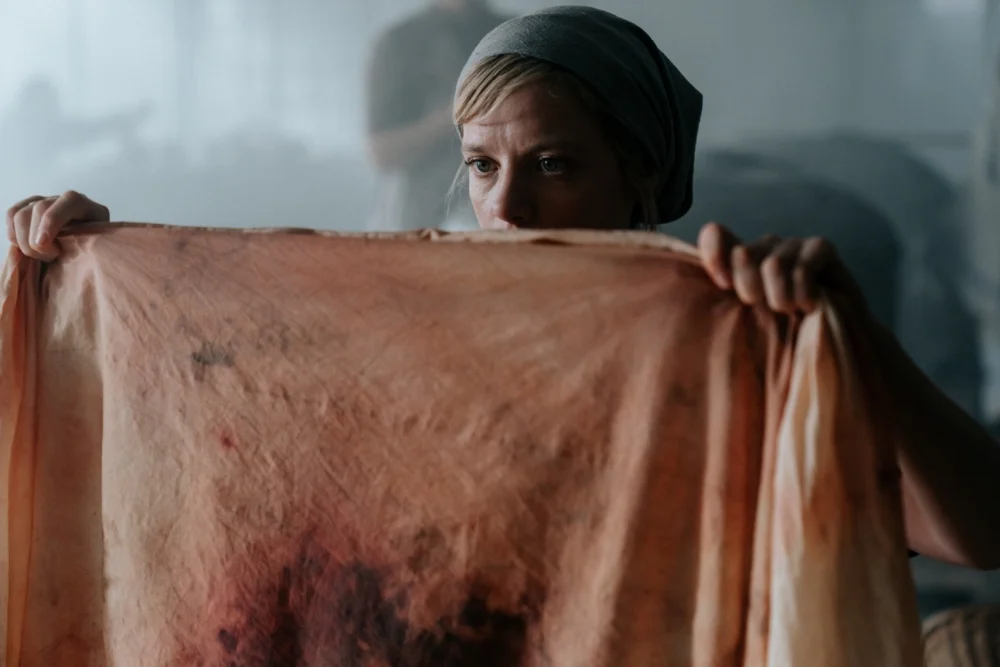
The Female Gaze on Wartime Despair: Ulrike Toni Vahl’s ‘Crux’ Dominates EFM with Harrowing WWII Narrative
The European Film Market (EFM) is abuzz with the intense anticipation surrounding “Crux,” a World War II drama that promises a stark, unflinching look at the human cost of conflict through a distinctly female lens. Spearheaded by acclaimed short filmmaker Ulrike Toni Vahl in her feature debut and backed by a formidable team of female producers, the film has already garnered significant attention, with sales and finance powerhouse Global Constellation successfully securing a first wave of pre-sales as it unveiled compelling first footage at the prestigious market.
In a landscape often dominated by grand narratives of battle and strategy, “Crux” carves out a vital space for the untold stories of civilian resilience and the profound moral collapse that can accompany the fraying edges of society. This ambitious project not only marks a pivotal moment for its director but also underscores the increasing influence of women in shaping complex historical narratives on screen. The film’s early market success is a testament to its powerful premise and the exceptional talent assembled, signalling its potential to resonate deeply with audiences worldwide.
At the helm is Ulrike Toni Vahl, whose transition from the short film circuit to feature-length directing is one of the most keenly watched developments in European cinema. Vahl arrives with a formidable reputation, having garnered critical acclaim for a string of shorts that showcase her unique ability to explore profound human experiences with sensitivity and visual prowess. Her earlier works, such as “Gömböc,” which premiered at the Locarno Film Festival, demonstrated a nuanced understanding of narrative structure and character development. “Below Zero” earned the Grand Prix at the Bristol Film Festival, hinting at her capacity to craft intense, emotionally charged stories, while “Suffering,” nominated for the prestigious German Short Film Award, further solidified her reputation for tackling challenging themes with an empathetic yet unsparing eye. These earlier successes have laid a robust foundation, indicating that Vahl is not merely making a debut, but rather stepping onto a larger canvas, ready to translate her distinctive vision into a feature film that promises to be both artful and impactful.
The narrative of “Crux” is anchored in the final, desperate throes of World War II, a period often depicted through the prism of military engagements. Vahl, however, steers her camera away from the frontlines, focusing instead on a quiet, unassuming village deep within Germany, a microcosm of a nation on the brink. Here, as the war machine grinds to its inevitable halt, the men are largely absent, called away to fight a losing battle. The burden of maintaining a semblance of life, of normalcy, falls squarely on the shoulders of those left behind – primarily women and children. It is within this fragile community that the story of Greta and Anni unfolds, two women whose daily struggle for survival is about to be irrevocably shattered by a series of horrifying discoveries.
The film delves into the psychological and societal impact of prolonged conflict, exploring how the human spirit endures, adapts, and sometimes shatters under immense pressure. The initial challenge for Greta, Anni, and their fellow villagers is to simply preserve their existence, to protect their children and their dwindling resources against the backdrop of an encroaching, unseen enemy. Yet, this already precarious balance is violently disturbed by the discovery of unknown corpses along the riverbank. This isn’t merely a macabre detail; it’s a profound symbol of the war’s insidious creep into their secluded world, a harbinger of the chaos that is about to engulf them entirely.
The escalating appearance of more bodies along the river triggers a terrifying descent into collective fear, which rapidly gives way to raw, unbridled hysteria. In a community already stretched thin by loss and deprivation, the unknown origin and growing number of the dead unleash a primal panic. The village, once a sanctuary, transforms into a crucible of suspicion and terror. This atmosphere culminates in a chilling and utterly desperate command: “No living Germans shall remain for the Russians to find.” This directive, steeped in the historical paranoia and scorched-earth policies of the collapsing Nazi regime, forces the villagers to confront an unthinkable choice, pushing them to the absolute limits of their moral and ethical boundaries. It’s a command that strips away any remaining pretense of civilized society, demanding an act of self-annihilation that challenges the very essence of survival. “Crux” thus promises to be a deeply unsettling examination of humanity’s breaking point, exploring what people are willing to do—or are forced to do—when all hope seems lost and the world as they know it is collapsing around them.
The artistic vision for “Crux” is further fortified by an exceptionally strong production team, notable for its significant female leadership. Martina Haubrich, from Cala Film, brings her experience from acclaimed projects like “Michael Kohlhaas,” suggesting a profound understanding of historical narratives and complex character studies. Her collaboration with Ewa Puszczyńska, representing Extreme Emotions, is particularly noteworthy. Puszczyńska is a titan in contemporary European cinema, renowned for her impeccable taste and her role in bringing to life some of the most critically acclaimed and challenging films of recent years. Her credits include the Oscar-winning “The Zone of Interest” and the haunting “Cold War,” both films that push boundaries and demand introspection from their audiences. Puszczyńska’s current role as a jury member for the prestigious Berlin International Film Festival further cements her status as a tastemaker and an influential figure in the industry. The involvement of such a distinguished producer not only lends immense credibility to “Crux” but also signals its potential for significant critical and awards recognition. Claudia Schröter, also from Cala Film Erfurt, rounds out this powerful producing trio, ensuring a robust and well-supported creative environment for Vahl’s debut. The confluence of these accomplished women in leading production roles is a powerful statement about the film’s intended depth and its commitment to a nuanced, impactful storytelling.
The ensemble cast assembled for “Crux” further elevates its profile, featuring some of Germany’s most compelling talents. Jella Haase, a familiar face from “Berlin Alexanderplatz” and Netflix’s hit series “Kleo,” brings a remarkable versatility to her roles, effortlessly transitioning between gritty drama and charismatic action. Her ability to portray strong, complex women who navigate difficult circumstances makes her an ideal fit for the demanding roles of Greta or Anni, promising a performance rich in emotional depth and resilience. Frida-Lovisa Hamann, known for her work in “Enfant Terrible,” offers another layer of nuanced talent, capable of embodying characters facing extreme psychological pressures. The sole male lead mentioned, Clemens Schick, whose credits include “Die Ermittlung” (The Investigation), brings a gravitas and intensity that will undoubtedly complement the female-centric narrative, perhaps embodying the moral ambiguity or the desperate authority that emerges in times of crisis. This carefully curated cast is poised to deliver powerful performances that will anchor the film’s exploration of survival and moral compromise.
Behind the camera, the visual language of “Crux” is in the hands of Piotr Sobociński Jr., a cinematographer whose work has already earned him international acclaim. A winner at the prestigious Camerimage festival, Sobociński Jr. is celebrated for his evocative and often haunting visual style, famously seen in the Oscar-nominated “Corpus Christi.” His involvement suggests that “Crux” will not only be a narrative powerhouse but also a visually stunning experience, employing light, shadow, and composition to amplify the film’s stark themes. One can anticipate a bleak yet beautiful aesthetic that captures the desolation of a war-torn landscape while also hinting at the lingering humanity within its characters. His masterful control over atmosphere and mood will be crucial in translating the psychological terror and moral decay into a palpable cinematic reality.
The robust financial backing for “Crux” further underscores the industry’s confidence in its potential. The film is supported by an impressive roster of national and international funding bodies, including Germany’s BKM (the cultural ministry), FFA (German Federal Film Board), DFFF (German Film Fund), MDM (Mitteldeutsche Medienförderung), FF MV (Filmförderung Mecklenburg-Vorpommern), and MBB (Medienboard Berlin-Brandenburg). The involvement of Eurimages, the Council of Europe’s fund for co-production, distribution, and exhibition of European cinematographic works, highlights the film’s strong European co-production credentials and its anticipated international appeal. Furthermore, support from the Polish Film Institute and broadcasters BR/ARTE signifies a broad collaborative effort, likely reflecting the Polish involvement through producer Ewa Puszczyńska, and ensuring wide reach across European public broadcasting channels. This extensive network of funding not only provides the necessary resources for a production of this scale but also serves as a stamp of approval from key cultural institutions, recognizing the film’s artistic merit and its importance as a historical narrative.
Global Constellation’s successful pre-sales at the EFM are a strong indicator of “Crux”‘s commercial viability and its ability to captivate international distributors. UFO Distribution has swiftly moved to secure rights for France, a significant market for European arthouse cinema, while Distri7 has taken on the Benelux territories, signaling strong belief in the film’s resonance in that region. Furthermore, distribution rights in German-speaking territories were shrewdly secured earlier by Vuelta Germany, ensuring that the film will reach its home audience with considerable fanfare. These early acquisitions from prominent European distributors highlight the film’s immediate market appeal and suggest that “Crux” is poised to become a significant presence on the international festival circuit and in cinemas, long before its official release. The combination of a compelling narrative, a strong female creative team, and significant industry backing positions “Crux” as one of the most exciting and anticipated European dramas of the coming year, promising a profound and unforgettable cinematic experience.