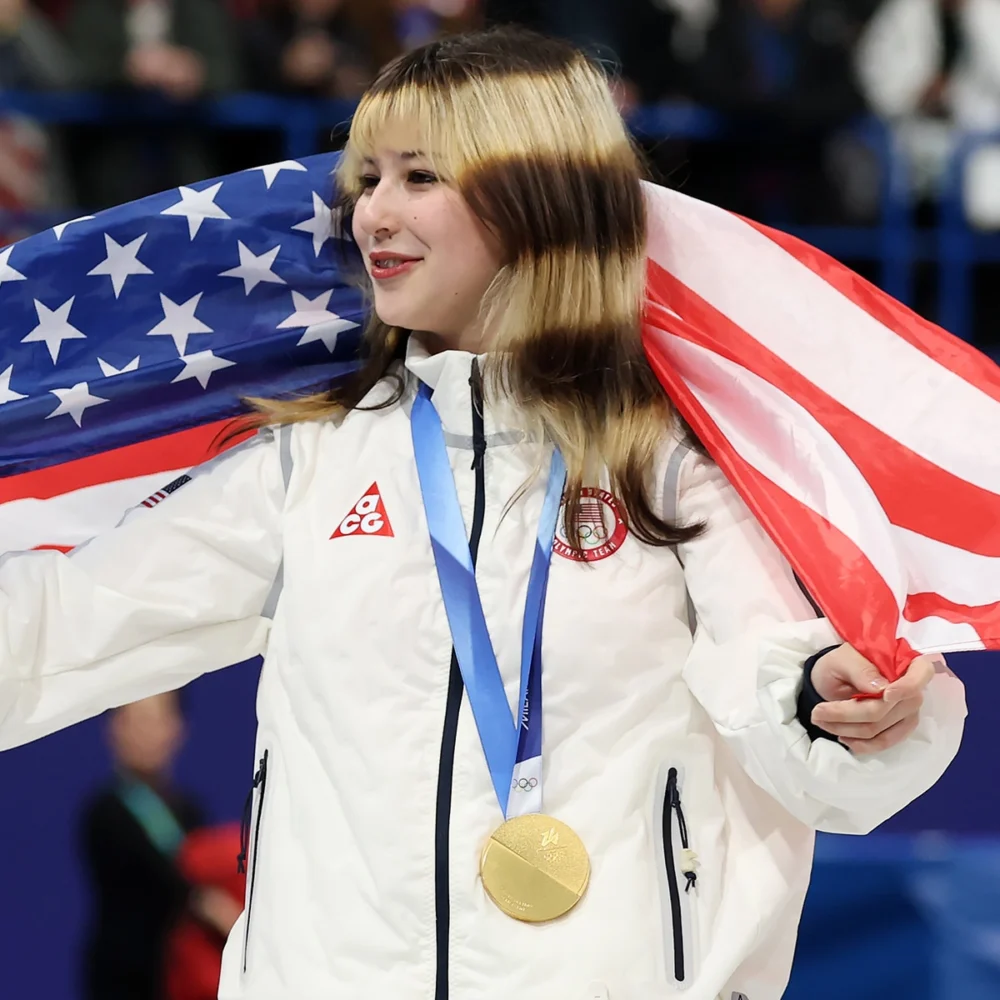
As the world’s eyes turned to the ice at the 2026 Winter Olympics in Milan-Cortina, American figure skater Alysa Liu captured the spotlight not just for her technical prowess, but for a striking aesthetic choice that carried a profound personal narrative. The 20-year-old, whose journey to the podium has been marked by both early retirement and a triumphant return, stepped onto the rink sporting dark brunette hair punctuated by bold, horizontal platinum blonde stripes. While many spectators viewed the "halos" as a trendy fashion statement, Liu revealed that the look is a living timeline of her evolution within the sport.
The inspiration for the hairstyle is rooted in the natural world. "I just wanted to be a tree," Liu shared during an interview with Paralympian Haven Shepherd. Just as the rings within a tree trunk serve as a chronological record of its growth and the seasons it has weathered, Liu’s stripes represent her own annual cycles of perseverance. The skater explained that she adds a new "ring" to her hair every December. Having started the tradition three years ago, the three distinct stripes visible during her gold-medal-winning performance in the team event on February 8 serve as a visual testament to her journey since re-entering the professional arena.
Liu’s path to the 2026 Games was anything but linear. After competing in the 2022 Beijing Olympics and securing a bronze at the World Championships that same year, she shocked the skating world by retiring at the age of 17. She later reflected on that period with striking honesty, noting that she had spent her entire childhood as a "dress-up doll" for the sport, often feeling disconnected from her own identity and social needs. After a hiatus spent as a student at UCLA, a recreational skiing trip reignited her competitive fire. Her comeback, she insists, is different; she is no longer skating for others, but entirely for herself. This sense of agency extended to her hair; while she sought professional assistance from St. Louis-based colorist Kelsey Miller to achieve a specific "milk tea" blonde shade, the athlete DIY’d the placement of the stripes herself. Miller noted that the five-hour transformation was a unique challenge, emphasizing that for an athlete like Liu, hair is a vital component of identity and competitive confidence.
Liu’s narrative of reclamation is a central theme among the women of Team USA at these Games. Her gold medal in the team event was shared with a roster of athletes who are similarly redefining the boundaries of their careers. Among them are Madison Chock and Evan Bates, the veteran ice dance duo who finally reached the Olympic summit as a married couple. Having tied the knot in June 2024, the pair entered their fourth Olympics with a renewed sense of partnership. While they secured a silver in the individual ice dance competition, their contribution to the team gold served as a crowning achievement for a 15-year journey. Bates noted the bittersweet nature of the moment, acknowledging that as they reach the "grand finale" of their careers, the goal was to remain present and soak in every fleeting second on the ice.
The theme of resilience is perhaps most poignantly embodied by the legends of the Alpine slopes, Mikaela Shiffrin and Lindsey Vonn. Shiffrin, now 30, entered the 2026 Games seeking a "redemption arc" following a disappointing showing in Beijing and a harrowing crash in late 2024 that required abdominal surgery. Supported by her fiancé, Norwegian skier Aleksander Aamodt Kilde, Shiffrin has adopted a more philosophical approach to the high-stakes environment of the Olympics, focusing on her connection with her coaching staff rather than the singular pursuit of hardware.
Vonn’s presence in Milan-Cortina was even more improbable. At 41, and after a 2019 retirement dictated by chronic pain, a partial knee replacement in 2024 gave her a new lease on life. Despite a brutal crash in January 2026 that resulted in a ruptured ACL, Vonn refused to let the opportunity slip away, declaring she would "risk everything" to compete in the downhill. Though a subsequent crash during the Olympic race resulted in a complex tibia fracture and ended her competitive run, her defiance in the face of physical limitation remained one of the most talked-about storylines of the Games.
As some legends face the end of their competitive chapters, others are using their platform to champion representation and legacy. Erin Jackson, the 33-year-old speed skating sensation who made history in Beijing as the first Black woman to win an individual Winter Olympic gold, returned not only as a competitor but as a flag bearer for the Opening Ceremony. Jackson has been vocal about the importance of being a visible face in a sport where diversity has historically been lacking. Her post-retirement vision involves founding an organization to help young Black athletes navigate the world of winter sports, ensuring that her "magic" on the ice translates into opportunities for the next generation.
Similarly, cross-country skiing icon Jessie Diggins is treating her fourth Olympics as a victory lap for her values. The 34-year-old, who plans to retire after these Games to focus on a quieter life of gardening and family, emphasized that every stride she takes is dedicated to those who "meet people with love." Her focus has shifted from the pressure of the podium to the joy of the movement and the community she represents.
The 2026 Games have also highlighted the extraordinary balancing act of the modern athlete. Bobsledders Kaillie Humphries and Elana Meyers Taylor are proving that motherhood and elite sport are not mutually exclusive. Humphries, 40, competed in her first Olympics since welcoming her son, Aulden, in 2024. Having switched from Team Canada to Team USA earlier in her career, she remains a powerhouse in the monobob and two-woman events. Her teammate, Meyers Taylor, 41, is navigating her fifth Olympics while raising two sons with significant health challenges. For Meyers Taylor, the ice has become a place of "me time," and she hopes her children see her not just with medals, but as a woman who gets back up every time she is knocked down.
The grit of Team USA extends to those in lower-profile sports who balance Olympic dreams with traditional day jobs. Mystique Ro, a skeleton athlete and the second-oldest of 11 siblings, works as a tour guide at the Lake Placid Olympic Center to fund her training. Hurtling headfirst down an icy track at 90 miles per hour requires a specific brand of "badassery," but Ro admits that the financial reality of the sport is its own kind of hurdle. Similarly, the silver-medal-winning curling duo of Cory Thiesse and Korey Dropkin maintain careers as a lab technician and a realtor, respectively, to support their journey to the world stage.
As the 2026 Winter Olympics continue to unfold, the stories of these athletes—from Alysa Liu’s symbolic tree rings to Lindsey Vonn’s indomitable spirit—paint a picture of a Team USA that is more mature, more diverse, and more self-aware than ever before. Whether they are landing quadruple axels like "Quad God" Ilia Malinin or navigating the complexities of parenthood and injury, these athletes are demonstrating that the true meaning of the Olympic spirit lies in the growth recorded through every season of their lives. For Liu, that growth is now visible for all to see, one platinum stripe at a time.