


Emily Brontë’s seminal novel, “Wuthering Heights,” has long stood as a pillar of romantic literature, its tempestuous narrative of love, betrayal, and revenge etched into the collective consciousness. Yet, like many classics, its on-screen interpretations have historically navigated a delicate balance between preserving its enduring allure and adapting to contemporary sensibilities. A fascinating lineage of film ratings reveals a telling progression in how this gothic masterpiece has been perceived and presented, moving from the decidedly demure to the audaciously explicit. Now, with Emerald Fennell’s latest cinematic endeavor, the story of Catherine Earnshaw and Heathcliff is catapulted into an uncompromising, R-rated reinvention, shattering decades of genteel retellings and finally laying bare the raw, visceral core of Brontë’s vision.
To trace the evolution of “Wuthering Heights” through the lens of Motion Picture Academy ratings is to witness a cultural shift in the acceptance and portrayal of complex human emotions on screen. The 1970 adaptation, starring a brooding Timothy Dalton as Heathcliff, was deemed suitable for all audiences, earning a G rating. This interpretation, while capturing some of the novel’s dramatic sweep, necessarily muted its inherent ferocity, conforming to an era where classic literary adaptations were often sanitized for broad appeal, emphasizing tragic romance over darker impulses. Two decades later, the 1992 version, featuring a young Ralph Fiennes embodying the tormented Heathcliff, earned a PG rating. This indicated a slight loosening of the reins, allowing for a touch more intensity or thematic complexity, but still keeping the narrative firmly within family-friendly bounds, largely shying away from explicit depictions of the novel’s psychological torment or sexual undercurrents.
The turn of the millennium brought a more radical, albeit still relatively chaste, update. The 2003 made-for-MTV version, transplanting the narrative to a high school setting with a youthful cast, reflected a burgeoning trend of modernizing classics for a new generation – a creative lineage clearly influenced by films like “Clueless.” This adaptation garnered a PG-13 rating, suggesting an edgier sensibility, perhaps touching upon adolescent angst and burgeoning desires with more frankness than its predecessors, but still stopping short of truly delving into the adult themes of obsession and destructive passion. Each step in this ratings progression chipped away at the long-held, polite veneer surrounding Brontë’s work, but none dared to fully embrace the storm brewing beneath the surface—until now.
Emerald Fennell, a director synonymous with provocative storytelling and a keen eye for the unsettling truths of human nature, takes the narrative into uncharted territory. Her “carnal reinvention” of “Wuthering Heights” has boldly earned a full-blown R rating, signaling a radical departure from all that came before. This is not merely an adaptation but a deliberate excavation of the material, amplifying elements that have always simmered beneath the text but were rarely, if ever, made explicit. Fennell seizes upon the passionate, almost violent, undercurrents of Brontë’s novel, bringing to the forefront the physical desire, the psychological torment, and the brutal power dynamics that drive Catherine and Heathcliff’s legendary, doomed affair.
From its audacious opening moments, Fennell plants an erotic suggestion that immediately reorients the viewer’s expectations. The film commences with the unsettling creaking of rope, quickly followed by what sounds unmistakably like orgasmic gasping. It’s a trick, a clever misdirection that doesn’t precisely align with the visual, yet its impact is undeniable: a powerful, carnal overture that declares this is not your grandmother’s “Wuthering Heights.” This bold gambit sets a tone of visceral intensity, hinting at elements of bondage and a raw sensuality that permeate the entire narrative. The question lingers: Is this foreplay or foreboding? Fennell posits that it is, unequivocally, both. It’s a scene designed to disarm, to provoke, and to firmly establish that this adaptation will not shy away from the darker, more unsettling aspects of desire and control.
Literary purists, accustomed to more reverent and restrained interpretations, may indeed object to such a daring approach. However, Fennell’s vision isn’t about disrespecting the source material; it’s about revealing a truth that was always there, simmering in the subtext. Her film amplifies the unspoken, the unrequited, and the often-repressed physical yearning that fuels the destructive relationship between Catherine Earnshaw (portrayed by “Barbie” star Margot Robbie, in a stark departure from her iconic role) and Heathcliff (Jacob Elordi, fresh from his roles in “Euphoria” and the upcoming “Frankenstein”). Beyond mere physical attraction, Fennell delves into the intricate “mind games” by which power relentlessly shifts between these two monumental figures, exploring the psychological warfare inherent in their bond.
This is decidedly not the “Wuthering Heights” that high school English teachers would comfortably screen in class. Fennell, with her signature flashy directorial style, takes liberties with the iconic characters, imbuing them with a raw, contemporary edge. Her approach feels less like a traditional adaptation of Emily Brontë’s sister Charlotte’s works, such as the earnest “Jane Eyre,” and more akin to Jean Rhys’s “Wide Sargasso Sea”—a sophisticated, subversive piece of fan fiction that reclaims and re-examines a classic narrative through a new, often darker, lens. The film revels in “heaving bosoms, damp flesh, and kinky sex,” though intriguingly, much of this explicit sensuality occurs outside the central Catherine-Heathcliff dynamic, serving instead to illustrate the pervasive atmosphere of desire and transgression that defines their world.
For nearly two centuries, Brontë’s novel has been cherished as a romantic fantasy. Fennell, however, treats it as an erotic one as well, leaning into every sensual detail imaginable. A bed strewn with broken eggs, a stable tryst involving whips and bridles, Catherine pleasuring herself en plein air – the list of provocative imagery goes on, each scene designed to evoke extreme sensations and challenge conventional notions of desire. This unapologetic embrace of the carnal and the transgressive aligns perfectly with the stylistic excesses championed by independent production companies like A24 and Neon, whose films often cater to a generation of moviegoers hungry for bold, immersive big-screen experiences that push boundaries.
Fennell’s aesthetic choices extend to the very architecture of the Yorkshire moors. The Earnshaw estate, which lends the work its iconic title, is transformed into something Tim Burton might conjure: an ominous, black farmhouse, starkly silhouetted against a backdrop of jagged rocks, constantly battered by wind and storms. It is a place that feels alive with brooding malevolence, a physical manifestation of Heathcliff’s untamed spirit. In stark contrast, Thrushcross Grange, the elegant residence of Catherine’s suitor, Edgar Linton, could have been meticulously decorated by the “American Horror Story” crew. Its flesh-colored walls and blood-red floors evoke a sense of uncanny opulence, a gilded cage that feels as menacing as the wild moors. One is a morgue, the other a bordello, each reflecting the twisted emotional landscapes inhabited by the characters.
The central conflict of Catherine’s choice remains. Faced with the stark realities of her impoverished home and her father’s (Martin Clunes) gambling debts, Catherine, as Fennell portrays it, has little option but to marry Edgar Linton (Shazad Latif), a man so decent as to appear almost dull in comparison to Heathcliff’s fire. This pragmatic decision, driven by a fear of ruin, is a betrayal of her own heart, a sacrifice of her “wild-willed soulmate” for the perceived stability of a comfortable marriage. The tragic irony is that this choice condemns her to a long, drawn-out suffering, a theme central to Brontë’s original narrative and underscored by Fennell’s unflinching lens.
The origins of Heathcliff are also given a sharp, unsentimental portrayal. Many years prior, in a misguided fit of “charity,” Mr. Earnshaw brought home a dirty, illiterate street urchin, intending for him to serve as his daughter’s “pet.” It was the young Catherine (Charlotte Mellington) who, with a childlike blend of innocence and possessiveness, named him Heathcliff (Owen Cooper). From the outset, their bond is presented as primal and inextricable. The girl, spoiled yet fiercely independent, recognizes in Heathcliff a reflection of her own untamed spirit and unyielding loyalty. She eventually confesses, with a heartbreaking purity, that “He’s more myself than I am.” Yet, in one of literature’s most cruel twists of fate, Heathcliff, while eavesdropping on a private exchange between Catherine and her housekeeper, Nelly (played with quiet intensity by Hong Chau), only overhears the devastating pronouncement: “It would degrade me to marry Heathcliff now.”
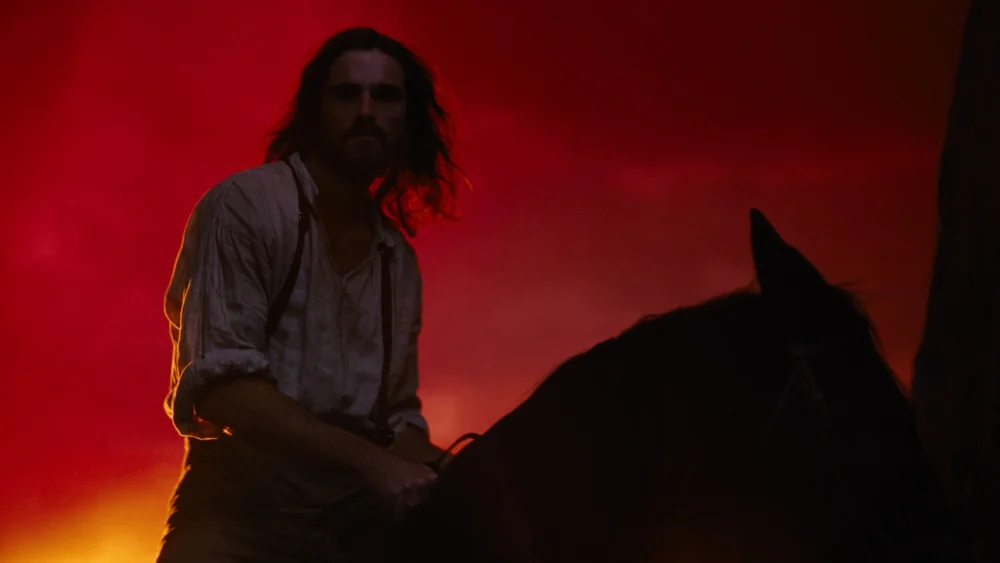
Heathcliff’s subsequent departure is rendered with one of Fennell’s most striking visual flourishes. Jacob Elordi, bearded and betrayed, is framed in silhouette against a deep crimson sky, a painterly tableau that is both “ridiculously overripe” and exquisitely beautiful. He appears at once shattered and defiantly resolute, evoking the iconic resolve of Scarlett O’Hara at the intermission of “Gone With the Wind.” This moment serves as a clear clue to Fennell’s operatic interpretation of the material, which finds its potent musical equivalent in Anthony Willis’s dramatic score and a curated selection of tortured-love songs from Charli XCX. Notably, “Chains of Love” by Charli XCX particularly nails the film’s underlying sadomasochistic subtext, further cementing the raw, often painful, nature of the central relationship.
Fennell’s “Wuthering Heights” is a film that risks smothering those who found “Saltburn” to be “too much.” Yet, this maximalist approach is precisely what a generation of filmgoers, accustomed to the bold aesthetics of A24 and Neon productions, craves from the big-screen experience. The movie is designed to evoke extreme sensations, mirroring the intensity of Catherine’s experiences, such as the scene where Nelly tightens her corset until it nearly snaps her ribs. Fennell’s direction is a masterclass in reading between the lines, unearthing a great deal of unspoken desire that has long been left to the reader’s imagination.
In this iteration, Heathcliff, the quintessential bad boy of Victorian literature, emerges as less devilish than in Brontë’s original text, yet his roguishness remains half of his undeniable appeal. There’s a deliciously naughty streak to his calculated revenge on Catherine, particularly in his chilling request for consent from Linton’s sister, Isabella (Alison Oliver), to use her for this very purpose. Jacob Elordi’s portrayal of this monstrous brute, so soon after embodying Frankenstein’s creation, is a fascinating study in nuanced villainy. Surprisingly, there is less overt flesh on display here than in some of his previous roles, but no fewer scars, both visible and psychological, speaking volumes about the character’s internal torment.
Heathcliff, in Fennell’s hands, needs no redemption; his wild magnetism is his essence. However, Margot Robbie’s emboldened Catherine assumes a greater degree of responsibility for the couple’s profound unhappiness, and with it, a more active complicity in exploring what might have been. This interpretation adds a layer of complexity to Catherine, moving her beyond a mere victim of circumstance or passion, and into a space of agency and self-awareness. The inherent tension, however, lies in the very act of satisfying their long-unrequited lust. By making explicit what was once implicit, Fennell risks defusing the very dynamic that has held audiences captive for centuries: the agonizing, tragic impossibility of their love.
After the audacious climax of “Saltburn,” which famously featured a character scandalously making love to a grave, Fennell was faced with the challenge of shocking audiences once more, but without simply repeating herself. Her solution for “Wuthering Heights” is both clever and impactful: instead of prolonging their physical pleasure, she cuts short the pair’s ultimate satisfaction. This deliberate choice underscores the film’s core message – that their love, while intensely carnal, is ultimately about something more profound and destructive than mere physical gratification. It’s a testament to Fennell’s directorial prowess that even in this abruptness, she ensures the audience’s emotional and sensory experience remains fully engaged, leaving us not with a sense of incompleteness, but with the lingering echo of a love too fierce to be contained by societal norms or even by life itself.