


Broadway’s Brilliant Binge: How ‘Titaníque’ Mastered the Art of Smart Stupidity, From Basement to Bright Lights
The hallowed stages of Broadway are witnessing a fascinating transformation, one where the lines between high art and joyous, self-aware absurdity are blurring into a vibrant, irresistible spectacle. Gone are the days when theatrical gravitas was the sole measure of success; today, audiences are clamoring for experiences that are not only entertaining but daringly playful, outrageously meta, and often, delightfully interactive. This cultural shift, arguably accelerated by a collective post-pandemic desire for pure, unadulterated escapism and laughter, finds its perfect emblem in the month’s most talked-about musical opening: “Titaníque,” a production that proves unequivocally that genuine theatrical genius can reside comfortably alongside the most gloriously “stupid” premises.
“Titaníque,” the musical spoof of James Cameron’s epic 1997 blockbuster “Titanic,” is far more than a simple parody. It’s a meticulously crafted comedic triumph that invites audiences into an extreme realm of theatrical ingenuity, where the familiar is twisted into the fantastically unexpected. Its arrival on Broadway is not just a testament to its singular charm but a clear indicator of a burgeoning trend that celebrates cleverness in chaos, delivering a unique blend of sharp wit and unbridled silliness that leaves spectators questioning, in the best possible way, what exactly constitutes a “serious” theatrical endeavor anymore.
The journey of “Titaníque” to the Great White Way is a legend in itself, a rags-to-riches narrative that perfectly encapsulates the show’s underdog spirit. It first surfaced in the creative ferment of Los Angeles in 2017, born from the collective brilliance and unhinged humor of a group of inspired pals. This initial incarnation was a raw, unpolished gem, quickly cultivating a loyal following among those in the know. Its true cult status, however, began to cement in 2022 when it dropped anchor in New York City, not in a glittering theater district venue, but in the improbable, delightfully grimy basement of an abandoned Gristedes supermarket. This unlikely setting became integral to its mystique, fostering an intimate, almost clandestine atmosphere where word-of-mouth buzzed with fervent enthusiasm. The sheer audacity of its premise, coupled with its shoestring budget and DIY charm, resonated deeply with a generation hungry for authentic, unconventional experiences. From that subterranean haven, its reputation grew exponentially, propelling it through increasingly larger downtown venues, then onto successful runs in other major cities both domestically and internationally, before finally setting its sights on Broadway.
Yet, as with any journey from the scrappy independent scene to the polished grandeur of Broadway, a critical question loomed large: Could “Titaníque” retain its “plucky, no-frills specialness” in the transition from theatrical steerage to first-class? The soul of a cult hit, often defined by its raw energy and intimate connection with its audience, is a fragile thing. Over-production or an attempt to sanitize its inherent outrageousness could easily sink the very qualities that made it beloved. The creative team, acutely aware of this precarious crossing, navigated the waters with remarkable precision, demonstrating a masterful understanding of how to elevate without diluting.
Their approach was one of meticulous curation. Production values were upgraded, but with a discerning hand, “just enough” to meet Broadway standards without sacrificing the show’s original, charmingly lo-fi aesthetic. Crucially, they injected a judicious amount of star power, strategically casting performers who could amplify the show’s comedic and vocal strengths while seamlessly integrating into its established ensemble. The additions of Deborah Cox, Frankie Grande, and particularly Jim Parsons — a deadpan delight whose semi-drag performance as Rose’s imperious mother, Ruth, provides invaluable comic ballast — were strokes of genius. Each brought not only their individual star appeal but also a deep comedic sensibility that perfectly aligned with “Titaníque’s” unique brand of humor. The musical arrangements, too, were dialed up a few notches, enriching the soundscape without ever going overboard, maintaining the playful spirit of the original while adding a layer of professional polish.
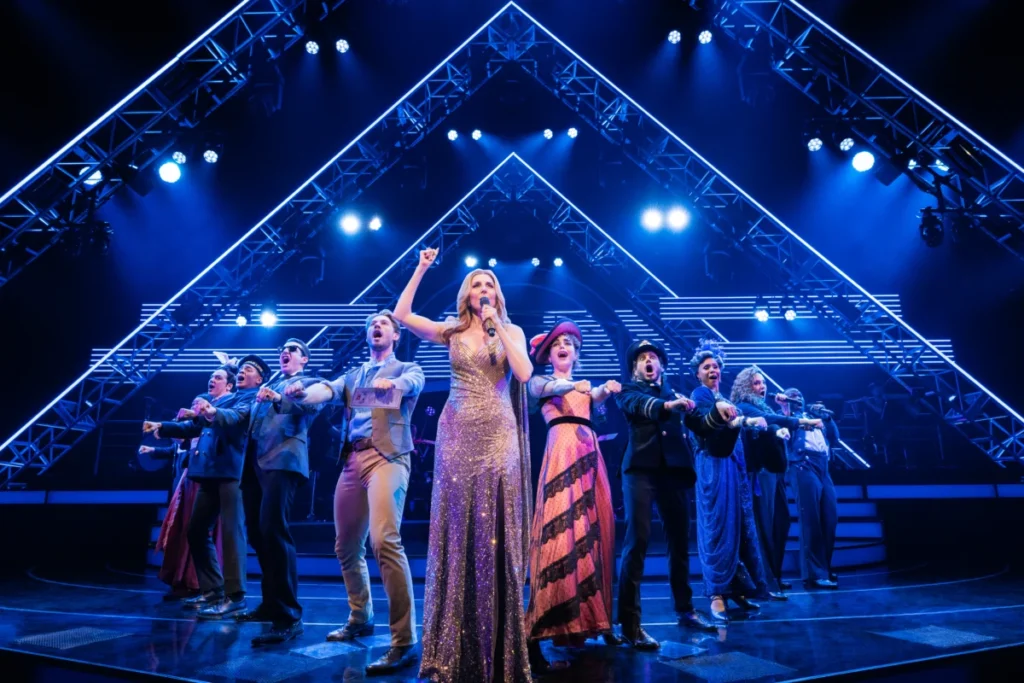
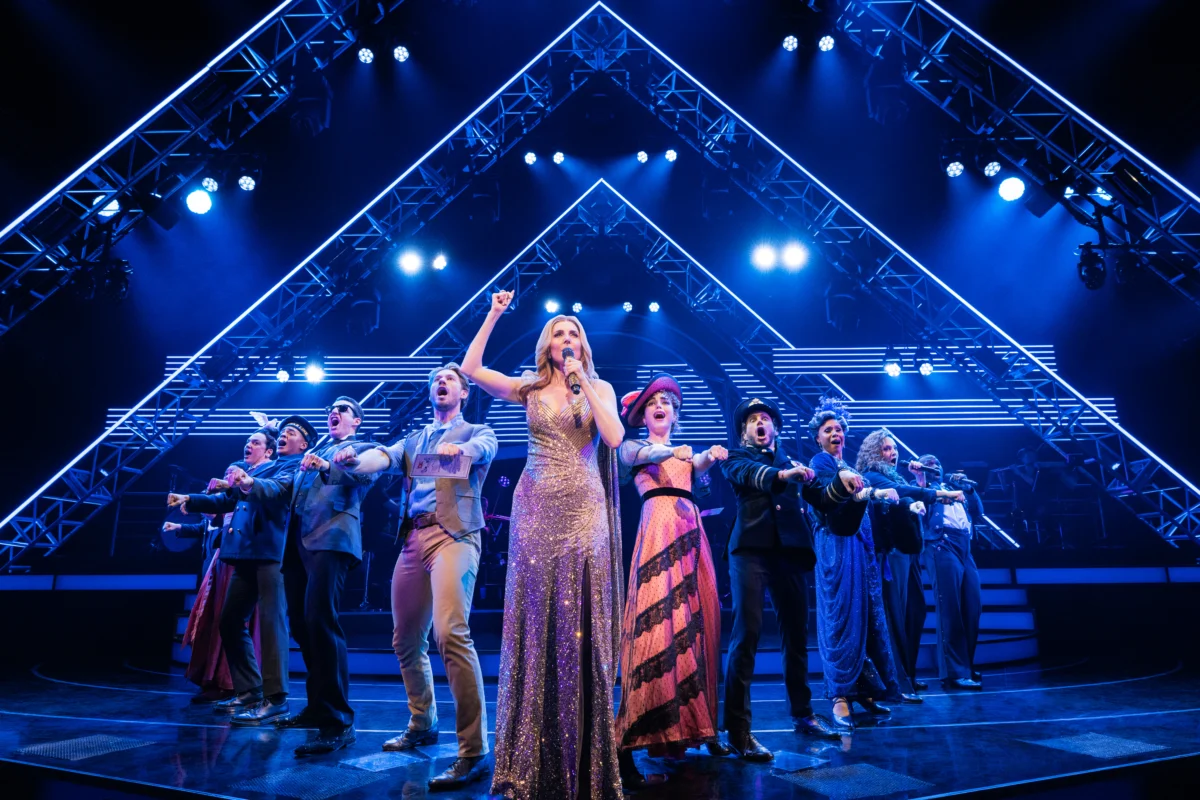
The enduring conceit of this anything-goes show remains deliciously daft, recalling other nautical trifles but with a distinctly meta twist. At its heart is the incomparable Marla Mindelle, who, as the French-Canadian diva Céline Dion, serves as the production’s self-appointed, utterly unreliable narrator. It is through her hilariously loopy, self-centered, and often anachronistic lens that the audience experiences her version of James Cameron’s iconic “Romeo-and-Juliet-at-sea” romantic tragedy. This narrative device is pure comedic gold, tapping into Dion’s larger-than-life persona and the cultural omnipresence of “My Heart Will Go On” to craft a story that is simultaneously familiar and utterly unhinged.
Remarkably, audiences need not possess encyclopedic knowledge of the 1997 film’s specifics, nor even grasp every rapid-fire cultural throwaway joke, to revel in the narrative gist within the delightful madness. The genius of “Titaníque” lies in its ability to operate on multiple comedic levels. Those who cherish the film will delight in the specific parodies, while newcomers will be swept up in the sheer force of its absurdity and the infectious energy of its cast. It is, essentially, a non-bio jukebox musical, a genre popularized by shows like “Mamma Mia!” but one that has veered gloriously off its spindle. While it primarily taps into Céline Dion’s expansive music catalog, transforming her power ballads into comedic weapons, it also boldly incorporates wildly non-sequitur songs like “Beauty and the Beast” and “Who Let the Dogs Out,” which simply erupt from nowhere, purely for the anarchic joy of it. This musical promiscuity is a core part of its charm, disorienting and delighting in equal measure. Adding to the spectacle are faux guest appearances by a surprisingly subdued Peabo Bryson, a delightfully confused Lenny Kravitz, and most magnificently, a show-stopping Tina Turner (an astonishing Layton Williams) who materializes as the fateful, fabulous, and undeniably bitchy iceberg that dooms the vessel and raises the “Titaníque” to its comedic peak.
Marla Mindelle, who not only embodies Céline Dion but also co-authored the show, delivers a performance that is nothing short of sensational. She doesn’t merely impersonate Dion; she channels her, nailing the diva’s quirky, sly-eyed, “kooky-crazy” persona with an assured ease that is both reverent and hilariously irreverent. With a bumpy Quebecois accent that occasionally slips into moments of pure, unadulterated French-Canadian charm, the slightly demented chanteuse glides in and out of the story, effortlessly transitioning from belting out Vegas-styled power ballads to narrating her profoundly skewed version of what “really” happened to the film’s characters on that fateful 1912 voyage. (Her presence on board, making her approximately 150 years old, is a detail tossed out with such casual abandon that the audience simply accepts it as part of the show’s delightful logic, because, truly, who’s counting?).
The manifest of this comedic voyage includes a roster of characters reimagined with brilliant satirical flair. Jack Dawson, played by Constantine Rousouli, is an “aging twunk” who knows precisely how to fill and show off his slim-fit khakis. Rousouli, another of the show’s co-scripters, amps up Leonardo DiCaprio’s iconic “perfect-hair, aw-shucks” boyishness to hysterical, almost grotesque, heights. His deranged drowning scene, a masterpiece of physical comedy and escalating absurdity, is both brilliant and totally bonkers, leaving the audience in stitches. Many of the film’s most iconic poses, props, and lines of dialogue are present and accounted for, serving as ripe fodder for mockery: the Heart of the Ocean necklace, here reimagined as something closer to an anchor; the triumphant “king of the world” railing scene; the steamy, cramped backseat sex; and, of course, the infamous floating door raft, all meticulously staged for maximum comedic impact.
As society gal Rose DeWitt Bukater, Melissa Barrera has freewheeling fun with Kate Winslet’s unhappy bride-to-be character, imbuing Rose with a spirited, almost rebellious energy that perfectly complements the show’s anarchic tone. Her journey from stifled heiress to liberated woman is given a wonderfully ridiculous spin. Rose’s aristocratic, and in this version, Grindr-loving fiancé Cal, is portrayed by John Riddle as one long, exquisitely executed metrosexual joke. Riddle’s performance is a masterclass in comedic timing, but he can also deliver the musical goods with an impressively powerful rendition of “I Surrender,” a moment that surprisingly grounds his otherwise outlandish character.
Indeed, one of the show’s undeniable strengths is the stunning vocal prowess of every member of the cast. Deborah Cox, as the formidable Molly Brown, truly makes waves with her powerful rendition of “All By Myself,” infusing the classic ballad with a newfound sense of defiant independence. Frankie Grande, as “Victor Garber” — the ship’s oblivious and endearingly idiotic captain — belts out “I Drive All Night” with an earnestness that makes his eventual crash all the more hilarious. And then there’s Layton Williams, whose Tina Turner as the iceberg out-divas even Dion herself with a scorching, show-stopping performance of “River Deep, Mountain High,” a moment of pure, unadulterated theatrical exhilaration. As Rose’s impoverished yet imperious mother Ruth, Jim Parsons, in semi-drag, provides crucial comic ballast with his signature dry deliveries and understated wit, proving that sometimes the quietest moments can land the biggest laughs amidst a ship of fools.
The humor in “Titaníque” is a mixed bag, to be sure, but in the most glorious sense. It’s less biting socio-satire and more akin to the affectionate lampoonery of “Forbidden Broadway,” where the jokes “nibble” rather than savage. The gags — good, bad, and delightfully cheap — come thick and fast, a non-stop barrage throughout the show’s brisk 90-minute runtime. They are filled, and sometimes pummeled, with an dizzying array of pop culture references, brand-name drops, groan-worthy puns, clever anachronistic humor, and plenty of naughty bits. (One can, perhaps, only laugh at so many “seaman” gags, but the show certainly tests that limit.) Every entendre is doubled down upon, and the show boasts the most corn on Broadway since “Shucked,” embracing its silliness with an unapologetic glee that is utterly infectious.
However, what truly elevates this comedic onslaught is the sheer confidence and whiplash intensity with which it is delivered and staged by Tye Blue, yet another of the show’s co-scripters. Blue’s direction ensures that even the most audacious or seemingly facile jokes land with maximum impact, almost duping the audience into believing they are clever as hell. The comic ensemble, a powerhouse of charisma, uniqueness, nerve, and talent — to borrow RuPaul’s iconic mantra (which finds a literal and hilarious echo in the show’s “lipsynch-for-your-lifeboats” number, a definite highlight) — makes these gags work by sheer force of will and an unwavering commitment to the bit. Their collective energy is so magnetic that even the most outlandish moments feel earned and inevitable.
Advertised as a strictly limited run, “Titaníque’s” established and fiercely loyal Millennial-friendly fan base ensures that audiences will be coming back for seconds, eager to relive its joyous absurdity. Its Broadway engagement, far from diminishing its allure, will undoubtedly give it further cachet for future cruises, solidifying its place as a contemporary cult classic with mainstream appeal. While one might not call the musical an entirely “night to remember” in the traditional sense of theatrical grandeur, it is undeniably a night of unforgettable, riotous laughter and brilliant, brazen entertainment. Let’s just say, with a wink and a nod to its French-Canadian muse, the show is, well, fantastíque.