


In an era where the personal often transcends the universal, contemporary documentary filmmaking increasingly turns its lens inward. Directors are courageously mining their own lives, experiences, and lineages to forge narratives that resonate deeply with audiences seeking authenticity and emotional candor. This burgeoning trend, marked by an intimate and often raw exploration of the self, finds a compelling new voice in British-Romanian filmmaker Rachel Taparjan’s latest work, “Something Familiar.” More than just an entry into this introspective genre, Taparjan’s film stands as a testament to the enduring power of self-examination, embarking on a valiant quest to deconstruct her own personality by meticulously sifting through her past, unearthing deeply buried demons and traumas. While some might contend that “Something Familiar” veers dangerously close to excessive self-reflection or even navel-gazing, its emotional fortitude and unwavering commitment to truth make it an undeniably potent cinematic experience.
Taparjan’s personal odyssey begins with a foundational truth: her adoption as an infant from a Romanian orphanage by a British couple. The circumstances surrounding this adoption are complex and layered with profound human emotion. The adoptive parents had tragically lost their own daughter at the tender age of six, and in a heart-wrenching attempt to mend their fractured lives, they adopted Taparjan as, in their own words, a “replacement.” This deeply personal and somewhat unsettling detail is revealed through poignant archival television footage, which captures the couple openly discussing their new daughter in a manner that, in retrospect, feels both candid and disquietingly frank, highlighting the societal norms and emotional landscapes of the time. The film then seamlessly transitions to the present day, following Taparjan as she embarks on a pilgrimage back to Romania, driven by an unshakeable desire to trace her origins, understand her roots, and ultimately, find her birth mother.
The journey is not merely geographical; it is an excavation of identity. Armed with fragmented adoption documentation, Taparjan discovers she has an older brother and a sister, a revelation that adds new dimensions to her understanding of self. The film meticulously chronicles her attempts to reconnect with these newfound familial connections, slowly, carefully peeling back the layers of her personal history. As these reunions unfold, Taparjan begins to reveal the deeply personal events that shaped her young adulthood, drawing a stark line between the idealized expectations of a stable, adopted life and the complex realities that often belie such narratives. This tension between anticipation and lived experience, coupled with the age-old debate of nature versus nurture, forms the bedrock of “Something Familiar.” The film probes whether Taparjan was, in some profound sense, destined to relive or grapple with the ancestral traumas of her biological family, even after growing up in an entirely different cultural and environmental landscape. It’s a question that resonates with anyone who has ever pondered the invisible threads that connect us to our past, and the profound impact of inherited narratives on our present.
Curiously, “Something Familiar” does not immediately plunge into Taparjan’s narrative. Instead, it opens with the story of Mihaela, another adoptee from the very same Romanian orphanage, who was adopted by an American family. Taparjan escorts Mihaela back to Romania on her own quest to find her birth mother, a parallel journey intended, perhaps, to establish a broader, more universal context for the adoptee experience. The initial segments featuring Mihaela aim to articulate a collective sentiment, suggesting that the struggles for identity and belonging are shared among those separated from their biological families. However, this narrative thread, while poignant in its own right, feels somewhat tangential to Taparjan’s deeply personal exploration. Its abrupt departure from the main narrative when Taparjan’s own story takes precedence leaves the audience with a sense of narrative dissonance. When Mihaela reappears in the end credit sequence, offering an update on her current life, the initial connection established earlier in the film has largely faded, overshadowed by the visceral power and emotional weight of Taparjan’s subsequent, much stronger, and more focused journey of self-discovery. This narrative choice, while perhaps intended to universalize the adoption experience, ultimately highlights the unique and compelling nature of Taparjan’s singular quest.
The core emotional power of “Something Familiar” truly takes hold as Taparjan begins her direct engagement with her biological family. Her first reunion is with her brother, Alexandru. The initial moments of their connection are infused with an immediate and palpable warmth, a nascent camaraderie that transcends years of separation and unfamiliarity. Through her introspective voiceover, Taparjan articulates the profound comfort and wonder she experiences upon seeing her own facial features reflected in another person, a mirroring that offers a tangible sense of belonging she had unknowingly yearned for. Together, they embark on the difficult search for their sister, Ana Maria, and it is during this search that they receive the heartbreaking news: their birth mother has passed away, closing off one avenue of direct confrontation and understanding.
The eventual reunion with Ana Maria is a pivotal moment, unleashing a torrent of long-held family secrets and traumas that had been carefully guarded for decades. It is here, in the raw, unvarnished interactions between the siblings, that the film reaches its emotional zenith. As the full scope of their shared history is laid bare, Taparjan turns her analytical gaze inward once more, meticulously unpacking her own past behaviors and seeking to understand the underlying drivers that shaped her. Both sisters, in these intensely personal scenes, exhibit a heartbreaking vulnerability before the camera, allowing their raw emotions and the weight of their shared trauma to surface without artifice. These moments, characterized by their authenticity and profound emotional depth, emerge as the undeniable strongest sequences in the entire film, offering an intimate glimpse into the enduring impact of familial bonds and inherited pain.
However, an undercurrent of earnestness occasionally mars the otherwise powerful proceedings. The film sometimes leans into what feels like “couch psychoanalysis,” with protagonists making declarative statements about being “survivors.” While undoubtedly true to their lived experiences, these pronouncements, delivered directly to the camera, can occasionally feel somewhat performative. The subjects, acutely aware of the lens fixed upon them, sometimes look straight into it, a choice that, rather than fostering intimacy, can paradoxically make scenes feel more staged than naturally unfolding. This self-consciousness is further amplified by Taparjan’s voiceover, which, while providing valuable narrative guidance, occasionally imbues the soundtrack with a similar earnestness that risks over-explaining rather than allowing emotions to speak for themselves. It is in the quieter, more unscripted moments – the genuine conversations, the hesitant gestures, and even the often-awkward silences – that the film truly breathes and reveals more profound emotion than any carefully constructed script or solemn narration ever could. Any catharsis experienced by the protagonists, it becomes clear, stems not from these forced talks or didactic explanations, but from the raw, unmediated space between words, where true understanding and connection are forged.
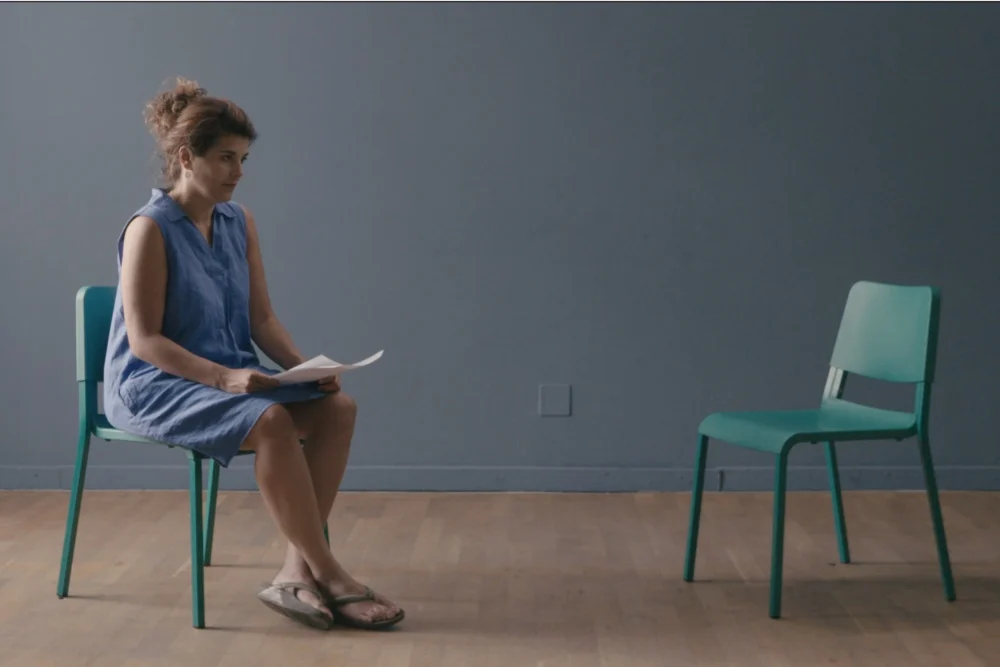
With the heartbreaking news of her birth mother’s passing, Taparjan is denied the opportunity for a direct confrontation, a face-to-face reckoning that many adoptees dream of. In a profoundly innovative and emotionally resonant creative choice, she instead turns to a unique therapeutic method: working with actors. Several performers are cast to play her mother, allowing Taparjan to engage in simulated conversations, asking the pointed questions that had long haunted her, and receiving improvised answers. The audience is not always privy to Taparjan’s immediate, visceral emotional responses during these scenes; her internal process remains largely unspoken, inviting viewers to project and interpret. However, the actors themselves, embodying the role with remarkable empathy and skill, deliver performances brimming with genuine emotion, reacting in a myriad of nuanced ways that reflect the complexities of such a fraught hypothetical reunion. By the film’s conclusion, it becomes clear that these performed scenes, though indirect, serve as a crucial conduit for Taparjan. Through this deeply personal artistic intervention, she is able to construct a profound understanding of her mother’s circumstances and motivations, an understanding that had eluded her for a lifetime and would have remained inaccessible without this imaginative approach.
“Something Familiar” is at its most compelling when it transcends the need for explicit explanation, when it allows the raw, human experience to simply unfold. Taparjan’s relentless search for identity, belonging, and an understanding of inherited trauma is undeniably affecting, a deeply personal quest that resonates universally. Despite its occasional rough edges and moments where artifice briefly intrudes, the film bravely uncovers something raw, unresolved, and profoundly human. Through this arduous, often messy process of confronting her past and embracing her present, Taparjan ultimately finds a way to reckon with her own complexities. She navigates the intricate landscape of her emotions with remarkable vulnerability, gradually letting go of the blame and shame that so often entangle parents, children, and siblings in cycles of unresolved pain. In “Something Familiar,” Taparjan doesn’t just tell her story; she lives it, transforming personal excavation into a poignant exploration of what it means to heal and to truly belong.